


Deuterium isotope probing (DIP) on Listeria innocua: Optimisation of labelling and impact on viability state
- PMID: 36893178
- PMCID: PMC9997870
- DOI: 10.1371/journal.pone.0280885
Deuterium isotope probing (DIP) on Listeria innocua: Optimisation of labelling and impact on viability state
Abstract
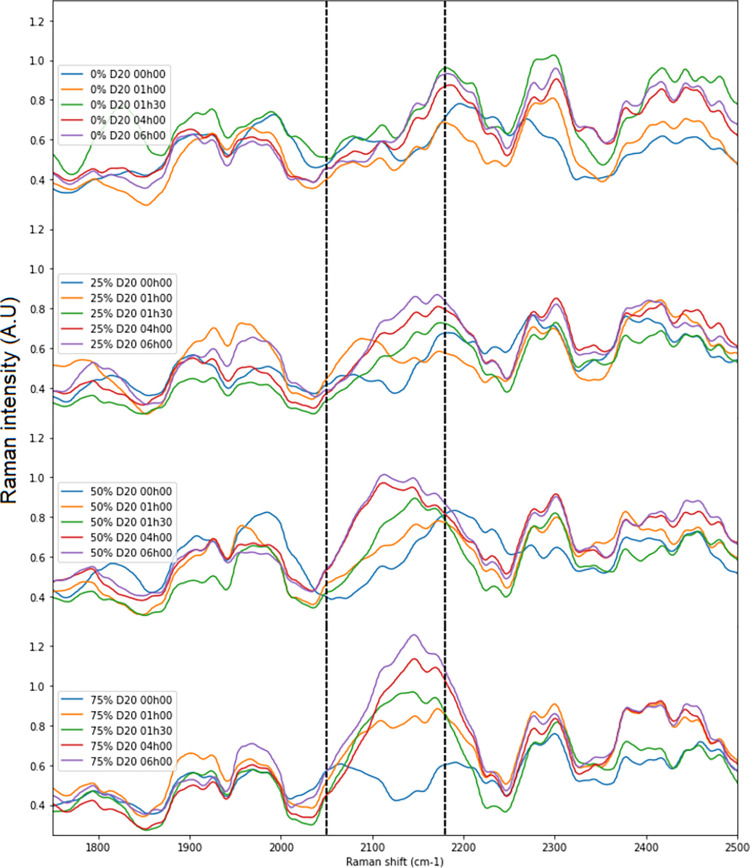
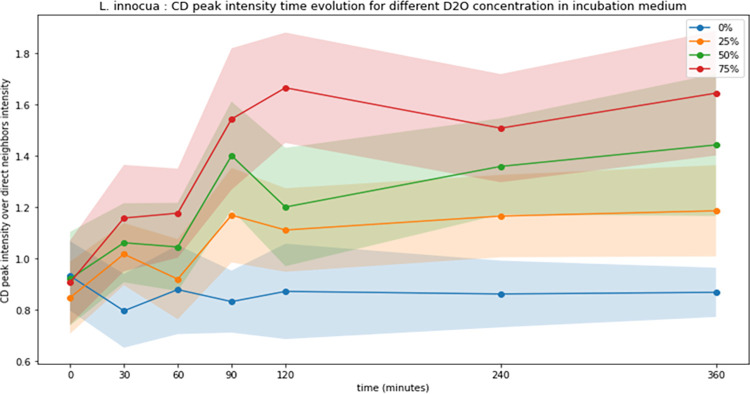
An innovative approach, Raman microspectroscopy coupled with deuterium isotope probing (Raman-DIP), can be used to evaluate the metabolism of deuterated carbon source in bacteria and also to presume different anabolic pathways. This method requires the treatment of cells with heavy water that could affect the bacterial viability state at higher concentration. In this study, we evaluated the effect of heavy water incorporation on the viability state of Listeria innocua cells. We exposed the L. innocua suspensions to different heavy water concentrations (0%, 25%, 50% and 75%) from 30 minutes to 72 h of incubation times at 37°C. The total, viable and viable culturable populations were quantified by qPCR, PMA-qPCR and plate count agar respectively. We analyzed heavy water incorporation by Raman-DIP. The exposure of L. innocua cells to different concentrations of heavy water did not alter their cell viability to 24 h incubation time. In addition, the maximum intensity for C-D band, specific for the incorporation of heavy water, was reached after 2 h of exposure in a media containing 75% v/v D2O but an early detection of the labelling was possible at t = 1 h 30 min. In conclusion, the use of D2O as a metabolic marker was validated and can be developed for the detection of L. innocua cell viability state.
Copyright: © 2023 Trigueros et al. This is an open access article distributed under the terms of the Creative Commons Attribution License, which permits unrestricted use, distribution, and reproduction in any medium, provided the original author and source are credited.
Conflict of interest statement
The authors have declared that no competing interests exist.
Figures

References
-
- Carlin CR, Liao J, Hudson LK, Peters TL, Denes TG, Orsi R, et al. Soil collected in the Great Smoky Mountains National Park yielded a novel Listeria species, L. swaminathanii, effectively expanding the sensu stricto clade to ten species. BioRxiv preprint. In press;2021.12.21.473762.
-
- EFSA. The European Union One Health 2020 Zoonoses Report. EFSA J [Internet]. 2021. [cited 2021 Dec 15];19(12). Available from: https://onlinelibrary.wiley.com/doi/abs/10.2903/j.efsa.2021.6971 - DOI - PMC - PubMed
-
- EFSA. Multi-country outbreak of Listeria monocytogenes serogroup IVb, multi-locus sequence type 6, infections linked to frozen corn and possibly to other frozen vegetables–first update. EFSA support publ [Internet]. 2018. [cited 2020 Dec 10];15(7). Available from: https://efsa.onlinelibrary.wiley.com/doi/abs/10.2903/sp.efsa.2018.EN-1448 - DOI
-
- Favaro M, Sarmati L, Sancesario G, Fontana C 2014. First case of Listeria innocua meningitis in a patient on steroids and eternecept. JMM Case Rep. 2014;1(2):e003103.
Publication types
MeSH terms
Substances
Supplementary concepts
LinkOut - more resources
Full Text Sources
Molecular Biology Databases
