


Promising applications of D-amino acids in periprosthetic joint infection
- PMID: 36894568
- PMCID: PMC9998894
- DOI: 10.1038/s41413-023-00254-z
Promising applications of D-amino acids in periprosthetic joint infection
Abstract
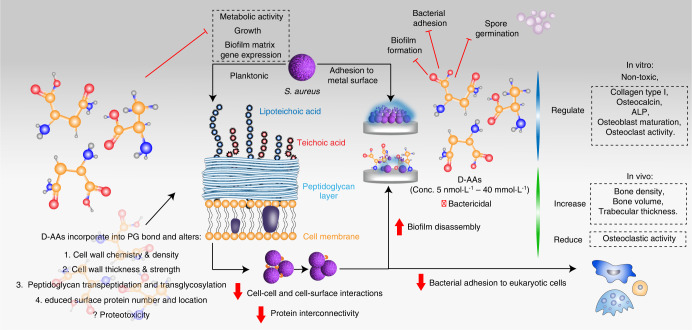
Due to the rise in our aging population, a disproportionate demand for total joint arthroplasty (TJA) in the elderly is forecast. Periprosthetic joint infection (PJI) represents one of the most challenging complications that can occur following TJA, and as the number of primary and revision TJAs continues to rise, an increasing PJI burden is projected. Despite advances in operating room sterility, antiseptic protocols, and surgical techniques, approaches to prevent and treat PJI remain difficult, primarily due to the formation of microbial biofilms. This difficulty motivates researchers to continue searching for an effective antimicrobial strategy. The dextrorotatory-isoforms of amino acids (D-AAs) are essential components of peptidoglycan within the bacterial cell wall, providing strength and structural integrity in a diverse range of species. Among many tasks, D-AAs regulate cell morphology, spore germination, and bacterial survival, evasion, subversion, and adhesion in the host immune system. When administered exogenously, accumulating data have demonstrated that D-AAs play a pivotal role against bacterial adhesion to abiotic surfaces and subsequent biofilm formation; furthermore, D-AAs have substantial efficacy in promoting biofilm disassembly. This presents D-AAs as promising and novel targets for future therapeutic approaches. Despite their emerging antibacterial efficacy, their role in disrupting PJI biofilm formation, the disassembly of established TJA biofilm, and the host bone tissue response remains largely unexplored. This review aims to examine the role of D-AAs in the context of TJAs. Data to date suggest that D-AA bioengineering may serve as a promising future strategy in the prevention and treatment of PJI.
© 2023. The Author(s).
Conflict of interest statement
The authors declare no competing interests.
Figures


References
-
- Simpson, AHRW. Incidence, complications and novel treatment strategies: joint arthroplasty. In: Musculoskeletal Infection. Springer International Publishing; 2022:227–282. 10.1007/978-3-030-83251-3_8
-
- Williams SN, Wolford ML, Bercovitz A. Hospitalization for total knee replacement among inpatients aged 45 and over:United States, 2000–2010. NCHS Data Brief. 2015;210:1–8. - PubMed
-
- Wolford ML, Palso K, Bercovitz A. Hospitalization for total hip replacement among inpatients aged 45 and over: United States, 2000–2010. NCHS Data Brief. 2015;210:1–8. - PubMed
-
- Hooper G, Lee AJ-J, Rothwell A, Frampton C. Current trends and projections in the utilisation rates of hip and knee replacement in New Zealand from 2001 to 2026. NZ Med. J. 2014;127:82–93. - PubMed
Publication types
LinkOut - more resources
Full Text Sources
