


Association of Oxidative Stress with Kidney Injury in a Hyperandrogenemic Female Rat Model
- PMID: 36895462
- PMCID: PMC9989239
- DOI: 10.30476/IJMS.2022.93594.2497
Association of Oxidative Stress with Kidney Injury in a Hyperandrogenemic Female Rat Model
Abstract
Background: Polycystic ovary syndrome (PCOS) is the most common reproductive dysfunction in premenopausal women. PCOS is associated with oxidative stress (OS), which is the main risk factor for renal diseases. This study aimed to investigate the mechanisms responsible for renal injury in a hyperandrogenemic female rat model.
Methods: This study was conducted from December 2019 to September 2021 at Shiraz Nephro-Urology Research Centre, Shiraz University of Medical Sciences (Shiraz, Iran). Thirty female Sprague-Dawley rats were randomly divided into three groups (n=10), namely control, sham, and dehydroepiandrosterone (DHEA). Plasma total testosterone, plasma creatinine (Cr), and blood urea nitrogen (BUN) levels were measured. In addition, total oxidant status (TOS), total antioxidant capacity (TAC), oxidative stress index (OSI), and histopathological changes in the ovaries and kidneys were determined. Data were analyzed using the GraphPad Prism software, and P<0.05 was considered statistically significant.
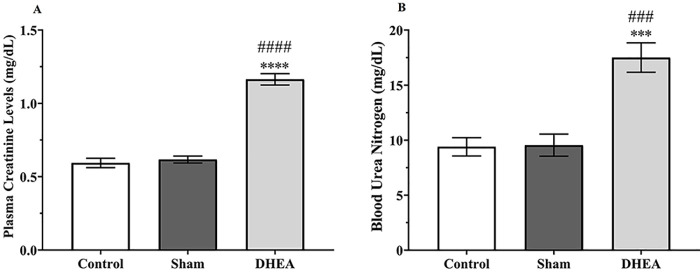
Results: Plasma total testosterone levels increased by nine-fold in DHEA-treated rats compared to controls (P=0.0001). Administration of DHEA increased Cr and BUN levels and caused severe renal tubular cell injury. In addition, plasma and tissue (kidney and ovary) TAC levels decreased significantly, but TOS levels and OSI values were significantly increased (P=0.019). Significant damage to both glomerular and tubular parts of the kidney and ovarian follicular structure was observed in the DHEA group.
Conclusion: Hyperandrogenemia caused systemic abnormalities through OS-related mechanisms and damaged renal and ovarian tissues. DHEA treatment in rat models is recommended to study the mechanisms that mediate PCOS-associated renal injury.
Keywords: Dehydroepiandrosterone; Kidney disease; Oxidative stress; Polycystic ovary syndrome.
Copyright: © Iranian Journal of Medical Sciences.
Conflict of interest statement
None declared.
Figures



References
-
- Chappell NR, Gibbons WE, Blesson CS. Pathology of hyperandrogenemia in the oocyte of polycystic ovary syndrome. Steroids. 2022;180:108989. doi: 10.1016/j.steroids.2022.108989. [ PMC Free Article ] - DOI - PMC - PubMed
Publication types
MeSH terms
Substances
LinkOut - more resources
Full Text Sources
Medical