


Performance of CRASH and IMPACT Prognostic Models for Traumatic Brain Injury at 12 and 24 Months Post-Injury
- PMID: 36895818
- PMCID: PMC9989509
- DOI: 10.1089/neur.2022.0082
Performance of CRASH and IMPACT Prognostic Models for Traumatic Brain Injury at 12 and 24 Months Post-Injury
Abstract
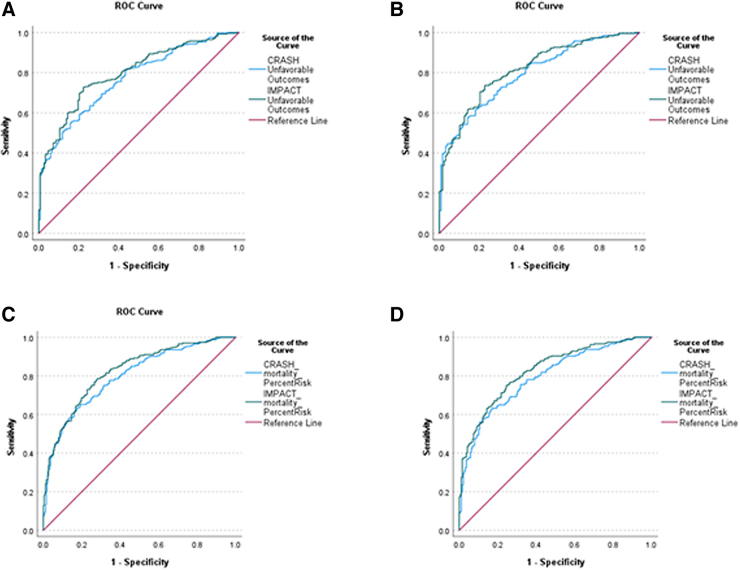
The Corticoid Randomization after Significant Head Injury (CRASH) and International Mission for Prognosis and Analysis of Clinical Trials (IMPACT) prognostic models are the most reported prognostic models for traumatic brain injury (TBI) in the scientific literature. However, these models were developed and validated to predict 6-month unfavorable outcome and mortality, and growing evidence supports continuous improvements in functional outcome after severe TBI up to 2 years post-injury. The purpose of this study was to evaluate CRASH and IMPACT model performance beyond 6 months post-injury to include 12 and 24 months post-injury. Discriminative validity remained consistent over time and comparable to earlier recovery time points (area under the curve = 0.77-0.83). Both models had poor fit for unfavorable outcomes, explaining less than one quarter of the variation in outcomes for severe TBI patients. The CRASH model had significant values for the Hosmer-Lemeshow test at 12 and 24 months, indicating poor model fit past the previous validation point. There is concern in the scientific literature that TBI prognostic models are being used by neurotrauma clinicians to support clinical decision making despite the goal of the models' development being to support research study design. The results of this study indicate that the CRASH and IMPACT models should not be used in routine clinical practice because of poor model fit that worsens over time and the large, unexplained variance in outcomes.
Keywords: adult brain injury; models of injury; traumatic brain injury.
© Shawn R. Eagle et al., 2023; Published by Mary Ann Liebert, Inc.
Conflict of interest statement
No competing financial interests exist.
Figures
References
-
- Nelson LD, Temkin NR, Dikmen S, et al. Recovery after mild traumatic brain injury in patients presenting to US Level I trauma centers: a Transforming Research and Clinical Knowledge in Traumatic Brain Injury (TRACK-TBI) Study. JAMA Neurol 2019;76(9):1049–1059; doi: 10.1001/jamaneurol.2019.1313 - DOI - PMC - PubMed
-
- Roozenbeek B, Lingsma HF, Lecky FE, et al. ; International Mission on Prognosis Analysis of Clinical Trials in Traumatic Brain Injury (IMPACT) Study Group; Corticosteroid Randomisation After Significant Head Injury (CRASH) Trial Collaborators; Trauma Audit and Research Network (TARN). Prediction of outcome after moderate and severe traumatic brain injury: external validation of the International Mission on Prognosis and Analysis of Clinical Trials (IMPACT) and Corticoid Randomisation After Significant Head injury (CRASH) prognostic models. Crit Care Med 2012;40(5):1609–1617; doi: 10.1097/CCM.0b013e31824519ce - DOI - PMC - PubMed
Grants and funding
LinkOut - more resources
Full Text Sources
Miscellaneous