Review
. 2023 Feb 21:14:1074839.
doi: 10.3389/fpls.2023.1074839. eCollection 2023.

Unlocking the potentials of nitrate transporters at improving plant nitrogen use efficiency

Affiliations
Review

Unlocking the potentials of nitrate transporters at improving plant nitrogen use efficiency

Oluwaseun Olayemi Aluko et al. Front Plant Sci. .

Abstract

Nitrate ( NO 3 - ) transporters have been identified as the primary targets involved in plant nitrogen (N) uptake, transport, assimilation, and remobilization, all of which are key determinants of nitrogen use efficiency (NUE). However, less attention has been directed toward the influence of plant nutrients and environmental cues on the expression and activities of NO 3 - transporters. To better understand how these transporters function in improving plant NUE, this review critically examined the roles of NO 3 - transporters in N uptake, transport, and distribution processes. It also described their influence on crop productivity and NUE, especially when co-expressed with other transcription factors, and discussed these transporters' functional roles in helping plants cope with adverse environmental conditions. We equally established the possible impacts of NO 3 - transporters on the uptake and utilization efficiency of other plant nutrients while suggesting possible strategic approaches to improving NUE in plants. Understanding the specificity of these determinants is crucial to achieving better N utilization efficiency in crops within a given environment.

Keywords: environmental stress; nitrate remobilization; nitrate transport and signaling; nitrate transporters; nitrate uptake; nitrogen use efficiency.


Conflict of interest statement

The authors declare that the research was conducted in the absence of any commercial or financial relationships that could be construed as a potential conflict of interest.

Figures
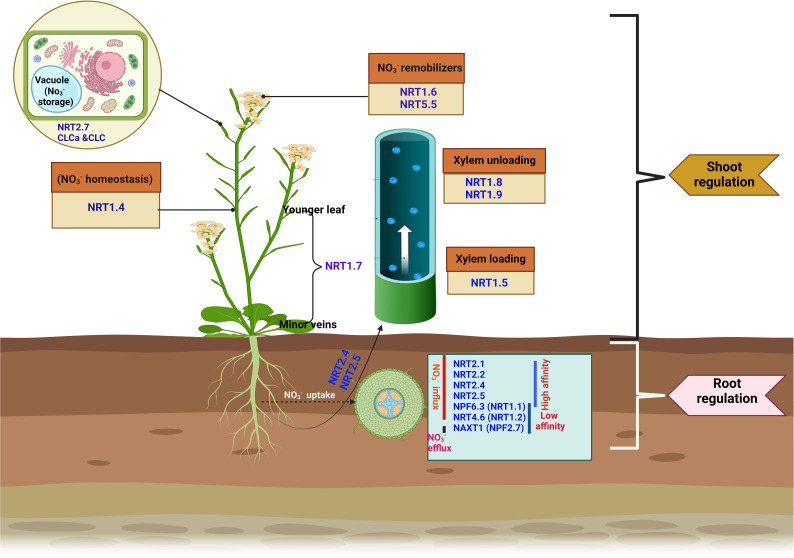
Figure 1
Figure 1
Key nitrate transporters involved in nitrate uptake, transport, and remobilization in plants. Nitrate transporters involved in NO3- acquisition from the root include NRT2.1, NRT2.2, NPF4.6 (NRT1.2), NRT2.4, NRT2.5, and NPF6.3 (NRT1.1). NPF2.7 performs the NO3- efflux function. In addition to the uptake function, NRT2.4 and NRT2.5 facilitates root-to-shoot NO3- transport. NRT1.5 is responsible for xylem loading, while NRT1.8 and NRT1.9 functions to unload NO3- from the xylem. NRT1.4 regulates NO3- homeostasis, and the expression of NRT1.7 in the phloem of the minor vein promotes nitrate remobilization from mature to younger leaves. At shoot, NRT1.6 and NPF5.5 act as a NO3- remobilizer, remobilizing NO3- in the embryo. NRT2.7 enhances NO3- storage in the seed vacuole.
Figure 2
Figure 2
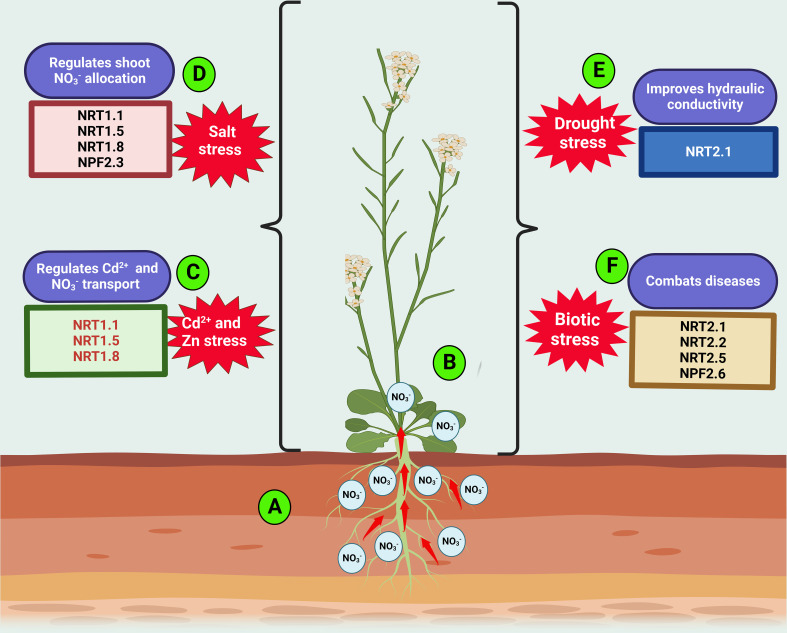
Roles of nitrate transporters in plant response to adverse environmental conditions. Environmental cues including heavy metals (Cd2+ and Zn), salinity, drought, and pathogenic stress engender reduction in plant growth and NUE. The resulting stressed plants accumulate more NO3- at the root (A) while retaining less in the shoot (B). Under Cd2+ or Zn stress, nitrate transporters, NRT1.1, NRT1.5 and NRT1.8 concurrently regulates Cd2+ or Zn uptake and NO3- allocation to the root (C). The transporters involved in root-to-shoot allocation of NO3- under salinity include NPF2.3, NRT1.1, NRT1.5, and NRT1.8 (D). NRT2.1 promotes plants’ tolerance to drought stress (E). In addition to NRT2.1, NRT2.2, NRT2.5 and NRT2.6 are involved in biotic stress regulation (F).

References

    1. Alfatih A., Wu J., Zhang Z.-S., Xia J.-Q., Jan S. U., Yu L.-H., et al. (2020). Rice NIN-LIKE PROTEIN 1 rapidly responds to nitrogen deficiency and improves yield and nitrogen use efficiency. J. Exp. Bot. 71, 6032–6042. doi: 10.1093/jxb/eraa292 - DOI - PubMed
    1. Almagro A., Lin S. H., Tsay Y. F. (2008). Characterization of the arabidopsis nitrate transporter NRT1. 6 reveals a role of nitrate in early embryo development. Plant Cell 20, 3289–3299. doi: 10.1105/tpc.107.056788 - DOI - PMC - PubMed
    1. Aluko O. O., Li C., Wang Q., Liu H. (2021). Sucrose utilization for improved crop yields: A review article. Int. J. Mol. Sci. 22 (9), 4704. doi: 10.3390/ijms22094704 - DOI - PMC - PubMed
    1. Alvarez-Aragon R., Rodriguez-Navarro A. (2017). Nitrate-dependent shoot sodium accumulation and osmotic functions of sodium in arabidopsis under saline conditions. Plant J. 91, 208–219. doi: 10.1111/tpj.13556 - DOI - PubMed
    1. Araus V., Vidal E. A., Puelma T., Alamos S., Mieulet D., Guiderdoni E., et al. (2016). Members of BTB gene family of scaffold proteins suppress nitrate uptake and nitrogen use efficiency. Plant Physiol. 171, 1523–1532. doi: 10.1104/pp.15.01731 - DOI - PMC - PubMed

LinkOut - more resources