


An artificially intelligent, natural language processing chatbot designed to promote COVID-19 vaccination: A proof-of-concept pilot study
- PMID: 36896332
- PMCID: PMC9989411
- DOI: 10.1177/20552076231155679
An artificially intelligent, natural language processing chatbot designed to promote COVID-19 vaccination: A proof-of-concept pilot study
Abstract
Objective: Our goal is to establish the feasibility of using an artificially intelligent chatbot in diverse healthcare settings to promote COVID-19 vaccination.
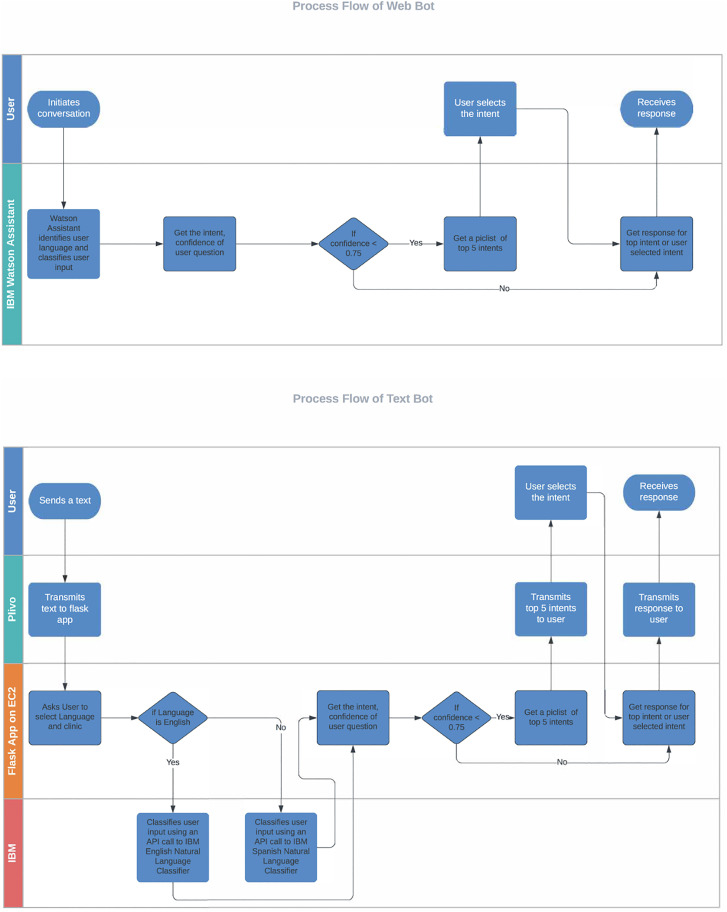
Methods: We designed an artificially intelligent chatbot deployed via short message services and web-based platforms. Guided by communication theories, we developed persuasive messages to respond to users' COVID-19-related questions and encourage vaccination. We implemented the system in healthcare settings in the U.S. between April 2021 and March 2022 and logged the number of users, topics discussed, and information on system accuracy in matching responses to user intents. We regularly reviewed queries and reclassified responses to better match responses to query intents as COVID-19 events evolved.
Results: A total of 2479 users engaged with the system, exchanging 3994 COVID-19 relevant messages. The most popular queries to the system were about boosters and where to get a vaccine. The system's accuracy rate in matching responses to user queries ranged from 54% to 91.1%. Accuracy lagged when new information related to COVID emerged, such as that related to the Delta variant. Accuracy increased when we added new content to the system.
Conclusions: It is feasible and potentially valuable to create chatbot systems using AI to facilitate access to current, accurate, complete, and persuasive information on infectious diseases. Such a system can be adapted to use with patients and populations needing detailed information and motivation to act in support of their health.
Keywords: Artificial intelligent; COVID-19 pandemic; chatbot; feasibility; vaccine hesitancy.
© The Author(s) 2023.
Conflict of interest statement
The authors declared no potential conflicts of interest with respect to the research, authorship, and/or publication of this article.
Figures



References
-
- The New York Times. Coronavirus in the U.S.: Latest map and case count, https://www.nytimes.com/interactive/2021/us/covid-cases.html (2022, accessed 10 April 2022).
-
- Centers for Disease Control and Prevention. COVID data tracker, https://covid.cdc.gov/covid-data-tracker/#vaccinations_vacc-people-onedo... (2022, accessed 11 April 2022).
-
- Centers for Disease Control and Prevention. Estimates of vaccine hesitancy for COVID-19, https://data.cdc.gov/stories/s/Vaccine-Hesitancy-for-COVID-19/cnd2-a6zw/ (2022, accessed 11 April 2022).
-
- Kaiser Family Foundation. KFF COVID-19 Vaccine Monitor: February 2022, https://www.kff.org/coronavirus-covid-19/poll-finding/kff-covid-19-vacci... (2022, accessed 12 April 2022).
LinkOut - more resources
Full Text Sources
Miscellaneous
