


Case Reports
doi: 10.14740/jmc4044.
Epub 2023 Feb 25.
Chronic Oral Amiodarone as a Cause of Acute Liver Failure
Affiliations
- PMID: 36896369
- PMCID: PMC9990705
- DOI: 10.14740/jmc4044
Item in Clipboard
Case Reports
Chronic Oral Amiodarone as a Cause of Acute Liver Failure
J Med Cases.
2023 Feb.
Abstract
Acute liver failure (ALF) is a rare condition that can have a variable clinical course and potentially fatal outcomes. Medication toxicity is a known etiology, however liver failure induced by amiodarone is rare and has been reported mostly in the setting of intravenous (IV) infusion. We present an 84-year-old patient who developed ALF after chronic use of oral amiodarone. The patient received supportive care and her symptoms improved.
Keywords: Acute liver failure; Adverse reaction; Amiodarone; Hepatotoxicity.
Copyright 2023, Calderon-Martinez et al.
Conflict of interest statement
The authors do not have any conflict of interest.
Figures
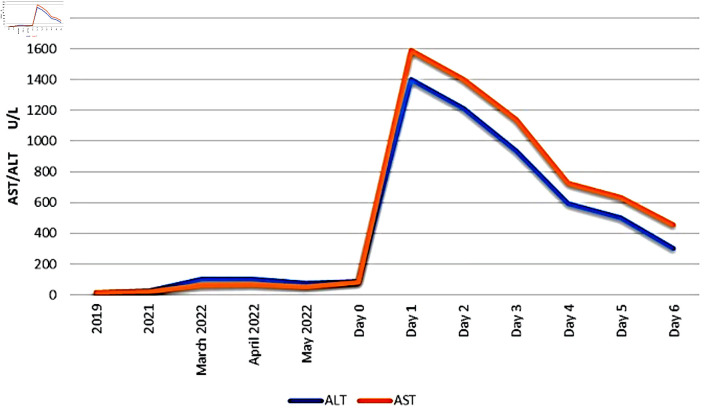
Liver function test (LFT) trending before and after admission. AST: aspartate aminotransferase; ALT: alanine aminotransferase.
References
-
- Lee WM, Hynan LS, Rossaro L, Fontana RJ, Stravitz RT, Larson AM, Davern TJ 2nd. et al. Intravenous N-acetylcysteine improves transplant-free survival in early stage non-acetaminophen acute liver failure. Gastroenterology. 2009;137(3):856–864.e851. doi: 10.1053/j.gastro.2009.06.006. - DOI - PMC - PubMed
-
- Chalasani NP, Hayashi PH, Bonkovsky HL, Navarro VJ, Lee WM, Fontana RJ, Practice Parameters Committee of the American College of G. ACG Clinical Guideline: the diagnosis and management of idiosyncratic drug-induced liver injury. Am J Gastroenterol. 2014;109(7):950–966. doi: 10.1038/ajg.2014.131. - DOI - PubMed
Publication types
LinkOut - more resources
Full Text Sources