. 2023 Mar 3;15(3):evad041.
doi: 10.1093/gbe/evad041.

De novo Assembly and Comparative Analyses of Mitochondrial Genomes in Piperales

Affiliations

De novo Assembly and Comparative Analyses of Mitochondrial Genomes in Piperales

Runxian Yu et al. Genome Biol Evol. .

Abstract

The mitochondrial genome of Liriodendron tulipifera exhibits many ancestral angiosperm features and a remarkably slow evolutionary rate, while mitochondrial genomes of other magnoliids remain yet to be characterized. We assembled nine new mitochondrial genomes, representing all genera of perianth-bearing Piperales, as well as for a member of the sister clade: three complete or nearly complete mitochondrial genomes from Aristolochiaceae and six additional draft assemblies including Thottea, Asaraceae, Lactoridaceae, and Hydnoraceae. For comparative purpose, a complete mitochondrial genome was assembled for Saururus, a member of the perianth-less Piperales. The average number of short repeats (50-99 bp) was much larger in genus Aristolochia than in other angiosperm mitochondrial genomes, and approximately 30% of repeats (<350 bp) were found to have the capacity to mediate recombination. We found mitochondrial genomes in perianth-bearing Piperales comprising conserved repertories of protein-coding genes and rRNAs but variable copy numbers of tRNA genes. We identified several shifts from cis- to trans-splicing of the Group II introns of nad1i728, cox2i373, and nad7i209. Two short regions of the cox1 and atp8 genes were likely derived from independent horizontal gene transfer events in perianth-bearing Piperales. We found biased enrichment of specific substitution types in different lineages of magnoliids and the Aristolochiaceae family showed the highest ratio of A:T > T:A substitutions of all other investigated angiosperm groups. Our study reports the first mitochondrial genomes for Piperales and uses this new information for a better understanding of the evolutionary patterns of magnoliids and angiosperms in general.

Keywords: Aristolochiaceae; HGT; Piperales; mitochondrial genome; mutation spectrum.


Figures

Fig. 1.
Fig. 1.
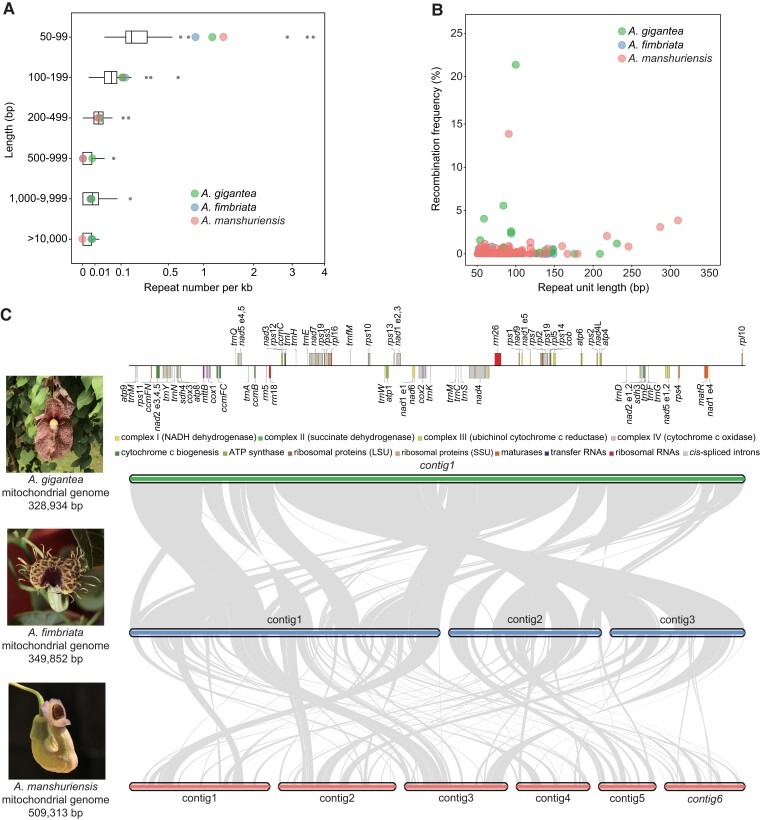
Mitochondrial genome features of three Aristolochia species. (A) Length distribution of repeats in the complete mitochondrial genomes of 74 angiosperms. Black vertical line: median; box: upper, and lower quartile, including 50% of the distribution; whiskers: minimum and maximum of the data, provided that their length does not exceed 1.5 × the interquartile range; black circles: outliers. (B) Recombination frequency for repeats of 50–350 bp in length. (C) Synteny among the three Aristolochia mitochondrial genomes studied here. Bars and ribbons represent contigs and syntenic regions, respectively (>250 bp). Contig names in standard and italic font represent those with circular and linear structures, respectively. Left, representative flower images and the estimated mitochondrial genome size. Top, annotation map of Aristolochia gigantea for reference.
Fig. 2.
Fig. 2.
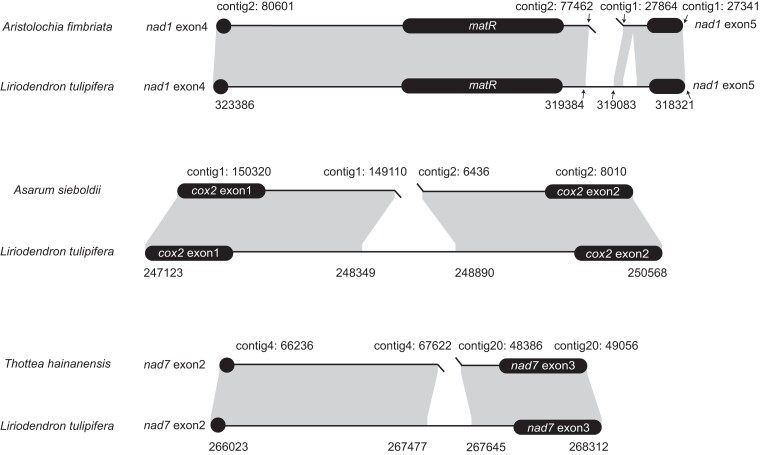
Schematic diagrams showing syntenic analysis of three mitochondrial introns in perianth-bearing Piperales and Liriodendron tulipifera. Flanking exons are shown as rounded black rectangles. Shading with genomic coordinates indicates homologous regions between mitochondrial genomes of each pair of species.
Fig. 3.
Fig. 3.
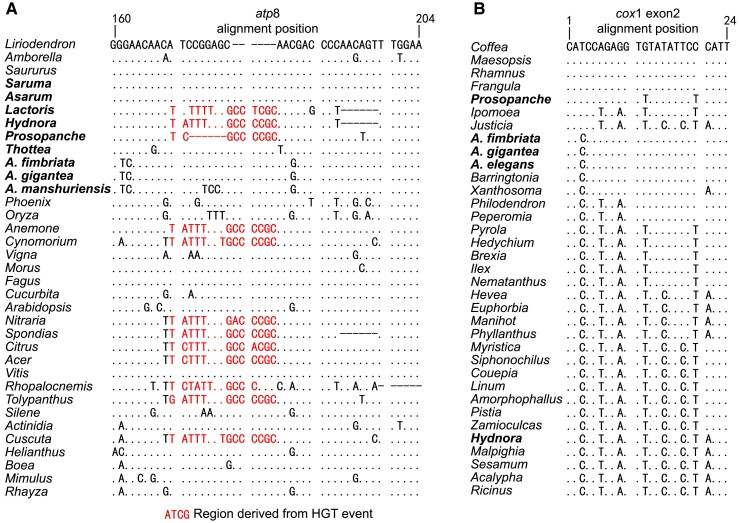
Nucleic acid alignments of atp8 and cox1. (A) Alignment of the atp8 gene region containing HGT sequences. (B) Alignment of the exon 2 region in cox1. Dots and hyphens indicate identical bases and gaps, respectively, compared to the reference sequence. Perianth-bearing Piperales species are shown in bold.
Fig. 4.
Fig. 4.
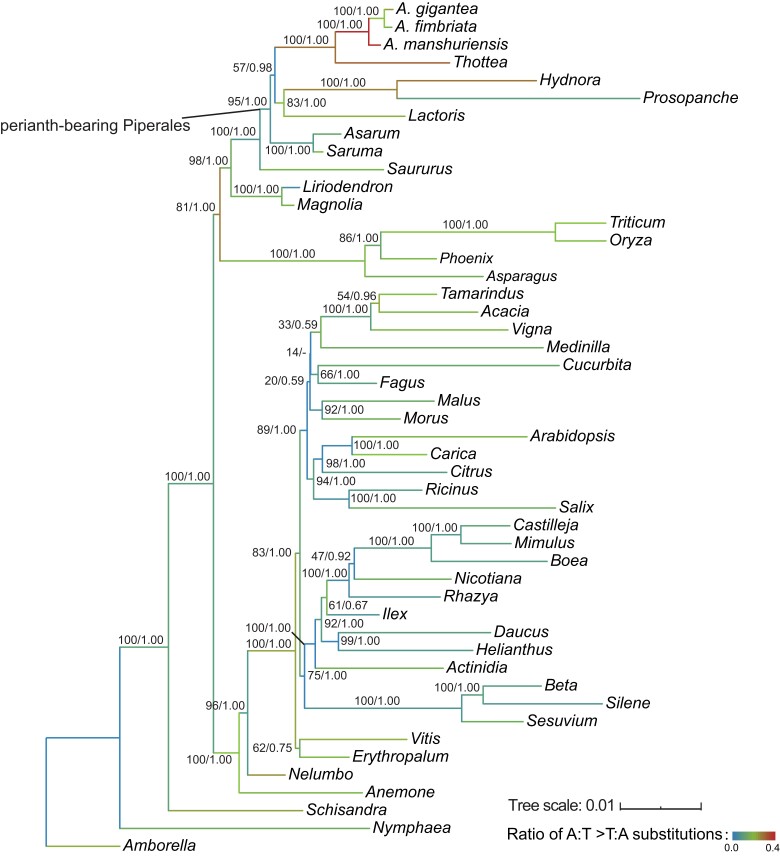
ML tree highlighting the mitochondrial mutation spectrum of 48 angiosperms. Enlarged view of the clade containing selected perianth-bearing Piperales studied in this analysis. Above each branch are bootstrap support values from ML and posterior probabilities from BI separated by a slash. RNA editing sites were excluded from the alignments. Branch colors indicate the proportion of A:T > T:A substitutions out of the total number of substitutions.
Fig. 5.
Fig. 5.
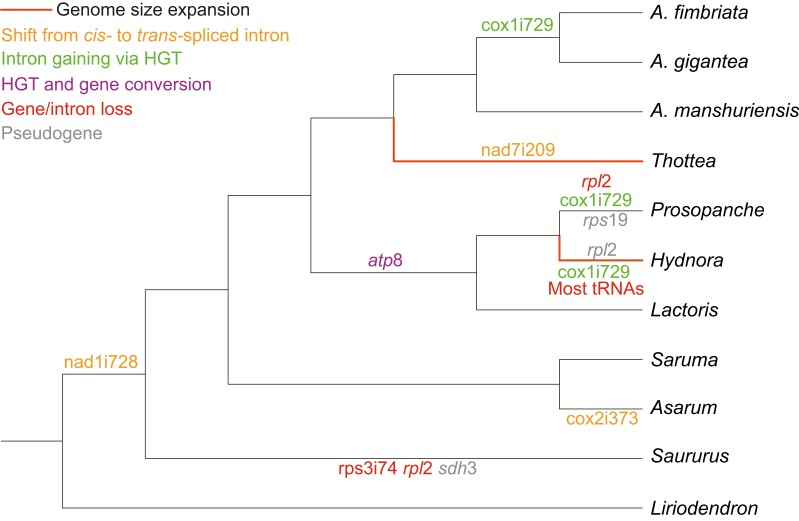
Summary of mitochondrial genome features in magnoliids.

References

    1. Allio R, et al. . 2021. Genome-wide macroevolutionary signatures of key innovations in butterflies colonizing new host plants. Nat Commun. 12:354. - PMC - PubMed
    1. Alverson AJ, Rice DW, Dickinson S, Barry K, Palmer JD. 2011. Origins and recombination of the bacterial-sized multichromosomal mitochondrial genome of cucumber. Plant Cell 23:2499–2513. - PMC - PubMed
    1. Barkman TJ, et al. . 2007. Mitochondrial DNA suggests at least 11 origins of parasitism in angiosperms and reveals genomic chimerism in parasitic plants. BMC Evol Biol. 7:248. - PMC - PubMed
    1. Bolger AM, Lohse M, Usadel B. 2014. Trimmomatic: a flexible trimmer for illumina sequence data. Bioinformatics 30:2114–2120. - PMC - PubMed
    1. Broz AK, Waneka G, Wu Z, Gyorfy MF, Sloan DB. 2021. Detecting de novo mitochondrial mutations in angiosperms with highly divergent evolutionary rates. Genetics 218:iyab039. - PMC - PubMed

Publication types