. 2023 Mar 10;136(3):35.
doi: 10.1007/s00122-023-04259-4.

Genome-wide association studies reveal novel loci for resistance to groundnut rosette disease in the African core groundnut collection

Affiliations

Genome-wide association studies reveal novel loci for resistance to groundnut rosette disease in the African core groundnut collection

Esther Achola et al. Theor Appl Genet. .

Abstract

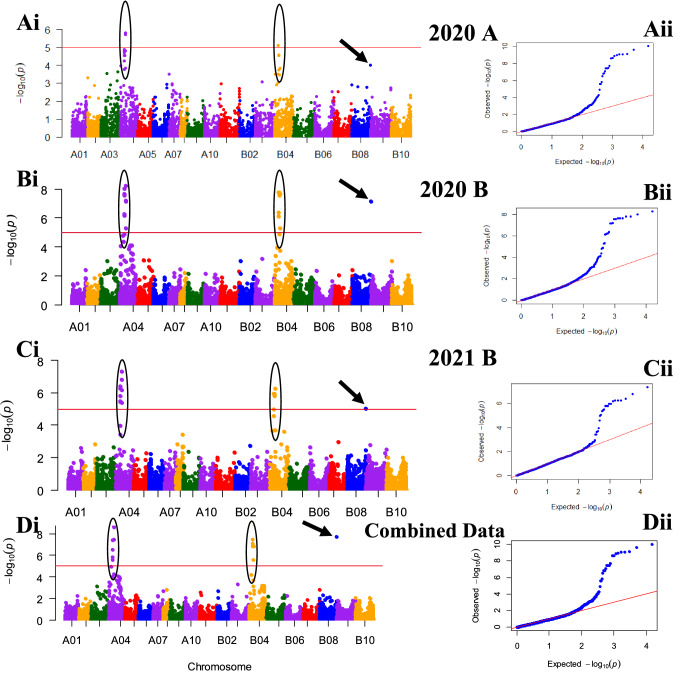
We identified markers associated with GRD resistance after screening an Africa-wide core collection across three seasons in Uganda Groundnut is cultivated in several African countries where it is a major source of food, feed and income. One of the major constraints to groundnut production in Africa is groundnut rosette disease (GRD), which is caused by a complex of three agents: groundnut rosette assistor luteovirus, groundnut rosette umbravirus and its satellite RNA. Despite several years of breeding for GRD resistance, the genetics of the disease is not fully understood. The objective of the current study was to use the African core collection to establish the level of genetic variation in their response to GRD, and to map genomic regions responsible for the observed resistance. The African groundnut core genotypes were screened across two GRD hotspot locations in Uganda (Nakabango and Serere) for 3 seasons. The Area Under Disease Progress Curve combined with 7523 high quality SNPs were analyzed to establish marker-trait associations (MTAs). Genome-Wide Association Studies based on Enriched Compressed Mixed Linear Model detected 32 MTAs at Nakabango: 21 on chromosome A04, 10 on B04 and 1 on B08. Two of the significant markers were localised on the exons of a putative TIR-NBS-LRR disease resistance gene on chromosome A04. Our results suggest the likely involvement of major genes in the resistance to GRD but will need to be further validated with more comprehensive phenotypic and genotypic datasets. The markers identified in the current study will be developed into routine assays and validated for future genomics-assisted selection for GRD resistance in groundnut.


Conflict of interest statement

All the authors declare that there is no conflict of interest.

Figures
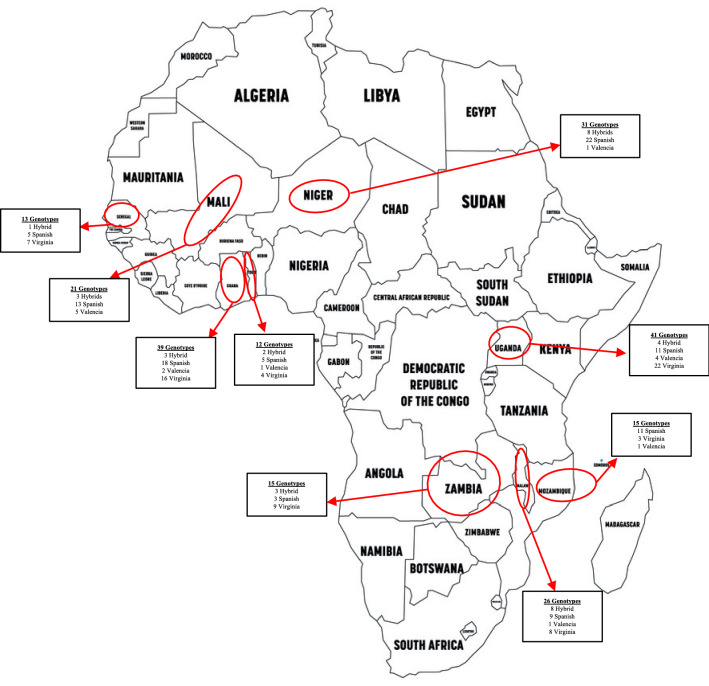
Fig. 1
Fig. 1
A map of Africa showing countries from which genotypes for core collection were obtained and their market classes
Fig. 2
Fig. 2
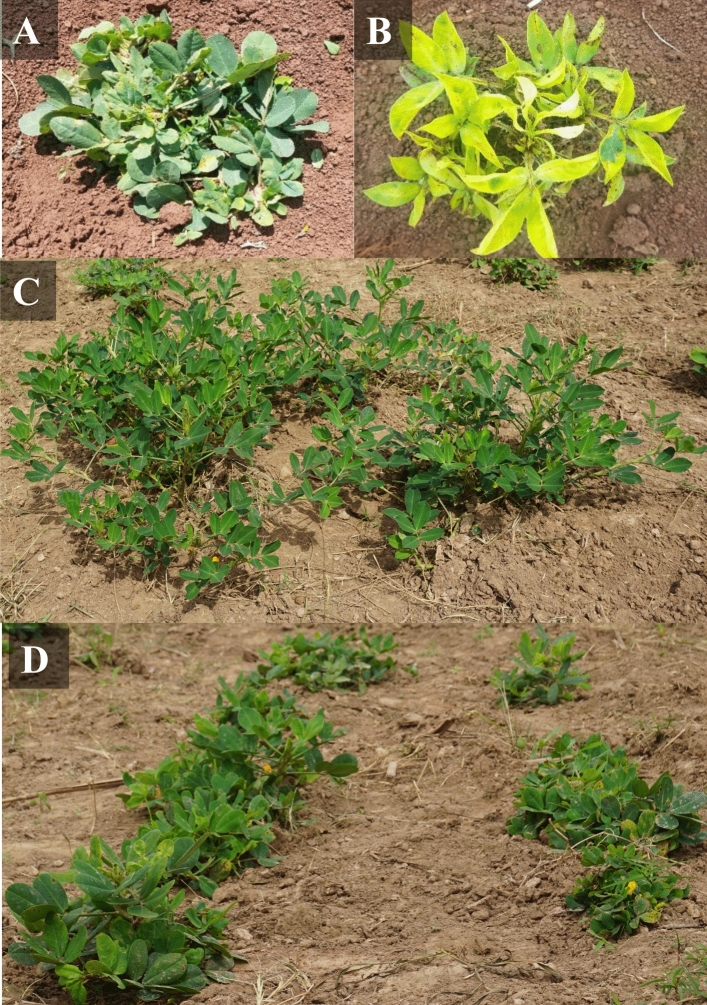
Symptoms of Groundnut Rosette Disease as observed in the field. A. Green rosette. B. Yellow rosette. C. Plot showing resistant check with 0% disease incidence at 60 DAP. D. Plot showing susceptible check with 100% PDI (all plants affected by GRD showing severe stuntedness) at 60 DAP
Fig. 3
Fig. 3
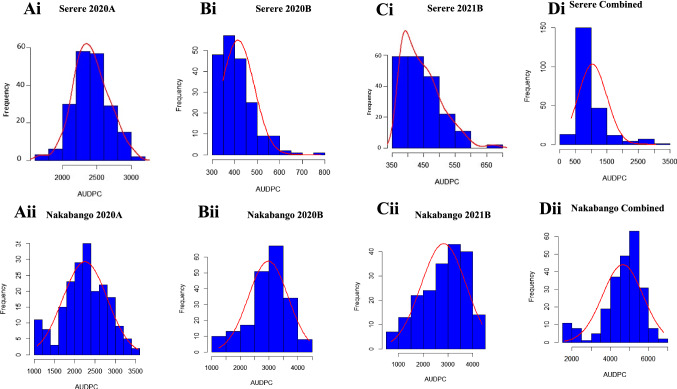
Phenotypic distribution of AUDPC across the two locations (Nakabango and Serere) for all seasons tested (2020A, 2020B, 2021B). The curves were drawn using BLUPs. There was no consistency in the distribution of the trait in Serere location (Ai, Bi, Ci and Di) as compared to Nakabango (Aii, Bii, Cii, Dii)
Fig. 4
Fig. 4
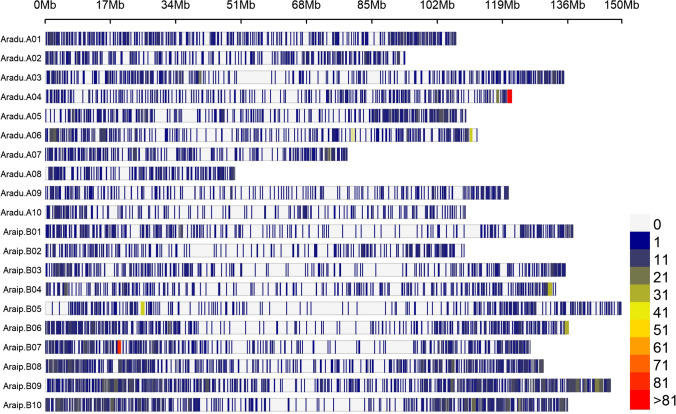
Distribution of high quality SNPs retained for population and marker-trait analysis against the joint A. ipaensis and A. duranensis reference genomes
Fig. 5
Fig. 5
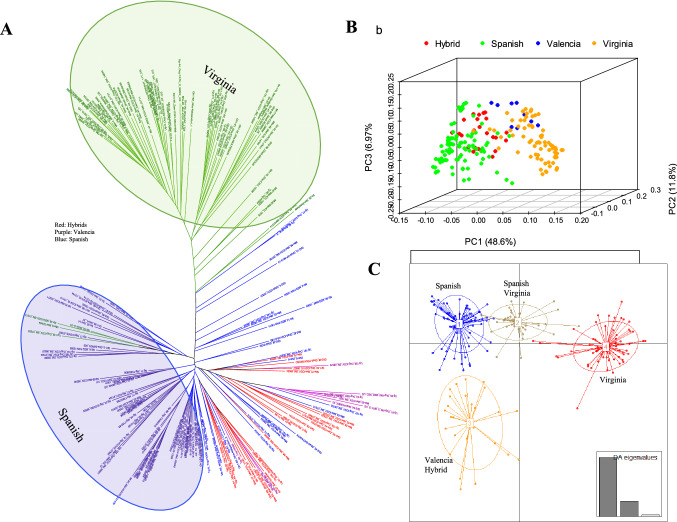
Relatedness of genotypes used in the study. A. A NJ tree revealing two major clusters comprising of Virginia and Spanish biological groups. Hybrid, Valencia and a number of Spanish genotypes appeared as admixtures. B. A PCA plot showing consistent clustering of the groundnut genotypes according to biological groups. The 3 PCs explained 67% genetic variation across the genotypes. C. A population structure analysis using DAPC that clustered the genotypes into 4 groups, of which the Spanish and Virginia clusters are the most distinct
Fig. 6
Fig. 6
Manhattan (Ai, Bi, Ci and Di) and QQ (Aii, Bii, Cii, Dii) plots drawn using ECMLM approach indicating SNPs significantly associated with resistance to GRD for Nakabango. The consistent peaks on the Manhattan plots are highlighted on chromosomes A04 and B04. An additional signal on chromosome B08 is indicated by an arrow. The solid red line across the Manhattan plots represents the significance threshold based on FDR correction (P < 0.05). Manhattan (Ei, Fi and Gi) and QQ (Eii, Fii and Gii) plots show GWAS results for Serere. No SNPs were significant at FDR threshold of P < 0.05
Fig. 7
Fig. 7
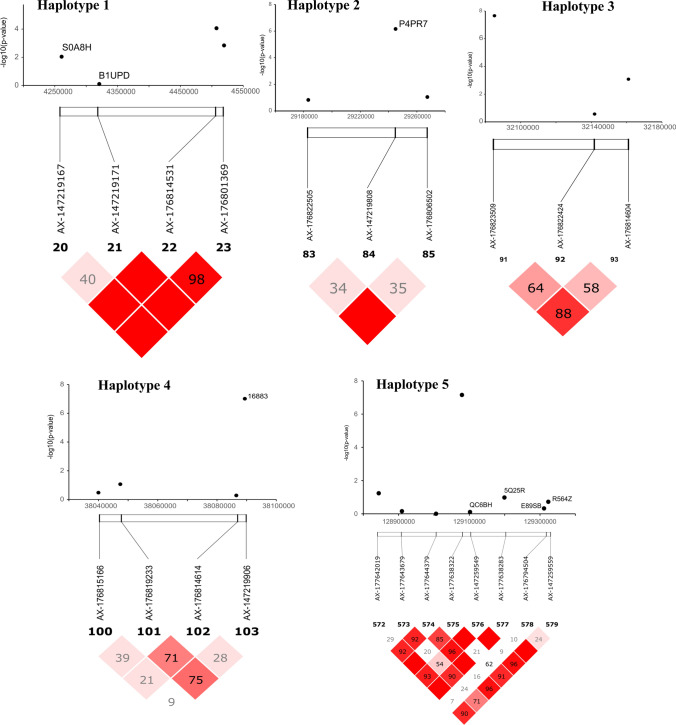
Five haplotypes significantly associated to GRD resistance. All the haplotypes were located in the QTL region of chromosome A04 except haplotype 5
Fig. 8
Fig. 8
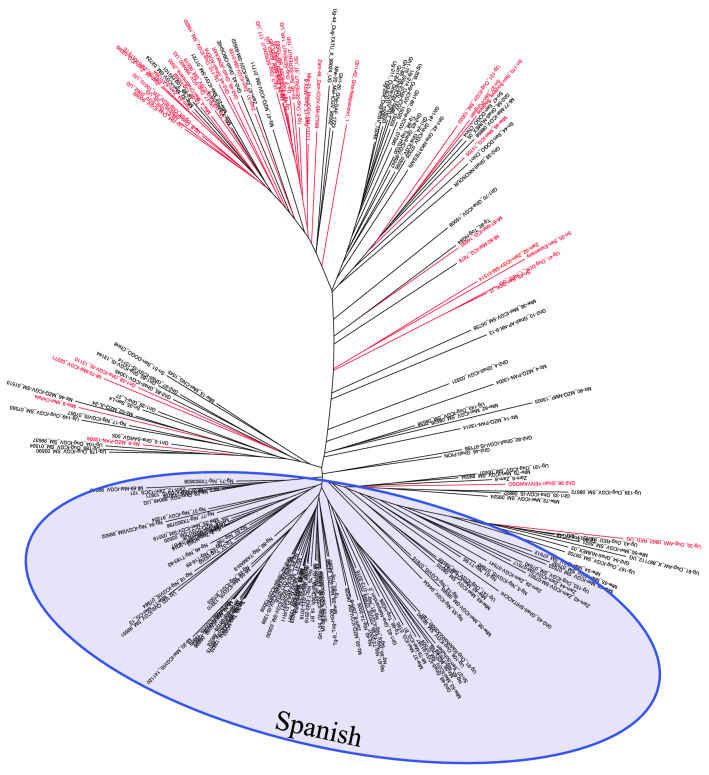
A N-J dendrogram showing the genetic diversity of the stable GRD resistant material in comparison with the African core set. The GRD resistant lines are highlighted in red. The predominantly Spanish cluster is highlighted in blue (color figure online)
Fig. 9
Fig. 9
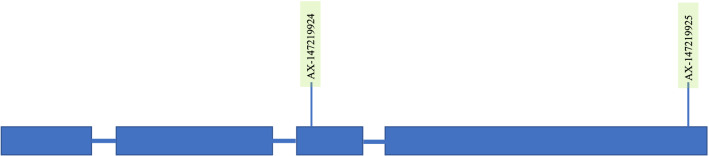
A sketch showing a hypothetical structure of the TIR-NBS-LRR disease resistance protein identified as a candidate gene on chromosome A04. Two markers co-localised on exons 3 and 4 are highlighted in light green. Figure not drawn to scale

References

    1. Ahmed B, Egwuma H, Idris MK. Groundnut (Arachis hypogaea) pod and haulm production in the tropical legume project states Nigeria. Afr J Agr Res. 2021;17(3):396–403. doi: 10.5897/AJAR2020.15269. - DOI
    1. Agarwal G, Clevenger J, Pandey MK, et al. High-density genetic map using whole-genome resequencing for fine mapping and candidate gene discovery for disease resistance in peanut. Plant Biotechnol. 2018;16(11):1954–1967. doi: 10.1111/pbi.12930. - DOI - PMC - PubMed
    1. Alqudah AM, Sallam A, Stephen Baenziger P, Börner A. GWAS: fast-forwarding gene identification and characterization in temperate cereals: lessons from barley–a review. J Adv Res. 2020;22:119–135. doi: 10.1016/j.jare.2019.10.013. - DOI - PMC - PubMed
    1. Amoah RA, Akromah R, Asibuo JY, Oppong A, Nyadanu D, Agyeman A, Bediako AK. Genetic control of resistance to rosette virus disease in groundnut (Arachis hypogaea L.) J Plant Breed Crop Sci. 2016;8(6):87–93. doi: 10.5897/JPBCS2015.0551. - DOI
    1. Arya SS, Salve AR, Chauhan S. Peanuts as functional food: a review. J Food Sci Technol. 2016;53(1):31–41. doi: 10.1007/s13197-015-2007-9. - DOI - PMC - PubMed