. 2023 Mar 10;6(1):38.
doi: 10.1038/s41746-023-00777-z.

Digital therapeutics from bench to bedside

Affiliations

Digital therapeutics from bench to bedside

Changwon Wang et al. NPJ Digit Med. .

Abstract

As a new therapeutic technique based on digital technology, the commercialization and clinical application of digital therapeutics (DTx) are increasing, and the demand for expansion to new clinical fields is remarkably high. However, the use of DTx as a general medical component is still ambiguous, and this ambiguity may be owing to a lack of consensus on a definition, in addition to insufficiencies in research and development, clinical trials, standardization of regulatory frameworks, and technological maturity. In this study, we conduct an in-depth investigation and analysis of definitions, clinical trials, commercial products, and the regulatory status related to DTx using published literature, ClinicalTrials.gov, and web pages of regulatory and private organizations in several countries. Subsequently, we suggest the necessity and considerations for international agreements on the definition and characteristics of DTx, focusing on the commercialization characteristics. In addition, we discuss the status and considerations of clinical research, key technology factors, and the direction of regulatory developments. In conclusion, for the successful settlement of DTx, real-world evidence-based validation should be strengthened by establishing a cooperative system between researchers, manufacturers, and governments, and there should be effective technologies and regulatory systems for overcoming engagement barriers of DTx.


Conflict of interest statement

The authors declare there is no conflict of interests. The views and opinions expressed are those of the authors and do not reflect those of the Ministry of Food and Drug Safety in Republic of Korea.

Figures
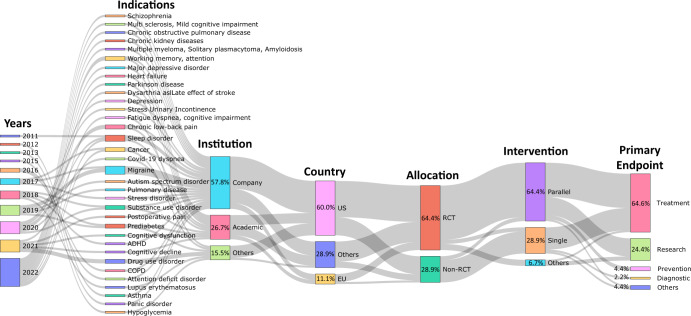
Fig. 1
Fig. 1. Sankey diagram depicting digital therapeutics-related clinical research studies that have been assigned a National Clinical Trial (NCT) number.
A Sankey diagram was utilized to analyze trends in indication, institution, country, trial type, intervention, and major outcomes. Between 2010 and 2022, a total of 31 clinical trials related to digital therapeutics were identified on the ClinicalTrials.gov website using the keyword “Digital therapeutics”. The clinical trials were conducted by a variety of institutions, including pharmaceutical companies, hospitals, research institutes, medical consortia, universities, and corporations. These trials were carried out in multiple countries, including the United States, Europe, Switzerland, Finland, South Korea, Italy, Brazil, Malaysia, Singapore, Canada, Israel, and Poland. The clinical trials employed interventions such as parallel, single, crossover, and factorial designs, with primary objectives that included treatment, research, prevention, diagnosis, supportive care, and basic science.
Fig. 2
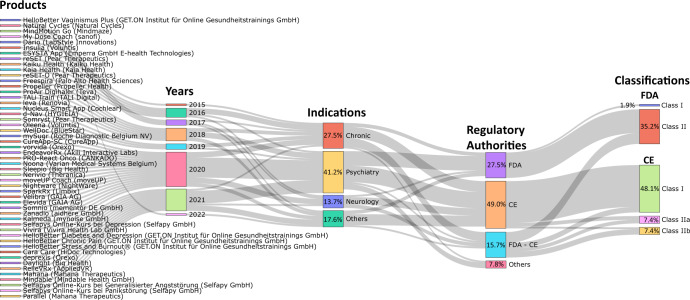
Fig. 2. Sankey diagram depicting the major indications and regulatory status of commercial digital therapeutics.
Sankey diagrams were employed to analyze trends in the types of indications, regulatory agency types, and class types for commercial digital therapeutic devices. The investigation focused on products listed on the DTA, DiGA, and mhealthbelgium websites, as well as products that had received FDA approval listed in the FDA medical device database. Regulatory authorities for each product were also investigated. Commercial digital therapeutics are primarily launched for indications related to chronic conditions, psychiatry, and neurology, with additional products available for urinary incontinence, ear disorders, hip and knee arthroplasty, tinnitus, irritable bowel syndrome, and vaginismus. Most commercial products have received approval from the FDA and CE regulatory agencies, while others have been approved by Japan’s Ministry of Health, Labour and Welfare (MHLW) and the Medicines and Healthcare products Regulatory Agency (MHRA).

References

    1. Chung JY. Digital therapeutics and clinical pharmacology. Transl. Clin. Pharm. 2019;27:6–11. doi: 10.12793/tcp.2019.27.1.6. - DOI - PMC - PubMed
    1. Dang A, Arora D, Rane P. Role of digital therapeutics and the changing future of healthcare. J. Fam. Med Prim. Care. 2020;9:2207–2213. doi: 10.4103/jfmpc.jfmpc_105_20. - DOI - PMC - PubMed
    1. Hong JS, Wasden C, Han DH. Introduction of digital therapeutics. Comput Methods Prog. Biomed. 2021;209:106319. doi: 10.1016/j.cmpb.2021.106319. - DOI - PubMed
    1. Patel NA, Butte AJ. Characteristics and challenges of the clinical pipeline of digital therapeutics. NPJ Digit Med. 2020;3:159. doi: 10.1038/s41746-020-00370-8. - DOI - PMC - PubMed
    1. Sepah SC, Jiang L, Peters AL. Long-term outcomes of a Web-based diabetes prevention program: 2-year results of a single-arm longitudinal study. J. Med Internet Res. 2015;17:e92. doi: 10.2196/jmir.4052. - DOI - PMC - PubMed