


Evolving Risk Classifications in AML in a Real-Life Scenario: After Changes upon Changes, Is It More and More Adverse?
- PMID: 36900222
- PMCID: PMC10001051
- DOI: 10.3390/cancers15051425
Evolving Risk Classifications in AML in a Real-Life Scenario: After Changes upon Changes, Is It More and More Adverse?
Abstract
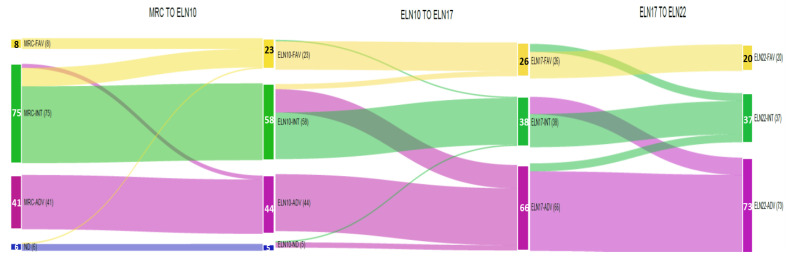
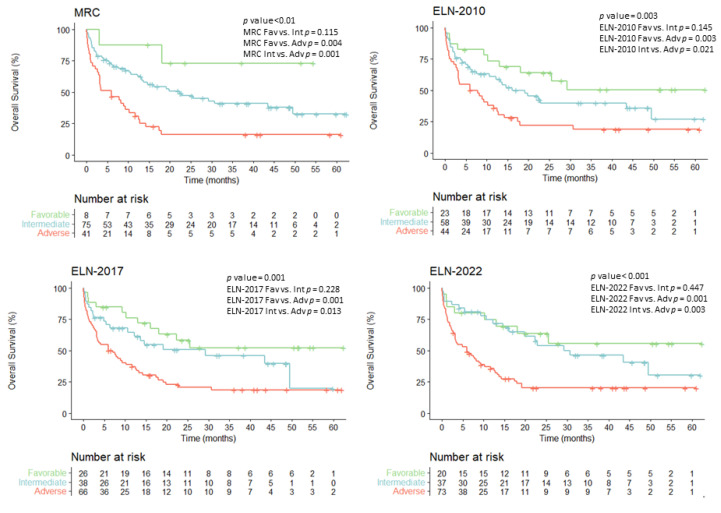
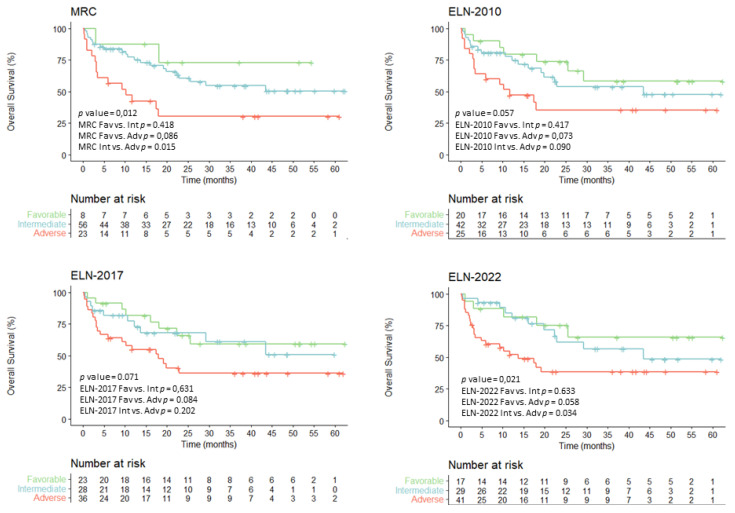
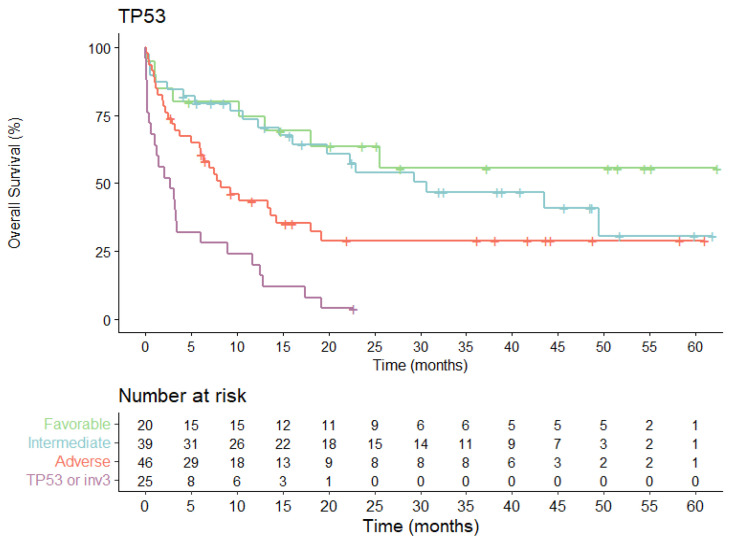
Acute myeloid leukemia (AML) is a heterogeneous disease classified into three risk categories (favorable, intermediate and adverse) with significant differences in outcomes. Definitions of risk categories evolve overtime, incorporating advances in molecular knowledge of AML. In this study, we analyzed the impacts of evolving risk classifications in 130 consecutive AML patients in a single-center real-life experience. Complete cytogenetic and molecular data were collected using conventional qPCR and targeted Next Generation Sequencing (NGS). Five-year OS probabilities were consistent among all classification models (roughly 50-72%, 26-32% and 16-20% for favorable, intermediate and adverse risk groups, respectively). In the same way, the medians of survival months and prediction power were similar in all models. In each update, around 20% of patients were re-classified. The adverse category consistently increased over time (31% in MRC, 34% in ELN2010, 50% in ELN2017), reaching up to 56% in the recent ELN2022. Noteworthily, in multivariate models, only age and the presence of TP53 mutations remained statistically significant. With updates in risk-classification models, the percentage of patients assigned to the adverse group is increasing, and so will the indications for allogeneic stem cell transplantation.
Keywords: European Leukemia Net; TP53 mutations; acute myeloid leukemia; risk classifications.
Conflict of interest statement
The authors declare no conflict of interest. The funders had no role in the design of the study; in the collection, analyses or interpretation of data; in the writing of the manuscript; or in the decision to publish the results.
Figures
References
-
- Grimwade D., Hills R.K., Moorman A.V., Walker H., Chatters S., Goldstone A.H., Wheatley K., Harrison C.J., Burnett A.K., National Cancer Research Institute Adult Leukaemia Working Group Refinement of cytogenetic classification in acute myeloid leukemia: Determination of prognostic significance of rare recurring chromosomal abnormalities among 5876 younger adult patients treated in the United Kingdom Medical Research Council trials. Blood. 2010;116:354–365. doi: 10.1182/blood-2009-11-254441. - DOI - PubMed
-
- Döhner H., Estey E.H., Amadori S., Appelbaum F.R., Büchner T., Burnett A.K., Dombret H., Fenaux P., Grimwade D., Larson R.A., et al. Diagnosis and management of acute myeloid leukemia in adults: Recommendations from an international expert panel, on behalf of the European LeukemiaNet. Blood. 2010;115:453–474. doi: 10.1182/blood-2009-07-235358. - DOI - PubMed
LinkOut - more resources
Full Text Sources
Research Materials
Miscellaneous
