


Molecular Mechanisms of Gastrointestinal Stromal Tumors and Their Impact on Systemic Therapy Decision
- PMID: 36900287
- PMCID: PMC10001062
- DOI: 10.3390/cancers15051498
Molecular Mechanisms of Gastrointestinal Stromal Tumors and Their Impact on Systemic Therapy Decision
Abstract
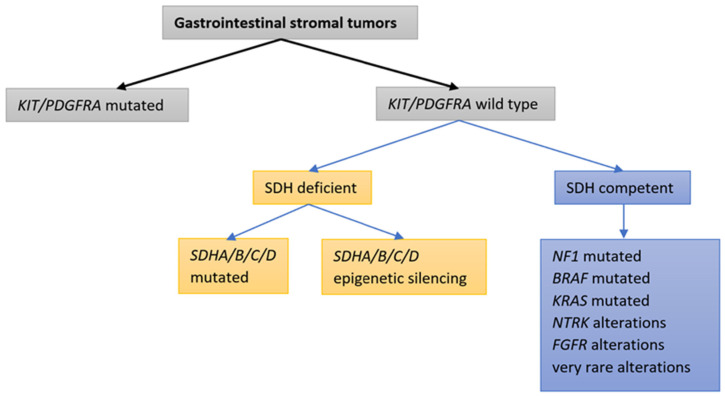
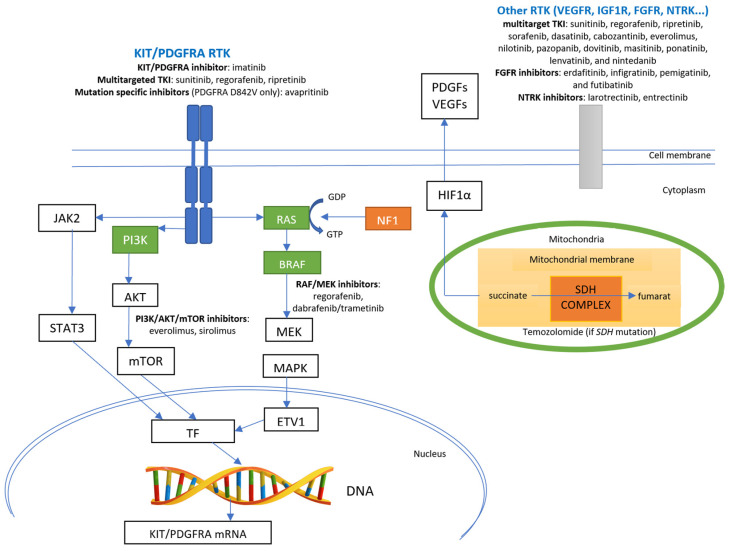
Gastrointestinal stromal tumors (GISTs) are soft tissue sarcomas that mostly derive from Cajal cell precursors. They are by far the most common soft tissue sarcomas. Clinically, they present as gastrointestinal malignancies, most often with bleeding, pain, or intestinal obstruction. They are identified using characteristic immunohistochemical staining for CD117 and DOG1. Improved understanding of the molecular biology of these tumors and identification of oncogenic drivers have altered the systemic treatment of primarily disseminated disease, which is becoming increasingly complex. Gain-of-function mutations in KIT or PDGFRA genes represent the driving mutations in more than 90% of all GISTs. These patients exhibit good responses to targeted therapy with tyrosine kinase inhibitors (TKIs). Gastrointestinal stromal tumors lacking the KIT/PDGFRA mutations, however, represent distinct clinico-pathological entities with diverse molecular mechanisms of oncogenesis. In these patients, therapy with TKIs is hardly ever as effective as for KIT/PDGFRA-mutated GISTs. This review provides an outline of current diagnostics aimed at identifying clinically relevant driver alterations and a comprehensive summary of current treatments with targeted therapies for patients with GISTs in both adjuvant and metastatic settings. The role of molecular testing and the selection of the optimal targeted therapy according to the identified oncogenic driver are reviewed and some future directions are proposed.
Keywords: GIST; KIT; PDGFRA; mutations; targeted therapy.
Conflict of interest statement
The authors declare no conflict of interest.
Figures
References
-
- Wang Z.H., Liang X.B., Wang Y., Ma G.L., Qu Y.Q., Tian X.W. Epidemiology survey of gastrointestinal stromal tumor in Shanxi Province in 2011. Zhonghua Yi Xue Za Zhi. 2013;93:2541–2544. - PubMed
-
- Cho M.Y., Sohn J.H., Kim J.M., Kim K.M., Park Y.S., Kim W.H., Jung J.S., Jung E.S., Jin S.Y., Kang D.Y., et al. Current trends in the epidemiological and pathological characteristics of gastrointestinal stromal tumors in Korea, 2003–2004. J. Korean Med. Sci. 2010;25:853–862. doi: 10.3346/jkms.2010.25.6.853. - DOI - PMC - PubMed
Publication types
LinkOut - more resources
Full Text Sources
Miscellaneous
