Review
. 2023 Feb 28;15(5):1519.
doi: 10.3390/cancers15051519.

Metabolic Barriers to Glioblastoma Immunotherapy

Affiliations
Review

Metabolic Barriers to Glioblastoma Immunotherapy

Nikita Choudhary et al. Cancers (Basel). .

Abstract

Glioblastoma (GBM) is the most common primary brain tumor with a poor prognosis with the current standard of care treatment. To address the need for novel therapeutic options in GBM, immunotherapies which target cancer cells through stimulating an anti-tumoral immune response have been investigated in GBM. However, immunotherapies in GBM have not met with anywhere near the level of success they have encountered in other cancers. The immunosuppressive tumor microenvironment in GBM is thought to contribute significantly to resistance to immunotherapy. Metabolic alterations employed by cancer cells to promote their own growth and proliferation have been shown to impact the distribution and function of immune cells in the tumor microenvironment. More recently, the diminished function of anti-tumoral effector immune cells and promotion of immunosuppressive populations resulting from metabolic alterations have been investigated as contributory to therapeutic resistance. The GBM tumor cell metabolism of four nutrients (glucose, glutamine, tryptophan, and lipids) has recently been described as contributory to an immunosuppressive tumor microenvironment and immunotherapy resistance. Understanding metabolic mechanisms of resistance to immunotherapy in GBM can provide insight into future directions targeting the anti-tumor immune response in combination with tumor metabolism.

Keywords: glioblastoma; glutamine metabolism; glycolysis; immunotherapy; lipid metabolism; metabolism; tryptophan metabolism; tumor microenvironment.


Conflict of interest statement

Authors declare no conflict of interest.

Figures
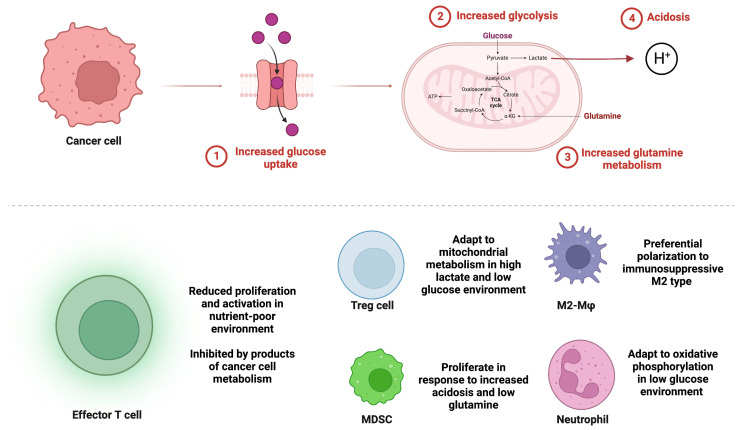
Figure 1
Figure 1
Glucose and glutamine metabolism in cancer cells alters immune cell populations in the glioblastoma tumor microenvironment. (Top) Cancer cells up regulate glucose transport into the cell (1) and increase glycolytic (2) and glutamine metabolism (3) leading to low levels of glucose and glutamine in the tumor microenvironment. Increased glycolysis results in acidosis from increased lactic acid production (4). (Bottom) Immune cell populations respond differentially to metabolic alterations in the tumor microenvironment. Anti-tumoral effector T cells have reduced function and proliferation. Pro-tumoral immunosuppressive populations of Tregs, MDSCs, M2 polarized macrophages, and neutrophils are enriched.
Figure 2
Figure 2
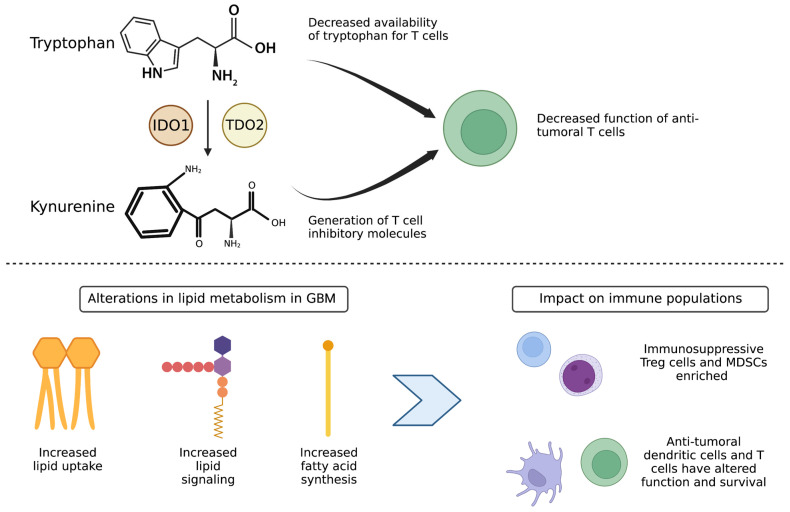
Altered tryptophan metabolism and lipid metabolism in GBM tumor cells contributes to an immunosuppressive population enriched tumor microenvironment. (Top) Tryptophan metabolism and generation of kynurenine degradation products by the enzymes IDO1 and TDO2 leads to decreased availability of tryptophan for T cells and generation of T cell inhibitory molecules, leading to decreased function of anti-tumoral T cells. (Bottom) Alterations in lipid metabolism lead to increased fatty acid oxidation and lipid signaling by immunosuppressive Treg and MDSC cells, leading to their enrichment over anti-tumor dendritic cells and cytotoxic T cells.
Figure 3
Figure 3
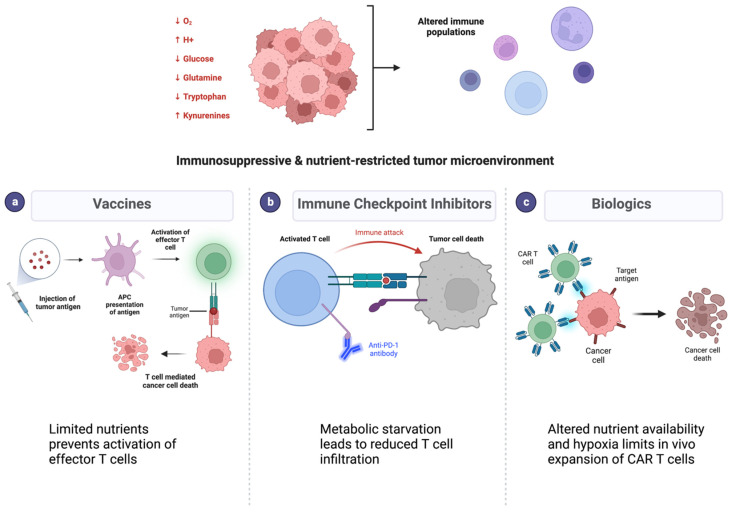
Immunosuppression and nutrient depletion in the tumor microenvironment limit efficacy of immunotherapies in glioblastoma. (Top) Cancer cell metabolism alters the pH, oxygen, and metabolite contents in the tumor microenvironment. (Bottom) Metabolic alterations result in resistance to different classes of immunotherapies such as vaccines (a), immune checkpoint inhibitors (b), and biologic therapies (c). Each of these mechanisms relies on an effective immune response which is diminished with metabolic alterations.

References

    1. Tan A.C., Ashley D.M., López G.Y., Malinzak M., Friedman H.S., Khasraw M. Management of glioblastoma: State of the art and future directions. CA Cancer J. Clin. 2020;70:299–312. doi: 10.3322/caac.21613. - DOI - PubMed
    1. Stupp R., Lukas R.V., Hegi M.E. Improving survival in molecularly selected glioblastoma. Lancet. 2019;393:615–617. doi: 10.1016/S0140-6736(18)33211-2. - DOI - PubMed
    1. Hanahan D., Weinberg R.A. Hallmarks of Cancer: The Next Generation. Cell. 2011;144:646–674. doi: 10.1016/j.cell.2011.02.013. - DOI - PubMed
    1. Yu M.W., Quail D.F. Immunotherapy for Glioblastoma: Current Progress and Challenges. Front. Immunol. 2021;12:1637. doi: 10.3389/fimmu.2021.676301. - DOI - PMC - PubMed
    1. Bausart M., Préat V., Malfanti A. Immunotherapy for glioblastoma: The promise of combination strategies. J. Exp. Clin. Cancer Res. 2022;41:35. doi: 10.1186/s13046-022-02251-2. - DOI - PMC - PubMed

LinkOut - more resources