


Insights into the Chemical Composition and In Vitro Bioactive Properties of Mangosteen (Garcinia mangostana L.) Pericarp
- PMID: 36900511
- PMCID: PMC10000740
- DOI: 10.3390/foods12050994
Insights into the Chemical Composition and In Vitro Bioactive Properties of Mangosteen (Garcinia mangostana L.) Pericarp
Abstract
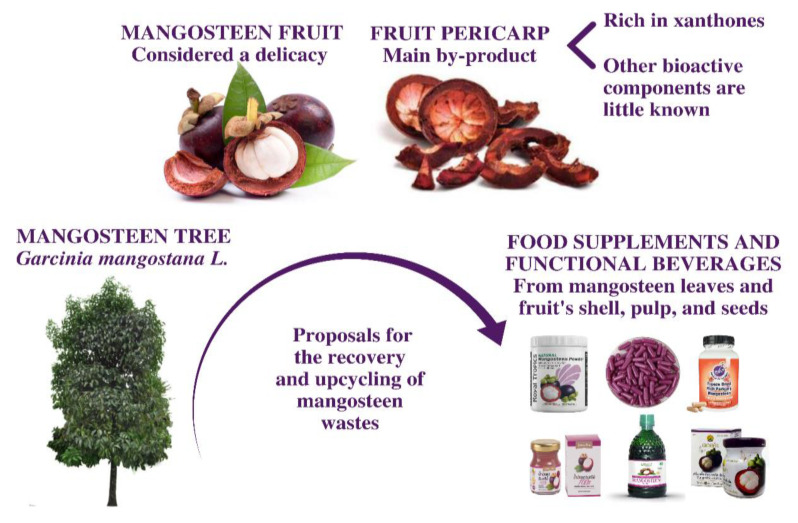
The industrial processing of mangosteen (Garcinia mangostana L.) generates high amounts of waste, as ~60% of the fruit is formed by an inedible pericarp. However, its pericarp has been explored as a source of xanthones; nevertheless, studies addressing the recovery of other chemical compounds from such biomass are still scarce. Hence, this study intended to elucidate the chemical composition of the mangosteen pericarp, including fat-soluble (tocopherols and fatty acids) and water-soluble (organic acids and phenolic compound non-xanthones) compounds present in the following extracts: hydroethanolic (MT80), ethanolic (MTE), and aqueous (MTW). In addition, the antioxidant, anti-inflammatory, antiproliferative and antibacterial potentials of the extracts were assessed. The mangosteen pericarp showed a composition with seven organic acids, three tocopherol isomers, four fatty acids and fifteen phenolic compounds. Regarding the extraction of phenolics, the MT80 was the most efficient (54 mg/g extract), followed by MTE (19.79 mg/g extract) and MTW (4.011 mg/g extract). All extracts showed antioxidant and antibacterial activities; however, MT80 and MTE extracts were more efficient than MTW. Only MTW did not show anti-inflammatory properties, whereas MTE and MT80 showed inhibitory activities towards tumor cell lines. Notwithstanding, MTE showed cytotoxicity towards normal cells. Our findings support the idea that the ripe mangosteen pericarp is a source of bioactive compounds, although their recovery is dependent on the extraction solvent.
Keywords: antiproliferative activity; bioactive compounds; flavonoids; food supplement; food waste recovery.
Conflict of interest statement
The authors declare no conflict of interest.
Figures


References
-
- Pothitirat W., Chomnawang M.T., Supabphol R., Gritsanapan W. Comparison of Bioactive Compounds Content, Free Radical Scavenging and Anti-Acne Inducing Bacteria Activities of Extracts from the Mangosteen Fruit Rind at Two Stages of Maturity. Fitoterapia. 2009;80:442–447. doi: 10.1016/j.fitote.2009.06.005. - DOI - PubMed
-
- Yuvanatemiya V., Srean P., Klangbud W.K., Venkatachalam K., Wongsa J., Parametthanuwat T., Charoenphun N. A Review of the Influence of Various Extraction Techniques and the Biological Effects of the Xanthones from Mangosteen (Garcinia Mangostana L.) Pericarps. Molecules. 2022;27:8775. doi: 10.3390/molecules27248775. - DOI - PMC - PubMed
-
- Cho E.J., Park C.S., Bae H.J. Transformation of Cheaper Mangosteen Pericarp Waste into Bioethanol and Chemicals. J. Chem. Technol. Biotechnol. 2020;95:348–355. doi: 10.1002/jctb.5904. - DOI
LinkOut - more resources
Full Text Sources
