


Economic Analysis of Border Control Policies during COVID-19 Pandemic: A Modelling Study to Inform Cross-Border Travel Policy between Singapore and Thailand
- PMID: 36901023
- PMCID: PMC10001629
- DOI: 10.3390/ijerph20054011
Economic Analysis of Border Control Policies during COVID-19 Pandemic: A Modelling Study to Inform Cross-Border Travel Policy between Singapore and Thailand
Abstract
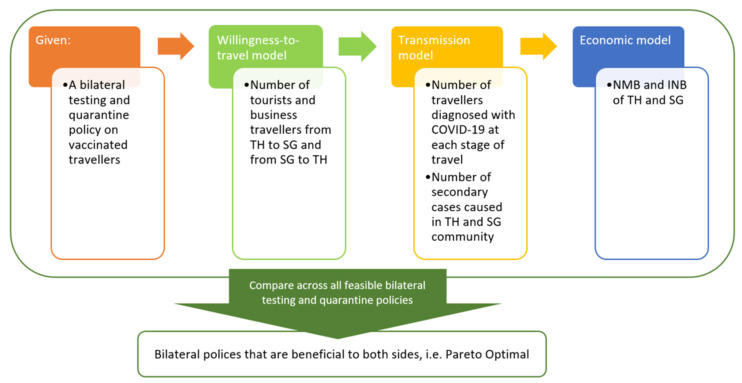
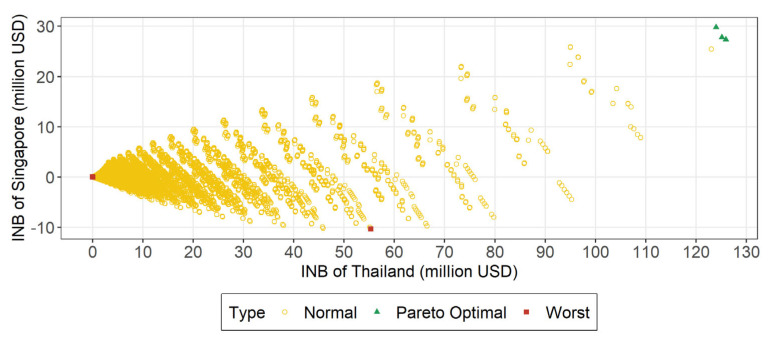
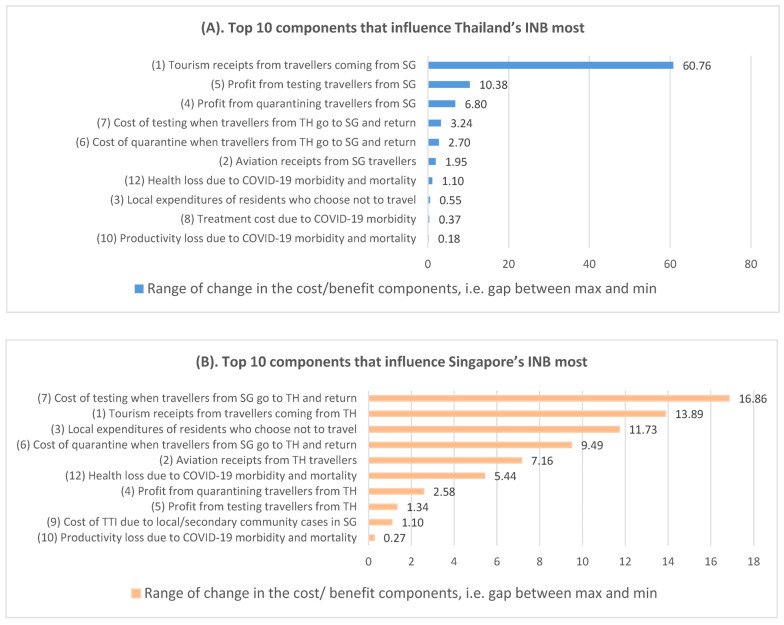
With countries progressing towards high COVID-19 vaccination rates, strategies for border reopening are required. This study focuses on Thailand and Singapore, two countries that share significant tourism visitation, to illustrate a framework for optimizing COVID-19 testing and quarantine policies for bilateral travel with a focus on economic recovery. The timeframe is the month of October 2021, when Thailand and Singapore were preparing to reopen borders for bilateral travel. This study was conducted to provide evidence for the border reopening policy decisions. Incremental net benefit (INB) compared to the pre-opening period was quantified through a willingness-to-travel model, a micro-simulation COVID-19 transmission model and an economic model accounting for medical and non-medical costs/benefits. Multiple testing and quarantine policies were examined, and Pareto optimal (PO) policies and the most influential components were identified. The highest possible INB for Thailand is US $125.94 million, under a PO policy with no quarantine but with antigen rapid tests (ARTs) pre-departure and upon arrival to enter both countries. The highest possible INB for Singapore is US $29.78 million, under another PO policy with no quarantine on both sides, no testing to enter Thailand, and ARTs pre-departure and upon arrival to enter Singapore. Tourism receipts and costs/profits of testing and quarantine have greater economic impacts than that from COVID-19 transmission. Provided healthcare systems have sufficient capacity, great economic benefits can be gained for both countries by relaxing border control measures.
Keywords: COVID-19; border-opening policy; economic evaluation; transmission; willingness to travel.
Conflict of interest statement
This study was commissioned by the Prime Minister of Thailand and financially supported by the National Research Council of Thailand. The sponsor was not involved in the study design, collection, analysis and interpretation of data, writing of the manuscript.
Figures
References
-
- World Bank International Tourism, Receipts (Current US$)—Thailand. 2022. [(accessed on 15 March 2022)]. Available online: https://data.worldbank.org/indicator/ST.INT.RCPT.CD?locations=TH.
-
- Singapore Toursim Board Tourism Sector Performance Q4 2019 Report. [(accessed on 15 March 2022)];2022 Available online: https://www.stb.gov.sg/content/dam/stb/documents/statistics-marketing-in....
-
- Thailand, I.B 2021. [(accessed on 1 October 2021)]; Available online: https://www.immigration.go.th/
-
- Board, S.T Tourism Receipts by Major Components. [(accessed on 1 March 2022)];2022 Available online: https://tablebuilder.singstat.gov.sg/table/TS/M550361.
-
- Lim C., McAleer M. Modelling International Travel Demand from Singapore to Australia. Anatolia. 2003;14:23–43. doi: 10.1080/13032917.2003.9687138. - DOI
Publication types
MeSH terms
Substances
LinkOut - more resources
Full Text Sources
Medical
