


Autogenic Training in Mental Disorders: What Can We Expect?
- PMID: 36901353
- PMCID: PMC10001593
- DOI: 10.3390/ijerph20054344
Autogenic Training in Mental Disorders: What Can We Expect?
Abstract
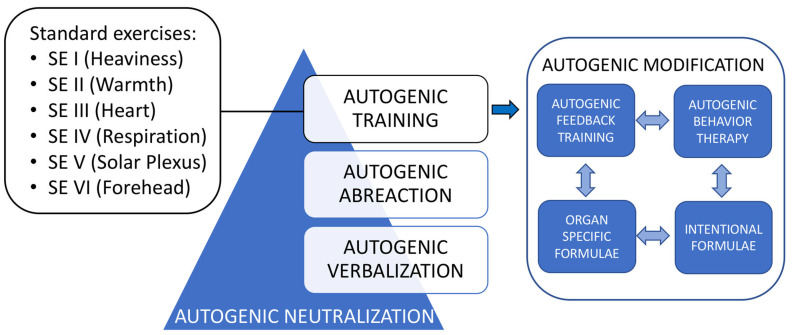
Autogenic training (AT) is a well-established self-induced relaxation technique based on autosuggestion. From the past two decades, an increasing number of AT studies strongly suggests the practical usefulness of psychophysiological relaxation in the area of medicine. Despite this interest, to date, limited critical clinical reflection on the application and effects of AT in mental disorders exists. The present paper reviews psychophysiological, psychopathological, and clinical aspects of AT in persons with mental disorders with emphasis on implications for future research and practice. Based on a formal literature search, 29 reported studies (7 meta-analyses/systematic reviews) were identified that examined the effects and impact of AT on mental disorders. The main psychophysiological effects of AT include autonomic cardiorespiratory changes paralleled by central nervous system activity modifications and psychological outputs. Studies demonstrate consistent efficacy of AT in reducing anxiety and medium range positive effects for mild-to-moderate depression. The impact on bipolar disorders, psychotic disorders, and acute stress disorder remains unexplored. As an add-on intervention psychotherapy technique with beneficial outcome on psychophysiological functioning, AT represents a promising avenue towards expanding research findings of brain-body links beyond the current limits of the prevention and clinical management of number of mental disorders.
Keywords: autogenic training; mental disorders; relaxation therapy.
Conflict of interest statement
Author D.B. is the owner of Crystal Comfort, LLC, a healthcare provider specializing in psychiatry, psychotherapy, and outpatient facilities that provided the APC funding. The APC funder was not involved in the study design, collection, analysis, interpretation of data, the writing of this article or the decision to submit it for publication. The remaining authors declare that the research was conducted in the absence of any commercial or financial relationships that could be construed as a potential conflict of interest.
Figures
References
-
- Schultz J.H. Das Autogene Training (Konzentrative Selbstentspannung) Georg Thieme Verlag Leipzig; Leipzig, Germany: 1932. p. 305.
-
- Litwic-Kaminska K., Kotyśko M., Pracki T., Wiłkość-Dębczyńska M., Stankiewicz B. The Effect of Autogenic Training in a Form of Audio Recording on Sleep Quality and Physiological Stress Reactions of University Athletes-Pilot Study. Int. J. Environ. Res. Public Health. 2022;19:16043. doi: 10.3390/ijerph192316043. - DOI - PMC - PubMed
-
- Luthe W., Schultz J.H. Autogenic Therapy: Medical Applications. Grune and Stratton; New York, NY, USA: 1970.
-
- Luthe W. About the Methods of Autogenic Therapy. In: Peper E., Ancoli S., Quinn M., editors. Mind/Body Integration. Springer; Boston, MA, USA: 1979.
Publication types
MeSH terms
LinkOut - more resources
Full Text Sources
Medical
Research Materials
Miscellaneous
