


Cholesterol Remnants, Triglyceride-Rich Lipoproteins and Cardiovascular Risk
- PMID: 36901696
- PMCID: PMC10002331
- DOI: 10.3390/ijms24054268
Cholesterol Remnants, Triglyceride-Rich Lipoproteins and Cardiovascular Risk
Abstract
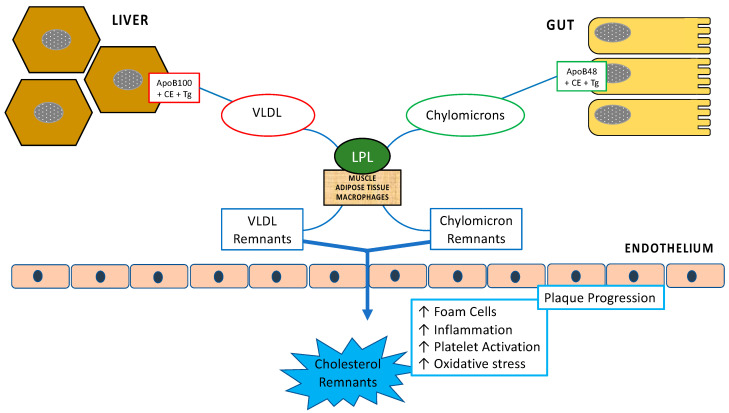
Randomized clinical trials with statins and other lipid-lowering drugs have shown the presence of a "residual cardiovascular risk" in those treated to "target" for LDL-cholesterol. This risk is mainly associated to lipid components other than LDL and in particular to remnant cholesterol (RC) and to lipoproteins rich in triglycerides in fasting and non-fasting conditions. During fasting, RCs correspond to the cholesterol content of the VLDL and their partially depleted triglyceride remnant containing apoB-100. Conversely, in non-fasting conditions, RCs include also cholesterol present in chylomicrons containing apoB-48. Therefore, RCs refer to total plasma cholesterol minus HDL-cholesterol and LDL-cholesterol, that is, all the cholesterol present in the VLDL, chylomicrons and in their remnants. A large body of experimental and clinical data suggests a major role of RCs in the development of atherosclerosis. In fact, RCs easily pass the arterial wall and bind to the connective matrix stimulating the progression of smooth muscle cells and the proliferation of resident macrophages. RCs are a causal risk factor for cardiovascular events. Fasting and non-fasting RCs are equivalent for predicting vascular events. Further studies on drugs effect on RC levels and clinical trials to evaluate the efficacy of RC reduction on cardiovascular events are needed.
Keywords: atherosclerosis; remnant cholesterol; residual cardiovascular risk; triglyceride-rich lipoprotein.
Conflict of interest statement
The authors declare no conflict of interest.
Figures
References
-
- Lawler P.R., Akinkuolie A.O., Chu A.Y., Shah S.H., Kraus W.E., Craig D., Padmanabhan L., Glynn R.J., Ridker P.M., Chasman D.I., et al. Atherogenic Lipoprotein Determinants of Cardiovascular Disease and Residual Risk Among Individuals With Low Low-Density Lipoprotein Cholesterol. J. Am. Heart Assoc. 2017;6:e005549. doi: 10.1161/JAHA.117.005549. - DOI - PMC - PubMed
-
- März W., Scharnagl H., Winkler K., Tiran A., Nauck M., Boehm B.O., Winkelmann B.R. Low-density lipoprotein triglycerides associated with low-grade systemic inflammation, adhesion molecules, and angiographic coronary artery disease: The Ludwigshafen Risk and Cardiovascular Health study. Circulation. 2004;110:3068–3074. doi: 10.1161/01.CIR.0000146898.06923.80. - DOI - PubMed
Publication types
MeSH terms
Substances
LinkOut - more resources
Full Text Sources
Miscellaneous
