Review
. 2023 Mar 1;24(5):4778.
doi: 10.3390/ijms24054778.

Toward the Development of Epigenome Editing-Based Therapeutics: Potentials and Challenges

Affiliations
Review

Toward the Development of Epigenome Editing-Based Therapeutics: Potentials and Challenges

Jun Ueda et al. Int J Mol Sci. .

Abstract

The advancement in epigenetics research over the past several decades has led to the potential application of epigenome-editing technologies for the treatment of various diseases. In particular, epigenome editing is potentially useful in the treatment of genetic and other related diseases, including rare imprinted diseases, as it can regulate the expression of the epigenome of the target region, and thereby the causative gene, with minimal or no modification of the genomic DNA. Various efforts are underway to successfully apply epigenome editing in vivo, such as improving target specificity, enzymatic activity, and drug delivery for the development of reliable therapeutics. In this review, we introduce the latest findings, summarize the current limitations and future challenges in the practical application of epigenome editing for disease therapy, and introduce important factors to consider, such as chromatin plasticity, for a more effective epigenome editing-based therapy.

Keywords: chromatin; chromatin plasticity; drug delivery; epigenetics; epigenome editing; in vivo.


Conflict of interest statement

The authors declare no conflict of interest.

Figures
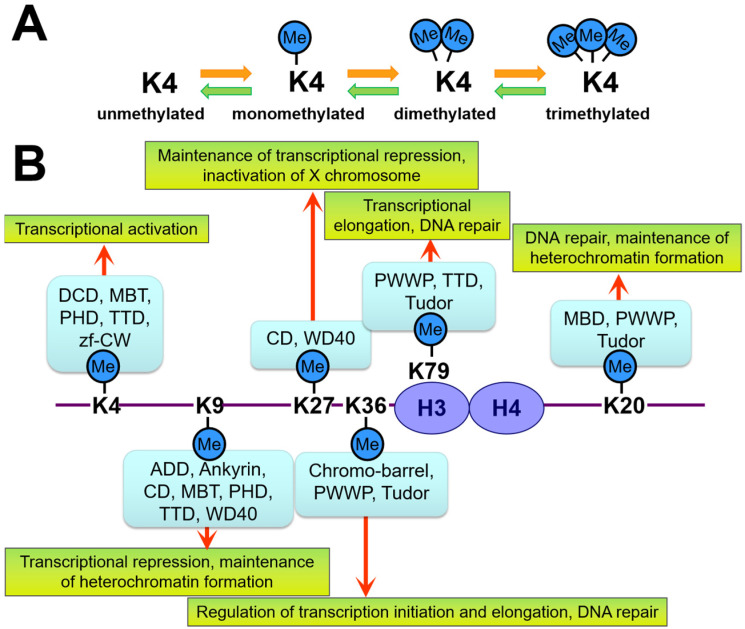
Figure 1
Figure 1
Schematic showing how lysine (K) methylation (Me) is recognized by different domains of “reader” proteins and their outcomes. (A) Each lysine residue on the histone can either be mono-, di-, or trimethylated. Each of these post-translational modifications is recognized by different “reader” proteins. (B) Methylation of lysine residues of H3 and H4 and the protein domains that recognize them. The binding proteins, and not histone modification, change the chromatin structure. ADD—Alpha-thalassemia intellectual disability syndrome X-linked (ATRX)-DNMT3-DNMT3L; CD—chromodomain; MBD—methyl-lysine-binding domain; MBT—malignant brain tumor; PHD—plant homeodomain; PWWP—conserved Pro-Trp-Trp-Pro motif; TTD—tandem Tudor domain; zf-CW—zinc-finger CW.
Figure 2
Figure 2
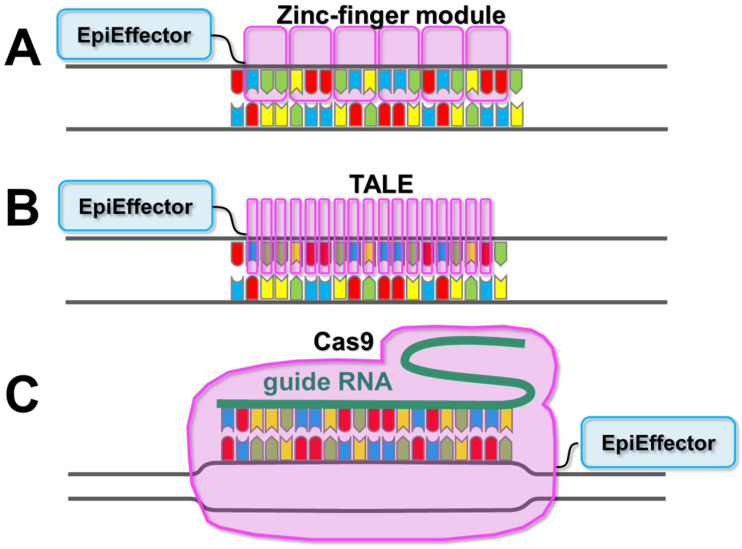
Schematic diagram of the DNA recognition domains available for epigenomic-modifying enzymes. (A) In zinc-finger arrays, each zinc-finger module recognizes three nucleotides. (B) In transcription activator-like effectors (TALEs), each repeat recognizes one nucleotide. (C) In clustered regulatory interspaced short palindromic repeats (CRISPR)/CRISPR-associated protein 9 (Cas9) (CRISPR/Cas9), one strand of the target site is recognized through Watson–Crick base pairing by a bound guide RNA. The attached effector domain (EpiEffector) is indicated by a blue shape. For details on EpiEffectors, please refer to Table 1 and earlier reviews [37,41,43,44,45].
Figure 3
Figure 3
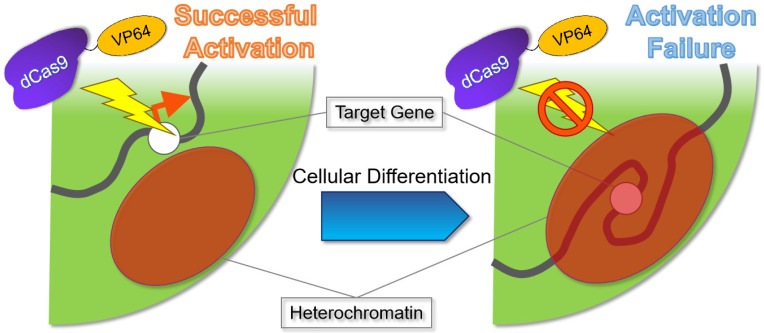
Schematic illustration of the importance of the chromatin structure in epigenome editing. During cell differentiation, the cell nucleus (light green) forms a heterochromatin (red) [137,138,141]. If the target gene is located within the heterochromatic region, it is inaccessible for expression (right panel). Dead Cas9 (dCas9)-four tandem repeats of the transcriptional activator VP16 (VP64) (dCas9-VP64) is shown as an example of an epigenomic-modifying enzyme.
Figure 4
Figure 4
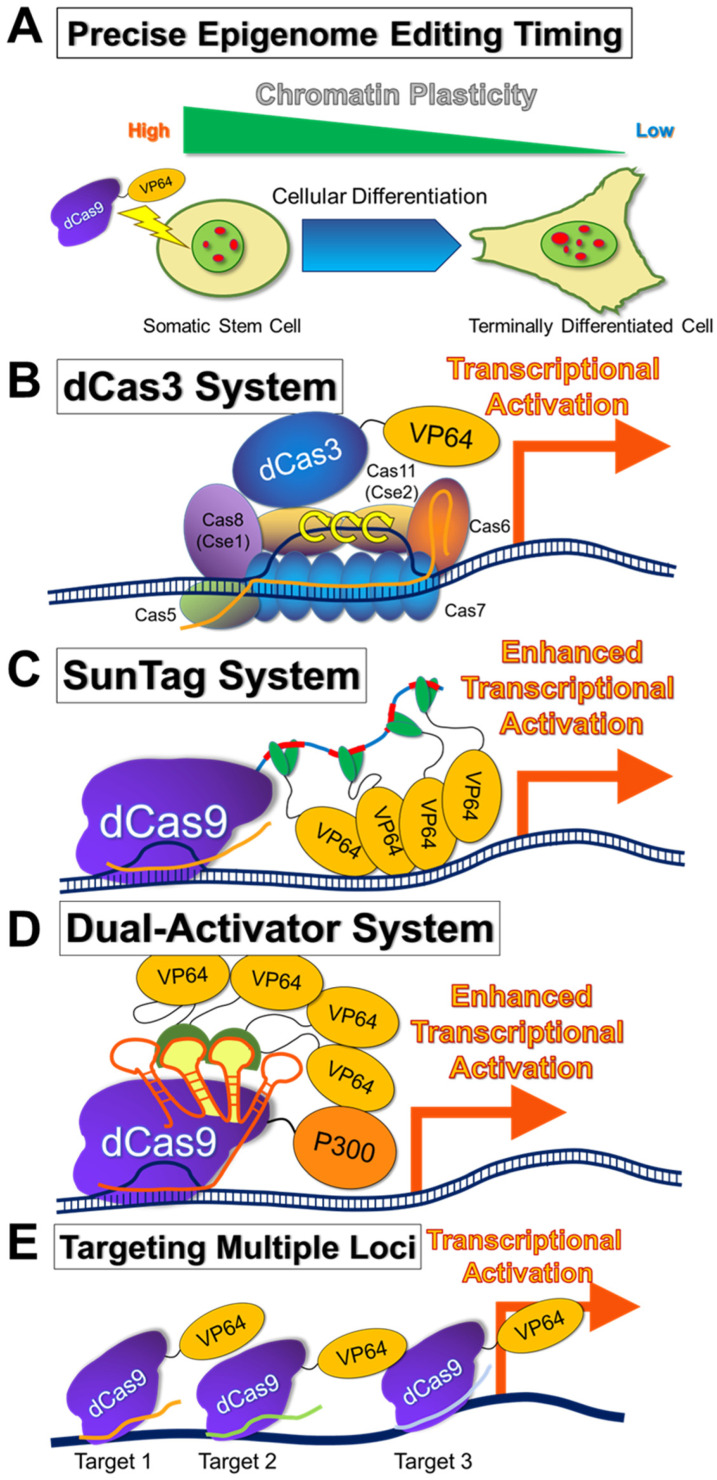
Strategies to improve therapeutic epigenome editing (A) Upon differentiation, the cell nuclei (light green) lose chromatin plasticity through forming heterochromatin structures (red dots) [137,141]. Chromatin plasticity must be considered for more effective and efficient epigenome editing. (B) Type I-E CRISPR effector is composed of CRISPR RNA (crRNA), Cas3 (possesses helicase and nuclease activity), and a large Cascade complex, which contains Cas5, Cas6, multiple Cas7, Cas8 (Cse1), recognizing the protospacer adjacent motif (PAM), and two Cas11 (Cse2) [131,133]. Although the dead Cas3 (dCas3) complex has not been used for epigenome editing, it would be important to determine its effect on epigenome editing. VP64 is shown as an example of the EpiEffector. (C) A scheme for CRISPR–dCas9 and a peptide repeat-based amplification of transcriptional activity using VP64 as an example of a SUperNova tag (SunTag) system. dCas9 fused with a peptide repeat can recruit multiple copies of single-chain fragment variable (scFv)-fused VP64 antibody [115]. Thus, multiple copies of VP64 can activate the target gene more efficiently. (D) A scheme for amplification of transcriptional activity using the dual-activator enCRISPRa system. P300 and VP64 are shown as examples of transcriptional activation EpiEffectors. VP64 is fused with MS2 coat protein (MCP), and MCP-VP64 fusion protein binds to MS2 hairpins within the single guide RNA (sgRNA) [54,115]. P300 and VP64 act synergistically to activate the target gene. CRISPRon and CRISPRoff (not shown in the figure; single artificial genes containing multiple EpiEffectors together with dCas9) are similar systems in which multiple EpiEffectors are simultaneously expressed to activate or repress a target gene [70]. (E) Targeting multiple loci within the target gene using epigenomic-modifying enzymes is a simple approach to effectively modulate the epigenome [98,99]. Three dCas9-VP64 targeting three different loci are shown as examples.

References

    1. Jinek M., Chylinski K., Fonfara I., Hauer M., Doudna J.A., Charpentier E. A programmable dual-RNA-guided DNA endonuclease in adaptive bacterial immunity. Science. 2012;337:816–821. doi: 10.1126/science.1225829. - DOI - PMC - PubMed
    1. Doyon Y., McCammon J.M., Miller J.C., Faraji F., Ngo C., Katibah G.E., Amora R., Hocking T.D., Zhang L., Rebar E.J., et al. Heritable targeted gene disruption in zebrafish using designed zinc-finger nucleases. Nat. Biotechnol. 2008;26:702–708. doi: 10.1038/nbt1409. - DOI - PMC - PubMed
    1. Urnov F.D., Rebar E.J., Holmes M.C., Zhang H.S., Gregory P.D. Genome editing with engineered zinc finger nucleases. Nat. Rev. Genet. 2010;11:636–646. doi: 10.1038/nrg2842. - DOI - PubMed
    1. Huang P., Xiao A., Zhou M., Zhu Z., Lin S., Zhang B. Heritable gene targeting in zebrafish using customized TALENs. Nat. Biotechnol. 2011;29:699–700. doi: 10.1038/nbt.1939. - DOI - PubMed
    1. Joung J.K., Sander J.D. TALENs: A widely applicable technology for targeted genome editing. Nat. Rev. Mol. Cell Biol. 2013;14:49–55. doi: 10.1038/nrm3486. - DOI - PMC - PubMed

LinkOut - more resources