Review
. 2023 Mar 5;24(5):4997.
doi: 10.3390/ijms24054997.

Microbiota-Derived Natural Products Targeting Cancer Stem Cells: Inside the Gut Pharma Factory

Affiliations
Review

Microbiota-Derived Natural Products Targeting Cancer Stem Cells: Inside the Gut Pharma Factory

Valentina Artusa et al. Int J Mol Sci. .

Abstract

Cancer stem cells (CSCs) have drawn much attention as important tumour-initiating cells that may also be crucial for recurrence after chemotherapy. Although the activity of CSCs in various forms of cancer is complex and yet to be fully elucidated, opportunities for therapies targeting CSCs exist. CSCs are molecularly distinct from bulk tumour cells, so they can be targeted by exploiting their signature molecular pathways. Inhibiting stemness has the potential to reduce the risk posed by CSCs by limiting or eliminating their capacity for tumorigenesis, proliferation, metastasis, and recurrence. Here, we briefly described the role of CSCs in tumour biology, the mechanisms involved in CSC therapy resistance, and the role of the gut microbiota in cancer development and treatment, to then review and discuss the current advances in the discovery of microbiota-derived natural compounds targeting CSCs. Collectively, our overview suggests that dietary intervention, toward the production of those identified microbial metabolites capable of suppressing CSC properties, is a promising approach to support standard chemotherapy.

Keywords: bioactive compounds; cancer stem cells (CSCs); drug resistance; gut microbiota; microbiota-derived metabolites; natural products.


Conflict of interest statement

The authors declare no potential conflicts of interest with respect to the research, authorship, and/or publication of this article.

Figures
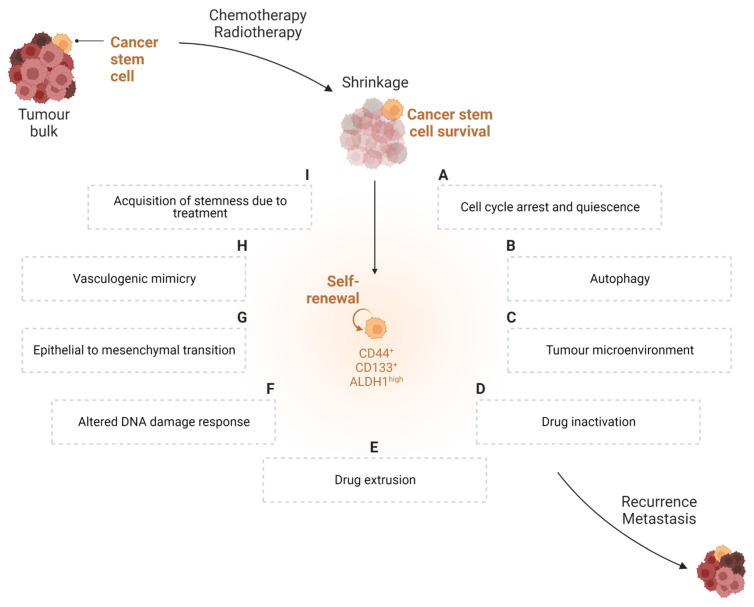
Figure 1
Figure 1
Schematic representation of the different mechanisms applied by CSCs to escape cancer therapy. A small number of cancer cells, known as cancer stem cells (CSCs), have a significant role in the failure of cancer treatment. Despite chemotherapy successfully eliminating a significant amount of the tumour bulk, the main factor for tumour recurrence and metastasis is the existence of CSCs that are resistant to chemotherapy and can regenerate themselves. CSC-mediated therapy resistance appears to be attributed to different mechanisms: cell cycle arrest and quiescence (A), autophagy (B), interactions with the tumour microenvironment (C), drug inactivation (D) and extrusion (E), alteration of the DNA damage response (F), epithelial-to-mesenchymal transition (G), and vasculogenic mimicry (H). Moreover, stemness-related therapy resistance could be induced by cancer treatment itself (I).
Figure 2
Figure 2
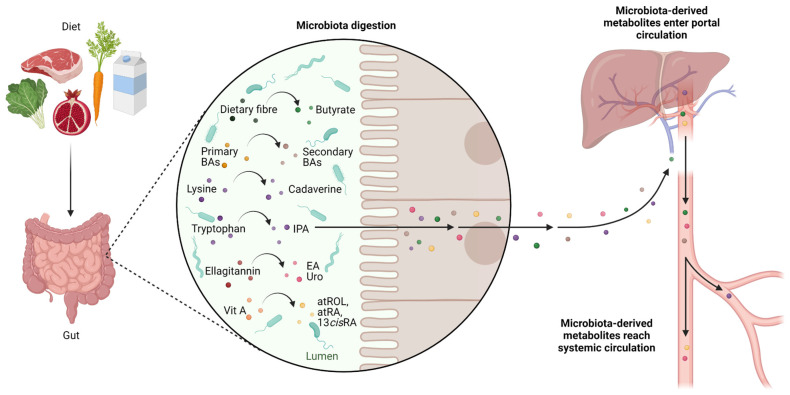
Schematic representation of the metabolites produced via microbiota digestion of dietary compounds that have the potential to target CSCs. The gut microbiota plays a role in digestion by metabolising indigestible macronutrients. The host’s metabolic capability is increased by the large enzymatic repertoire of the microbial population, which integrates the function of mammalian enzymes and allows the host to metabolise a variety of food substrates. Numerous bacterial metabolites are produced by the intestinal microbiota’s metabolic activities toward the available substrates and may accumulate in the lumen. Microbiota-derived metabolites possess enhanced or even different bioactivities compared to their parental compounds. Moreover, they can access circulation and potentially diffuse systemically. Specific products of microbial digestion, highlighted in the zoomed callout, have been found to target CSC features. BAs, biliary acids; IPA, indolepropionic acid; EA, ellagic acid; Uro, urolithins; atROL, all-trans-retinol; atRA, all-trans retinoic acid; 13cisRA, 13-cis-retinoic acid.

References

    1. Baudino T.A. Targeted Cancer Therapy: The Next Generation of Cancer Treatment. Curr. Drug Discov. Technol. 2015;12:3–20. doi: 10.2174/1570163812666150602144310. - DOI - PubMed
    1. Waldman A.D., Fritz J.M., Lenardo M.J. A Guide to Cancer Immunotherapy: From T Cell Basic Science to Clinical Practice. Nat. Rev. Immunol. 2020;20:651–668. doi: 10.1038/s41577-020-0306-5. - DOI - PMC - PubMed
    1. Baldo B.A., Pagani M. Adverse Events to Nontargeted and Targeted Chemotherapeutic Agents: Emphasis on Hypersensitivity Responses. Immunol. Allergy Clin. N. Am. 2014;34:565–596, viii. doi: 10.1016/j.iac.2014.04.003. - DOI - PubMed
    1. Carvalho A., Fernandes A.R., Baptista P.V. Applications of Targeted Nano Drugs and Delivery Systems. Elsevier; Amsterdam, The Netherlands: 2019. Nanoparticles as Delivery Systems in Cancer Therapy; pp. 257–295.
    1. Chang J.C. Cancer Stem Cells: Role in Tumor Growth, Recurrence, Metastasis, and Treatment Resistance. Medicine. 2016;95:S20–S25. doi: 10.1097/MD.0000000000004766. - DOI - PMC - PubMed

Substances