


Increasing Number of Cases Due to Candida auris in North Italy, July 2019-December 2022
- PMID: 36902700
- PMCID: PMC10003924
- DOI: 10.3390/jcm12051912
Increasing Number of Cases Due to Candida auris in North Italy, July 2019-December 2022
Abstract
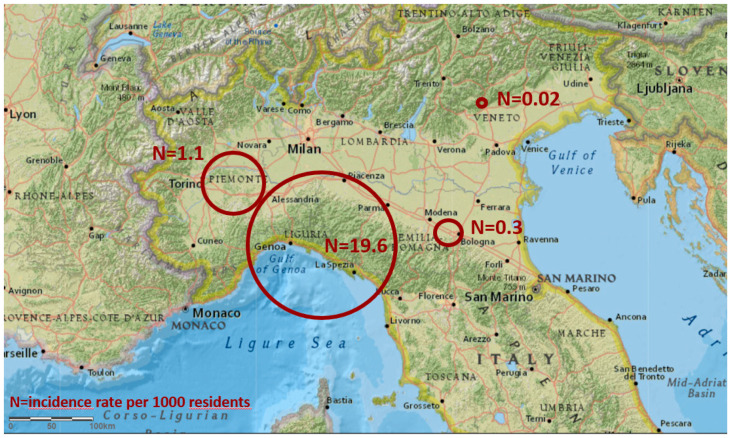
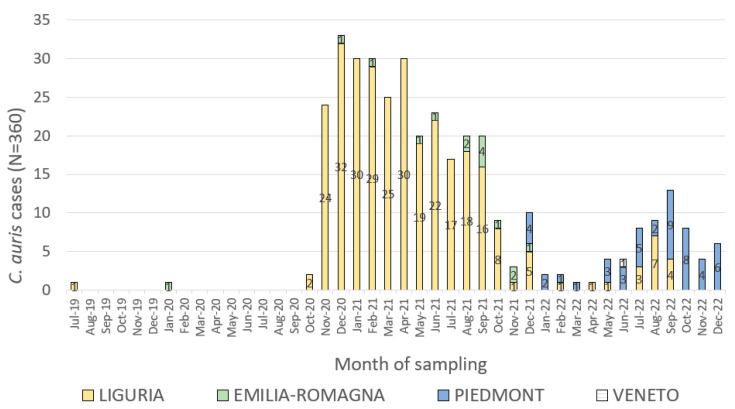
Candida auris is an emerging fungus that represents a serious health threat globally. In Italy, the first case was detected in July 2019. Then, one case was reported to the Ministry of Health (MoH) on January 2020. Nine months later, a huge number of cases were reported in northern Italy. Overall, 361 cases were detected in 17 healthcare facilities between July 2019 and December 2022 in the Liguria, Piedmont, Emilia-Romagna, and Veneto regions, including 146 (40.4%) deaths. The majority of cases (91.8%) were considered as colonised. Only one had a history of travel abroad. Microbiological data on seven isolates showed that all but one strain (85.7%) were resistant to fluconazole. All the environmental samples tested negative. Weekly screening of contacts was performed by the healthcare facilities. Infection prevention and control (IPC) measures were applied locally. The MoH nominated a National Reference Laboratory to characterise C. auris isolates and store the strains. In 2021, Italy posted two messages through the Epidemic Intelligence Information System (EPIS) to inform on the cases. On February 2022, a rapid risk assessment indicated a high risk for further spread within Italy, but a low risk of spread to other countries.
Keywords: Candida auris; Italy; epidemic; epidemiology; healthcare-associated infections; outbreak.
Conflict of interest statement
The authors declare no conflict of interest.
Figures
References
-
- Centers for Disease Control and Prevention Tracking Candida Auris. [(accessed on 1 December 2022)]; Available online: https://www.cdc.gov/fungal/candida-auris/tracking-c-auris.html.
-
- OECD. ECDC. EFSA. EMA Antimicrobial Resistance in the EU/EEA: A One Health Response. 2022. [(accessed on 1 December 2022)]. Available online: https://www.ecdc.europa.eu/sites/default/files/documents/antimicrobial-r....
LinkOut - more resources
Full Text Sources
