


Eating Vegetables First Regardless of Eating Speed Has a Significant Reducing Effect on Postprandial Blood Glucose and Insulin in Young Healthy Women: Randomized Controlled Cross-Over Study
- PMID: 36904173
- PMCID: PMC10005673
- DOI: 10.3390/nu15051174
Eating Vegetables First Regardless of Eating Speed Has a Significant Reducing Effect on Postprandial Blood Glucose and Insulin in Young Healthy Women: Randomized Controlled Cross-Over Study
Abstract
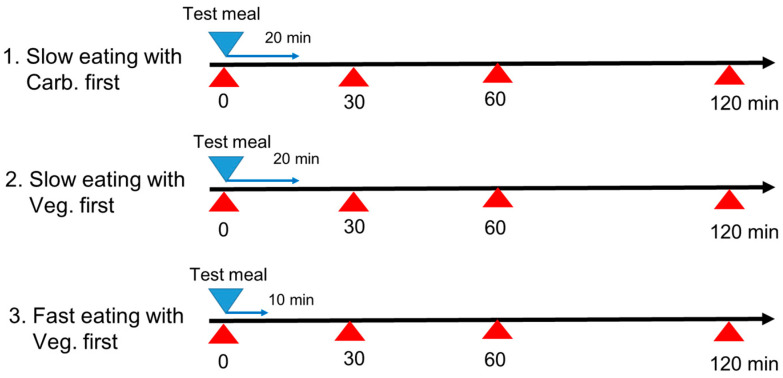
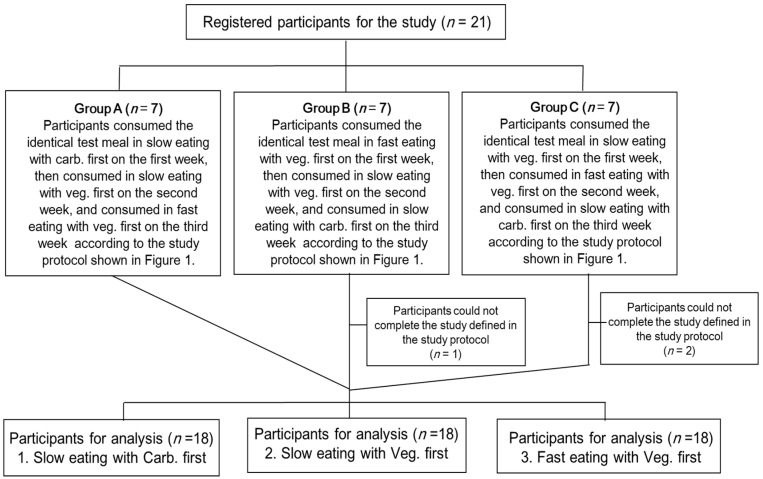
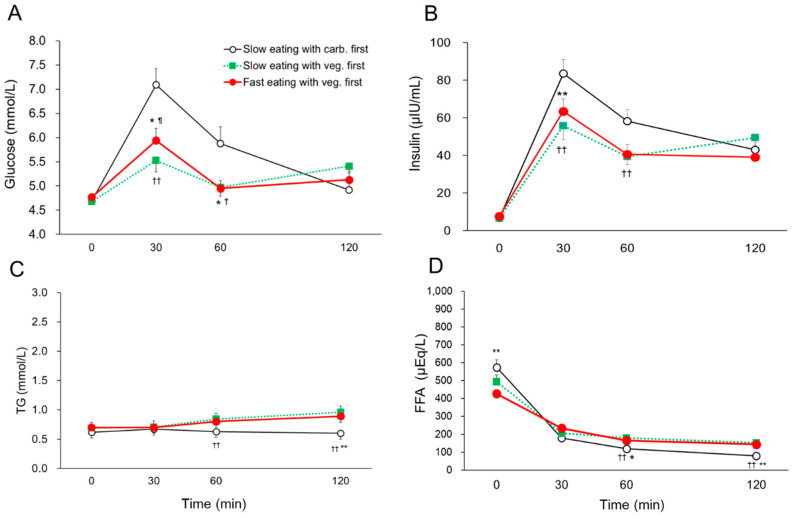
People with fast eating habits have been reported to have an increased risk of diabetes and obesity. To explore whether the speed of eating a test meal (tomato, broccoli, fried fish, and boiled white rice) influences postprandial blood glucose, insulin, triglyceride, and free fatty acid levels, 18 young, healthy women consumed a 671 kcal breakfast at fast speed (10 min) and slow speed (20 min) with vegetables first and slow speed (20 min) with carbohydrate first on three separate days. This study was conducted using a within-participants cross-over design in which all participants consumed identical meals of three different eating speeds and food orders. Significant ameliorations of both fast and slow eating with vegetables first regimen on postprandial blood glucose and insulin levels at 30 and 60 min were observed compared with those of slow eating with carbohydrates first. In addition, the standard deviation, large amplitude of excursion, and incremental area under the curve for blood glucose and insulin in both fast and slow eating with vegetables first were all significantly lower than those of slow eating with carbohydrate first. Interestingly, there was no significant difference between fast and slow eating on postprandial blood glucose and insulin levels as long as vegetables were consumed first, although postprandial blood glucose at 30 min was significantly lower in slow eating with vegetables first than that of fast eating with the same food order. These results suggest that food order with vegetables first and carbohydrate last ameliorates postprandial blood glucose and insulin concentrations even if the meal was consumed at fast speed.
Keywords: carbohydrate; diet; eating speed; food order; insulin; postprandial blood glucose; type 2 diabetes; vegetable.
Conflict of interest statement
Potential conflicts of interest were follows: Y.H. reports grants from Asahi Kasei Pharma and personal fees from Mitsubishi Tanabe Pharma Corp., Novo Nordisk Pharma Ltd., Sanofi K.K., and Daiichi Sankyo Co. Ltd. outside the submitted work. M.F. received grants from Takeda Pharma Co. Ltd., Sanofi K.K., Kissei Phama Co. Ltd., Mitsubishi Tanabe Pharma Corp, Astellas Pharma Inc., Nippon Boehringer Ingelheim Co. Ltd., Daiichi Sankyo Co. Ltd., MSD K.K., Sanwa Kagagu Kenkyusho CO., LtD., Kowa Pharma Co. Ltd., Kyowa Kirin Co., Ltd., Sumitomo Dainippon Pharma Co., Ltd., Novo Nordisk Pharma Ltd., Ono Pharma Co. Ltd., Eli Lilly Japan K.K., Taisho Pharma Co., Ltd., Tejin Pharma LtD., Nippon Chemiphar Co., Ltd., Johnson & Johnson k.k. Medical Co., Abbott japan Co. Ltd., and Terumo Corp., and personal fees from Teijin Pharma Ltd., Arkray Inc., Kissei Pharma Co., Ltd., Novo Nordisk Pharma Ltd., Mitsubishi Tanabe Pharma Corp., Sanofi K.K., Takeda Pharma Co. Ltd., Astellas Pharma Inc., MSD K.K., Kyowa Kirin Co. Ltd., Sumitomo Dainippon Pharma Co. Ltd., Daiichi Sankyo Co. Ltd., Kowa Pharma Co. Ltd., Ono Pharma Co. Ltd., Sanwa Kagaku Kenkyusho Co. Ltd., Nippon Boehringer Ingelheim Co., Ltd., Taisho Pharma Co., Ltd., Bayer Yakuhin, Ltd., AstraZeneca K.K., Mochida Pharma Co. Ltd., Abbott japan Co. Ltd., Eli Lilly Japan K.K., Medtronic Japan Co. Ltd., and Nipro Corp. outside the submitted work. The sponsors were not involved in the study design; in the collection, analysis, interpretation of data; in the writing of this manuscript; or in the decision to submit the article for publication. The authors, their immediate families, and any research foundations with which they are affiliated have not received any financial payments or other benefits from any commercial entity related to the subject of this article. The authors declare that although they are affiliated with a department that is supported financially by a pharmaceutical company, the authors received no current funding for this study and this does not alter their adherence to all the journal policies on sharing data and materials. The other authors have nothing to disclose.
Figures
References
-
- IDF Diabetes Atlas . IDF Diabetes Atlas. 10th ed. International Diabetes Federation; Brussels, Belgium: 2022. [(accessed on 5 January 2023)]. Available online: https://diabetesatlas.org/
-
- Powers A.C., Stafford J.M., Rickels M.R. Chapter 398, Diabetes mellitus: Complications. In: Jameson J.L., Fauci A.S., Kasper D.L., Hauser S.L., Longo D.L., Loscalzo J., editors. Harrison's Principles of Internal Medicine. 20th ed. McGraw-Hill Education; New York, NY, USA: 2018. pp. 1–17.
-
- Davies M.J., D'Alessio F., Kernan W.N., Mathieu C., Mingrone G., Rossing P., Tsapas A., Wexler D.J., Buse J.B. Management of Hyperglycemia in type 2 diabetes, 2018. A consensus Report by the American Diabetes Association (ADA) and the European Association for the Study of diabetes (EASD) Diabetes Care. 2018;41:2669–2701. doi: 10.2337/dci18-0033. - DOI - PMC - PubMed
-
- Diabetes Control and Complications Trial Research Group. Nathan D.M., Genuth S., Lachin J., Cleary P., Crofford O., Davis M., Rand L., Siebert C. The effect of intensive treatment of diabetes on the development and progression of long-term complications in insulin-dependent diabetes mellitus. N. Engl. J. Med. 1993;329:977–986. doi: 10.1056/NEJM199309303291401. - DOI - PubMed
Publication types
MeSH terms
Substances
Grants and funding
LinkOut - more resources
Full Text Sources
Medical
