


Dietary Sources of Anthocyanins and Their Association with Metabolome Biomarkers and Cardiometabolic Risk Factors in an Observational Study
- PMID: 36904207
- PMCID: PMC10005166
- DOI: 10.3390/nu15051208
Dietary Sources of Anthocyanins and Their Association with Metabolome Biomarkers and Cardiometabolic Risk Factors in an Observational Study
Abstract
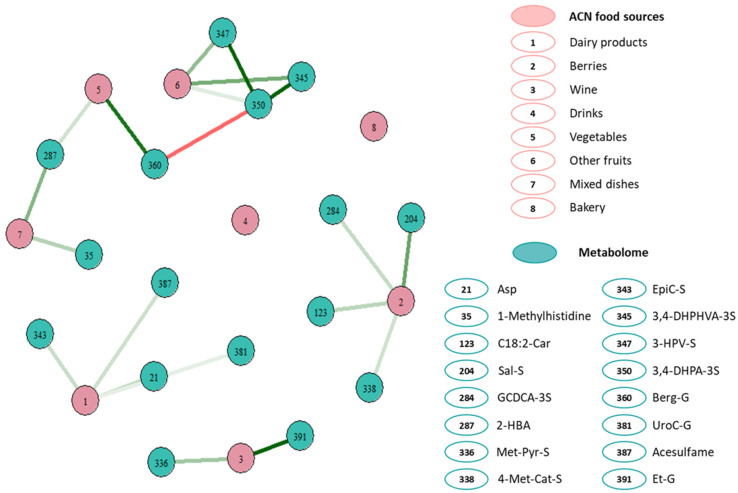
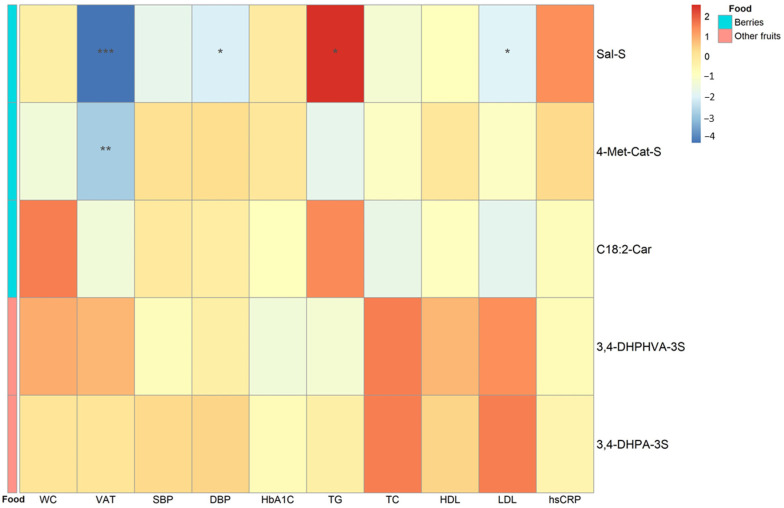
Anthocyanins (ACNs) are (poly)phenols associated with reduced cardiometabolic risk. Associations between dietary intake, microbial metabolism, and cardiometabolic health benefits of ACNs have not been fully characterized. Our aims were to study the association between ACN intake, considering its dietary sources, and plasma metabolites, and to relate them with cardiometabolic risk factors in an observational study. A total of 1351 samples from 624 participants (55% female, mean age: 45 ± 12 years old) enrolled in the DCH-NG MAX study were studied using a targeted metabolomic analysis. Twenty-four-hour dietary recalls were used to collect dietary data at baseline, six, and twelve months. ACN content of foods was calculated using Phenol Explorer and foods were categorized into food groups. The median intake of total ACNs was 1.6mg/day. Using mixed graphical models, ACNs from different foods showed specific associations with plasma metabolome biomarkers. Combining these results with censored regression analysis, metabolites associated with ACNs intake were: salsolinol sulfate, 4-methylcatechol sulfate, linoleoyl carnitine, 3,4-dihydroxyphenylacetic acid, and one valerolactone. Salsolinol sulfate and 4-methylcatechol sulfate, both related to the intake of ACNs mainly from berries, were inversely associated with visceral adipose tissue. In conclusion, plasma metabolome biomarkers of dietary ACNs depended on the dietary source and some of them, such as salsolinol sulfate and 4-methylcatechol sulfate may link berry intake with cardiometabolic health benefits.
Keywords: anthocyanins; berries; cardiometabolic health; diet; food matrix; gut microbiota; metabolomics.
Conflict of interest statement
The authors declare no conflict of interest.
Figures
References
-
- Celli G.B., Tan C., Selig M.J., States U. Anthocyanidins and Anthocyanins. Encycl. Food Chem. 2017:218–223. doi: 10.1016/B978-0-08-100596-5.21780-0. - DOI
Publication types
MeSH terms
Substances
Grants and funding
- (Spain, PCIN-2017-076)/The DiGuMet project "Diet × gut microbiome-based metabotypes to determine cardio-metabolic risk and tailor intervention strategies for improved health" supported within the European Joint Programming Initiative "A Healthy Diet for a Healthy Life" (http://
- CB16/10/00269/CIBERFES, funded by the Instituto de Salud Carlos III and co-funded by the Eu-ropean Regional Development Fund's "Away to make Europe",
- 2017SGR1546/The Generalitat de Catalunya's Agency AGAUR
- grant nº 10619/The Danish Cancer Society, Knæk Cancer 2012 and Den A.P. Møllerske Støttefond
- DNR 2016-00314/FORMAS
- NA/The scholarship ajuts de personal investigador predoctoral en formació (APIF) from the Univer-sity of Barcelona
- 72200061/The Chilean government through the National Agency for Research and Development (ANID)/Food and Nutrition Doctoral Program/DOCTORADO BECAS CHILE/2019
- Program (CPII20/00009)/"Miguel Servet" from the Institute of Health Carlos III (co-funded by the European Social Fund (ESF) - ESF investing in your future)
- NA/The ICREA Academia Award 2018
- grant nr 2019-01264/Swedish Research Council (Discovery and validation of novel biomarkers of gut microbiota, diet and their interactions associated with type 2 diabetes risk)
