. 2023 Mar 3;23(5):2801.
doi: 10.3390/s23052801.

A New Generation of OPM for High Dynamic and Large Bandwidth MEG: The 4He OPMs-First Applications in Healthy Volunteers

Affiliations

A New Generation of OPM for High Dynamic and Large Bandwidth MEG: The 4He OPMs-First Applications in Healthy Volunteers

Tjerk P Gutteling et al. Sensors (Basel). .

Abstract

MagnetoEncephaloGraphy (MEG) provides a measure of electrical activity in the brain at a millisecond time scale. From these signals, one can non-invasively derive the dynamics of brain activity. Conventional MEG systems (SQUID-MEG) use very low temperatures to achieve the necessary sensitivity. This leads to severe experimental and economical limitations. A new generation of MEG sensors is emerging: the optically pumped magnetometers (OPM). In OPM, an atomic gas enclosed in a glass cell is traversed by a laser beam whose modulation depends on the local magnetic field. MAG4Health is developing OPMs using Helium gas (4He-OPM). They operate at room temperature with a large dynamic range and a large frequency bandwidth and output natively a 3D vectorial measure of the magnetic field. In this study, five 4He-OPMs were compared to a classical SQUID-MEG system in a group of 18 volunteers to evaluate their experimental performances. Considering that the 4He-OPMs operate at real room temperature and can be placed directly on the head, our assumption was that 4He-OPMs would provide a reliable recording of physiological magnetic brain activity. Indeed, the results showed that the 4He-OPMs showed very similar results to the classical SQUID-MEG system by taking advantage of a shorter distance to the brain, despite having a lower sensitivity.

Keywords: MEG; OPM; SQUID; atomic magnetometer; brain activity; helium OPM; neuroimaging.


Conflict of interest statement

The authors declare the following competing interests: M.L.P., A.P.-L. and E.L. hold founding equity in Mag4Health SAS, a French start-up company that is developing and commercializing MEG systems based on He-OPM technology. R.R. and S.M. are employees of Mag4Health SAS. Mag4Health SAS provided technical support to the data acquisition. For the recordings performed until 1 February 2022, S.M., A.P.-L. and E.L. were still employees of CEA LETI.

Figures

Figure A1
Figure A1
Individual averages of the somatosensory stimulation experiment, comparing SQUID-MEG and 4He-OPMs in radial and tangential direction for the sensors with the best SNR. Pearson product-moment correlations between SQUID-MEG and either radial 4He-OPMs (rradial) or tangential 4He-OPMs (rtangential). Amplification factors for SQUID-MEG and tangential 4He-OPM relative to radial 4He-OPM are indicated in the individual figure legends.
Figure A2
Figure A2
Individual averages of the visual stimulation experiment, comparing SQUID-MEG and 4He-OPMs in radial and tangential direction for the sensor with the best SNR. Pearson product-moment correlations between SQUID-MEG and either radial 4He-OPMs (rradial) or tangential 4He-OPMs (rtangential). Amplification factors for SQUID-MEG and tangential 4He-OPMs relative to radial 4He-OPMs are indicated in the individual figure legends.
Figure 1
Figure 1
Experimental setup. (A) SQUID-MEG system used in this study with the subject in a typical seated position. (B): Top left: Subject setup with the five 4He-OPMs used in the somatosensory task. One of them serving as a reference sensor (green label) is placed over the top of the head, and the four other ones are located on the left side of the subject. The cables are supported by a wooden frame. Top right: Same setup on a phantom head without the wooden frame. Bottom right: zoomed view of one of the 4He-OPMs used and zoomed view of the sensors installed in the headset. The sensor has a 2 cm by 2 cm by 5 cm footprint. The glass cell containing the sensitive helium gas and the associated Helmholtz coils are visible. (C) SQUID-MEG sensors layout with the sensors closest to the OPMs location in red for the somatosensory task and in blue for the visual task. (D) 4He-OPMs sensors layout in red for the somatosensory task and in blue for the visual task.
Figure 2
Figure 2
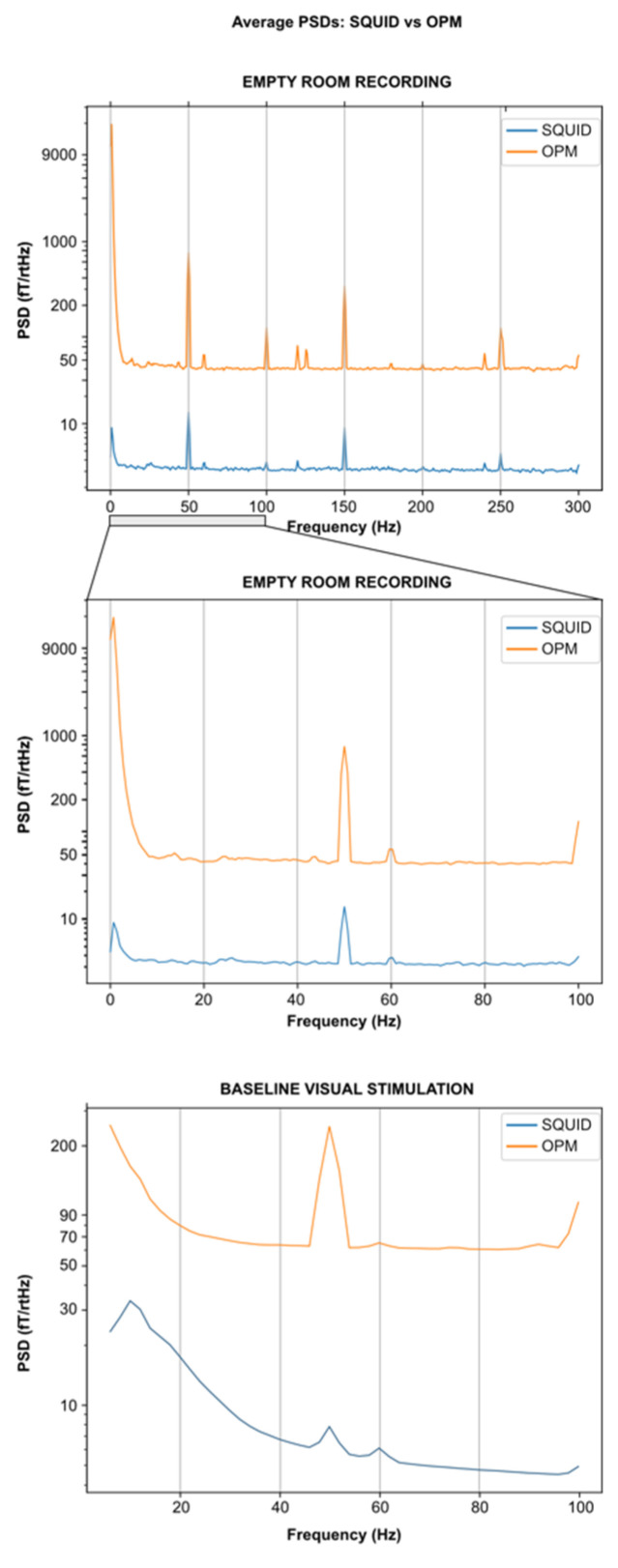
Empty room and visual task baseline average PSDs for SQUID-MEG and 4He-OPMs. Mean PSDs obtained after averaging PSDs over sessions and over all the sensors used in this study: SQUID-MEG: MLO31, MLO11, MRO21, MRO11, MLC11, MLC13, MLC33, MLC31 and 4He-OPMs: All 4 sensors except the reference with the two directions (radial and a tangential one) used in this study. No notch filters were applied for this figure. Top: Empty room full spectrum up to 300 Hz. Middle: Empty room spectrum zoomed up to 100 Hz. Bottom: Visual task baseline (500 ms) spectrum up to 100 Hz.
Figure 3
Figure 3
Event-related fields for SQUID-MEG (A), 4He-OPMs in the radial (B) and tangential axis (C). Gray-filled lines at the bottom of each panel represent the RMS of the combined signal. Gray vertical area denotes the suppressed stimulation artifact. Note that the scales for SQUID-MEG and 4He-OPMs are not the same.
Figure 4
Figure 4
Individual time-courses of best SNR sensors following somatosensory stimulation for SQUID-MEG, radial 4He-OPMs and tangential 4He-OPMs. For visualization only, a multiplication factor and polarity alignment are applied to the SQUID-MEG and tangential axis of the 4He-OPMs sensors with reference to the radial axis 4He-OPMs. The top three panels depict three representative subjects with varying degrees of correlation between SQUID-MEG and 4He-OPMs. The bottom panel shows the group average (n = 17).
Figure 5
Figure 5
Average signal-to-noise ratio per modality, sensor type and axis. Black horizontal bars denote the group means. Plots span the entire data range.
Figure 6
Figure 6
Group averaged event-related fields for conventional SQUID-MEG (A), 4He-OPMs in the radial (B) and tangential direction (C). Gray-filled lines at the bottom of each panel represent the RMS of the combined signal. Note that the scales for SQUID-MEG and 4He-OPMs are not the same.
Figure 7
Figure 7
Individual time-courses of best SNR sensors following visual stimulation for SQUID, 4He-OPMs radial and 4He-OPMs tangential sensors. For visualization only, a multiplication factor and polarity alignment are applied to the SQUID-MEG and tangential 4He-OPMs with reference to the radial 4He-OPM sensor. The top three panels depict three representative subjects with varying degrees of correspondence between SQUID-MEG and 4He-OPMs. The bottom panel shows the group average (n = 18).
Figure 8
Figure 8
Average signal-to-noise ratio per modality, sensor type and axis, calculated as the maximum absolute post-stimulus onset deflection [0 s, 0.3 s] divided by the standard error of the baseline [−0.2 s, 0 s]. Black horizontal bars denote the group means. Plots span the entire data range.
Figure 9
Figure 9
Group-average time-frequency representation of the visual experiment MEG data for the SQUID-MEG and 4He-OPM in the radial and tangential axes (A). Values denote the percent change relative to baseline [−0.4 s, 0 s]. Note that the scale is different between SQUID and 4He-OPMs sensors. Significant clusters (p < 0.05, two-tailed) are contained within areas marked in black. The onset of the visual stimulus was at t = 0. (B,C) depict time-frequency representations of two selected participants, one with a high individual gamma frequency (B) and a low to average frequency (C), in the gamma range for SQUID-MEG (left) and 4He-OPMs (radial axis, (middle)). Post-stimulus percent signal change [0.1 s, 0.4 s] is depicted on the (right) (scaling is adjusted for comparison).

References

    1. Baillet S. Magnetoencephalography for Brain Electrophysiology and Imaging. Nat. Neurosci. 2017;20:327–339. doi: 10.1038/nn.4504. - DOI - PubMed
    1. Cohen D. Magnetoencephalography: Detection of the Brain’s Electrical Activity with a Superconducting Magnetometer. Science. 1972;175:664–666. doi: 10.1126/science.175.4022.664. - DOI - PubMed
    1. Budker D., Romalis M.V. Optical Magnetometry. Nat. Phys. 2006;3:277. doi: 10.1038/nphys566. - DOI
    1. Iivanainen J., Stenroos M., Parkkonen L. Measuring MEG Closer to the Brain: Performance of on-Scalp Sensor Arrays. Neuroimage. 2017;147:542–553. doi: 10.1016/j.neuroimage.2016.12.048. - DOI - PMC - PubMed
    1. Boto E., Meyer S.S., Shah V., Alem O., Knappe S., Kruger P., Fromhold T.M., Lim M., Glover P.M., Morris P.G., et al. A New Generation of Magnetoencephalography: Room Temperature Measurements Using Optically-Pumped Magnetometers. Neuroimage. 2017;149:404–414. doi: 10.1016/j.neuroimage.2017.01.034. - DOI - PMC - PubMed