Review
. 2023 Mar 11;8(1):113.
doi: 10.1038/s41392-023-01383-x.

Tumor cell plasticity in targeted therapy-induced resistance: mechanisms and new strategies

Affiliations
Review

Tumor cell plasticity in targeted therapy-induced resistance: mechanisms and new strategies

Zhen-Duo Shi et al. Signal Transduct Target Ther. .

Abstract

Despite the success of targeted therapies in cancer treatment, therapy-induced resistance remains a major obstacle to a complete cure. Tumor cells evade treatments and relapse via phenotypic switching driven by intrinsic or induced cell plasticity. Several reversible mechanisms have been proposed to circumvent tumor cell plasticity, including epigenetic modifications, regulation of transcription factors, activation or suppression of key signaling pathways, as well as modification of the tumor environment. Epithelial-to-mesenchymal transition, tumor cell and cancer stem cell formation also serve as roads towards tumor cell plasticity. Corresponding treatment strategies have recently been developed that either target plasticity-related mechanisms or employ combination treatments. In this review, we delineate the formation of tumor cell plasticity and its manipulation of tumor evasion from targeted therapy. We discuss the non-genetic mechanisms of targeted drug-induced tumor cell plasticity in various types of tumors and provide insights into the contribution of tumor cell plasticity to acquired drug resistance. New therapeutic strategies such as inhibition or reversal of tumor cell plasticity are also presented. We also discuss the multitude of clinical trials that are ongoing worldwide with the intention of improving clinical outcomes. These advances provide a direction for developing novel therapeutic strategies and combination therapy regimens that target tumor cell plasticity.


Conflict of interest statement

The authors declare no competing interests.

Figures

Fig. 1
Fig. 1
Changes in acquired therapy resistance induced by treatment initiation and discontinuation, with different scenarios employed to interpret the development of the therapy-resistant phenotype. According to the Darwinian selection model, drug-tolerant persistors (DTPs) that originated from the primary tumor tissue are selected and enriched by treatments. The Lamarckian induction model regards the acquired drug-indifferent phenotype as the result of tumor cell adaptation to treatments that leads to formation of induced DTPs. The coexisting model suggests that formation of both primary and induced DTPs occur and together contribute to the acquired therapy resistance
Fig. 2
Fig. 2
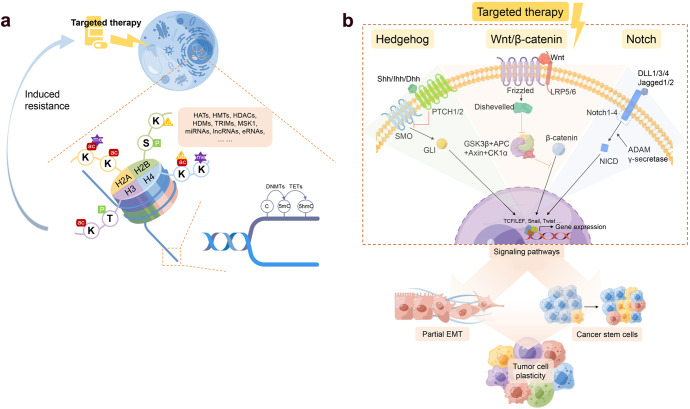
Therapeutic resistance involvement in epigenetic modifications and EMT/MET. a Schematic representation of therapy-induced drug resistance through chemical epigenetic modifications. Four core histone proteins (H2A, H2B, H3, and H4) can be diversely modified by multiple enzymes that result in methylation, acetylation, phosphorylation, or ubiquitylation. DNA can be methylated at the 5-carbon of the cytosine base to form 5-methylcytosine (5-mC), which can be further oxidized to form 5-hydroxymethyl cytosine (5-hmC). Enzymes involved in the epigenetic modifications of either histone or DNA can be utilized as potential future therapeutic targets against tumor cell plasticity. K, Lysine; S, Serine; R, Arginine; T, Threonine; me, methylation; ac, acetylation; ub, ubiquitination; P, phosphorylation; HAT, histone acetyltransferase; HMT, histone methyltransferase; HDAC, histone deacetylase; HDM, histone demethylase; TRIM, tripartite mortif; MSK1, mitogen- and stress-activated protein kinase 1; DNMT, DNA methyltransferase; TET, ten-eleven translocation enzymes. b Primary tumor cells undergo EMT and MET to achieve metastasis. Primary tumor cells undergo EMT by losing epithelial traits and acquiring mesenchymal characteristics, which enables tumor cells to migrate and invade into blood or lymphatic vessels. In circulation, tumor cells exhibit a “partial EMT” within the epithelial-mesenchymal spectrum. During colonization, migratory tumor cells with mesenchymal traits undergo MET to restore epithelial characteristics and proliferate to form a secondary tumor. Therapeutic resistance and invasiveness are higher in mesenchymal states, whereas a hybrid state of epithelial and mesenchymal indicates the highest level of stemness and capacity of self-adaptation. The process of EMT/MET is regulated by crosstalk among genomic factors, MET-TFs, and multiple signaling pathways. EM, epithelial-mesenchymal transition, MET mesenchymal-epithelial transition, TF transcription factor, miR microRNA
Fig. 3
Fig. 3
Mechanisms driving tumor cell plasticity and drug resistance. Both tumor microenvironment factors and EMT-related signaling pathways regulate the EMT process. The activation of EMT facilitates the dedifferentiation of non-cancer stem cells (CSCs) to CSC, which contributies to tumor heterogeneity
Fig. 4
Fig. 4
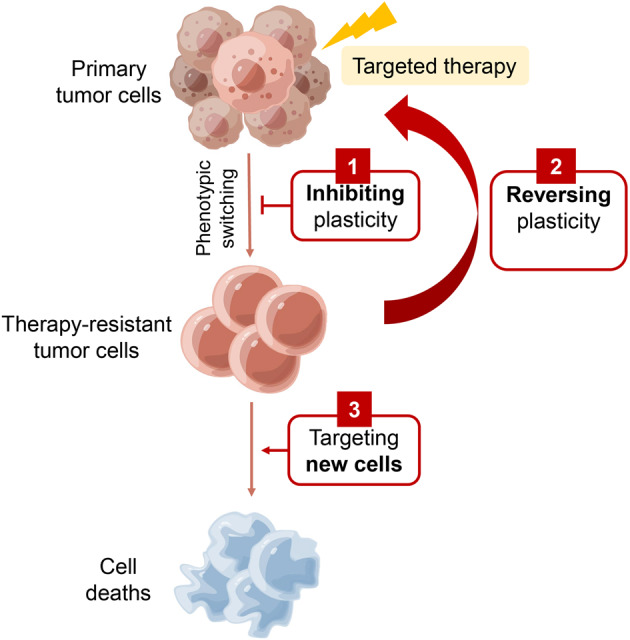
Therapeutic strategies targeting tumor cell plasticity. Three main strategies can be used in combination treatment against tumor cell plasticity: 1) prevent tumor cell plasticity; 2) reverse the phenotypic switching; and 3) direct therapy to target the induced therapy-resistant tumor cells
Fig. 5
Fig. 5
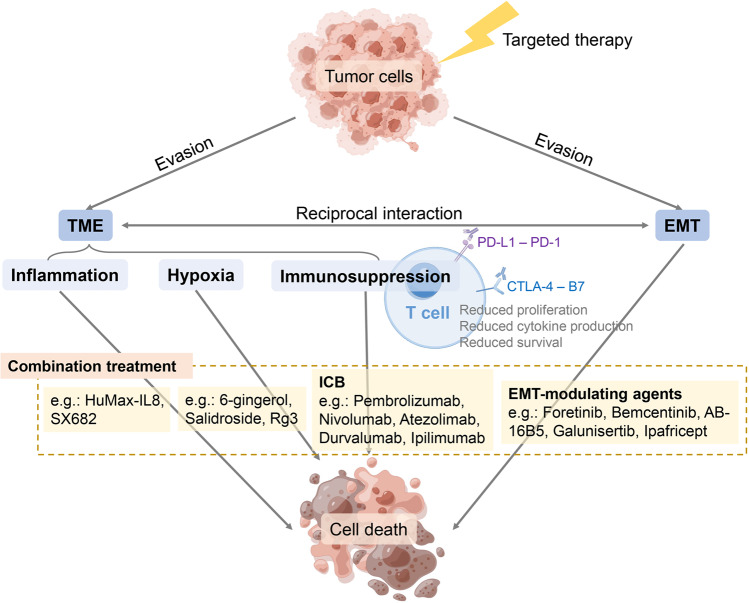
Combination treatments for overcoming the tumor cell plasticity induced-therapy resistance. Tumor cells evade targeted treatments by interacting with TME and via EMT programs. Inflammation, hypoxia, and immunosuppressive TME contribute to therapy evasion, and such induced-resistance could be inhibited by a combination treatment including anti-inflammation and anti-hypoxic drugs and immunosuppressive ICB regimens. EMT-modulating agents, on the other hand, could also deal with plasticity induced-therapy resistance as a combination treatment and lead to tumor cell death. TME tumor microenvironment, EMT epithelial-to-mesenchymal transition, ICB immune checkpoint blockade, Rg3 ginseng-extracted 20(R)-Ginsenoside

References

    1. Quintanal-Villalonga A, et al. Comprehensive molecular characterization of lung tumors implicates AKT and MYC signaling in adenocarcinoma to squamous cell transdifferentiation. J. Hematol. Oncol. 2021;14:170. doi: 10.1186/s13045-021-01186-z. - DOI - PMC - PubMed
    1. Paksa A, Rajagopal J. The epigenetic basis of cellular plasticity. Curr. Opin. Cell Biol. 2017;49:116–122. doi: 10.1016/j.ceb.2018.01.003. - DOI - PMC - PubMed
    1. Waddington CH. Embryology, epigenetics and biogenetics. Nature. 1956;177:1241–1241. doi: 10.1038/1771241a0. - DOI
    1. Tata PR, Rajagopal J. Cellular plasticity: 1712 to the present day. Curr. Opin. Cell Biol. 2016;43:46–54. doi: 10.1016/j.ceb.2016.07.005. - DOI - PMC - PubMed
    1. Castranova D, et al. Live Imaging of Intracranial Lymphatics in the Zebrafish. Circ. Res. 2021;128:42–58. doi: 10.1161/CIRCRESAHA.120.317372. - DOI - PMC - PubMed

Publication types