. 2023 Feb 22:17:1130505.
doi: 10.3389/fncel.2023.1130505. eCollection 2023.

The cerebellum and anxiety

Affiliations

The cerebellum and anxiety

Pei Wern Chin et al. Front Cell Neurosci. .

Abstract

Although the cerebellum is traditionally known for its role in motor functions, recent evidence points toward the additional involvement of the cerebellum in an array of non-motor functions. One such non-motor function is anxiety behavior: a series of recent studies now implicate the cerebellum in anxiety. Here, we review evidence regarding the possible role of the cerebellum in anxiety-ranging from clinical studies to experimental manipulation of neural activity-that collectively points toward a role for the cerebellum, and possibly a specific topographical locus within the cerebellum, as one of the orchestrators of anxiety responses.

Keywords: Purkinje cells; anxiety; cerebellum; molecular layer interneurons; neuromodulation.


Conflict of interest statement

The authors declare that the research was conducted in the absence of any commercial or financial relationships that could be construed as a potential conflict of interest.

Figures
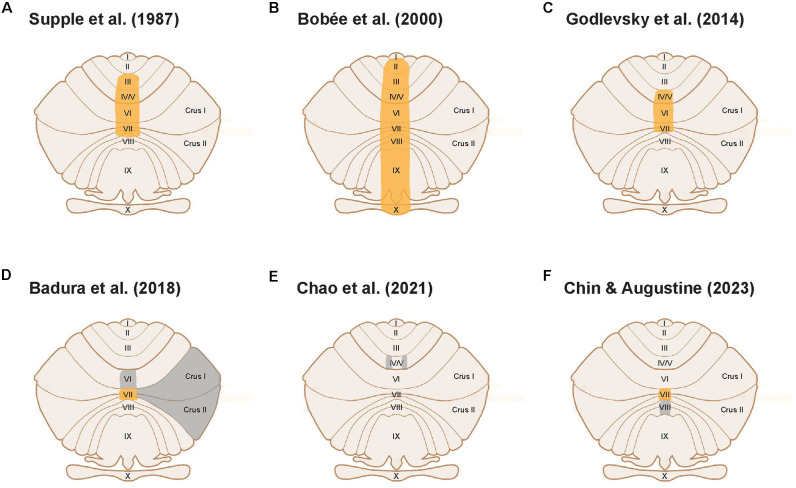
Figure 1
Figure 1
Cerebellar cortical areas experimentally tested for a functional role in anxiety behavior. Unfolded view of the cerebellar cortex illustrates cerebellar lobules. Orange areas indicate cerebellar lobules implicated in anxiety behavior; gray areas indicate cerebellar areas that were not implicated in anxiety behavior. (A–C) Large-scale lesion or electrical stimulation studies establishing a cerebellar role in anxiety. (D) Lobule VII modulates anxiety behavior, whereas lobules VI, Crus I, and II do not. (E) Areas within lobules IV/V do not affect anxiety behavior. (F) Lobule VII modulates anxiety while lobule VIII does not.
Figure 2
Figure 2
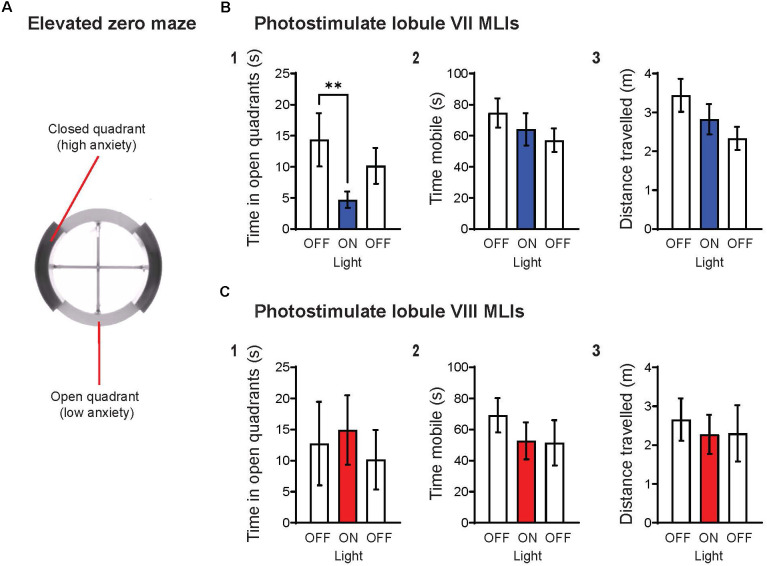
Optogenetic stimulation of MLIs in lobule VII, but not lobule VIII, increases anxiety levels. (A) Schematic representation of the elevated zero maze (EZM), consisting of two open quadrants (45 lux) and two closed quadrants (15 lux) enclosed by 14 cm high walls. The EZM has an outer diameter of 55 cm, a 6 cm-wide platform, and is elevated 60 cm off the floor. Animals were tested on the EZM for a total of 6 min, with three 2-min epochs OFF-ON-OFF, where light (470 nm, 11 mW/mm2, 10 Hz, 50% duty cycle) was delivered only during the “ON” epoch. Timed light delivery and behavioral tracking were performed using the ANY-maze software. Upon completion of experiments, histological confirmation of genotype and optical fiber placement were performed for all animals. Animals with indeterminate or incorrect placement of optical fiber were excluded from the analysis. (B) Photostimulation of lobule VII MLIs (1) significantly decreased time spent in open quadrants (p = 0.008**), yet had no effect on (2) mobility or (3) distance traveled. (C) Photostimulation of lobule VIII MLIs did not have any significant effects on the indicated behaviors. Wilcoxon signed rank test; lobule VII: n = 8; lobule VIII, n = 5. Data are mean ± SEM.

References

    1. Abela A. R., Browne C. J., Sargin D., Prevot T. D., Ji X. D., Li Z., et al. . (2020). Median raphe serotonin neurons promote anxiety-like behavior via inputs to the dorsal hippocampus. Neuropharmacology 168:107985. 10.1016/j.neuropharm.2020.107985 - DOI - PubMed
    1. American Psychiatric Association (2022). Diagnostic and Statistical Manual of Mental Disorders, Text Revision (DSM-5-TR). Washington, DC: American Psychiatric Association.
    1. Apps R., Hawkes R., Aoki S., Bengtsson F., Brown A. M., Chen G., et al. . (2018). Cerebellar modules and their role as operational cerebellar processing units. Cerebellum 17, 654–682. 10.1007/s12311-018-0952-3 - DOI - PMC - PubMed
    1. Asher M., Rosa J.-G., Cvetanovic M. (2021). Mood alterations in mouse models of spinocerebellar ataxia type 1. Sci. Rep. 11, 713–713. 10.1038/s41598-020-80664-9 - DOI - PMC - PubMed
    1. Badura A., Verpeut J. L., Metzger J. W., Pereira T. D., Pisano T. J., Deverett B., et al. . (2018). Normal cognitive and social development require posterior cerebellar activity. eLife 7:e36401. 10.7554/eLife.36401 - DOI - PMC - PubMed

LinkOut - more resources