Intraoperative prevention and conservative management of postoperative prolonged air leak after lung resection: a systematic review
- PMID: 36910073
- PMCID: PMC9992588
- DOI: 10.21037/jtd-22-736
Intraoperative prevention and conservative management of postoperative prolonged air leak after lung resection: a systematic review
Abstract
Background: Prolonged air leak (PAL) due to an alveolar-pleural fistula (APF) is the most common complication after lung surgery. PAL is associated with an increased risk of morbidity and mortality, a longer chest tube duration, hence a prolonged hospitalization. Management of PAL may be challenging, and the thoracic surgeon should be aware of the possible therapeutic strategies.
Methods: A systematic literature review was performed in PubMed, Cochrane Library, EMBASE, Ovid and Google Scholar. Title, abstract and full-text screening was performed, followed by structured data extraction, methodological quality assessment and Cochrane risk of bias assessment. Inclusion criteria were: case-control studies/randomized controlled trials (RCTs) comparing the new tested method with the standard of care to manage PAL after lung surgery; PAL due to APF; at least 10 patients; English-written papers.
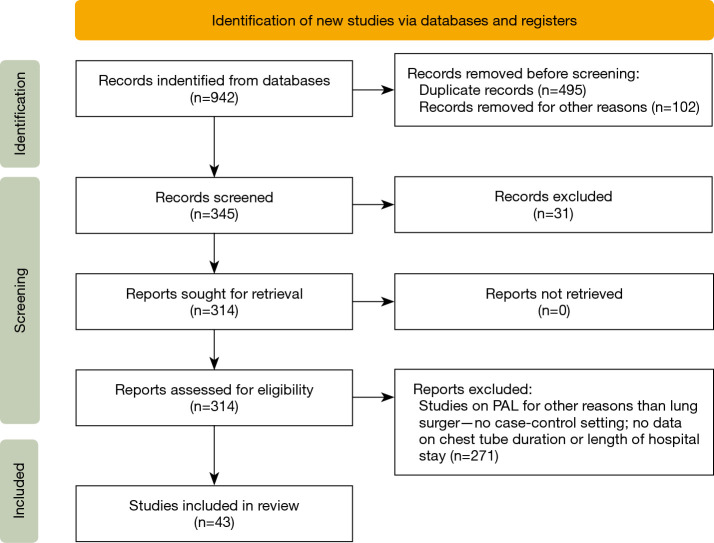
Results: A total of 942 initial papers from literature search, resulted in 43 papers after the selection. This systematic review found that the use of intraoperative measures as surgical sealants or pleural tenting, as well as a proper management of the chest drain and the use of blood patch or sclerosant agents seem to reduce postoperative air leaks incidence and/or duration and length of chest drain stay and hospitalization.
Conclusions: Different measures have been described in literature to manage or prevent postoperative PAL. Most of them seem to be safe and efficient if compared to the "wait and see" strategy, even if large comparative studies that standardize the intra- and post-operative management of APF after lung resection are lacking and, actually, hard to conceptualize. However, there is a large consensus on the value of a preoperative PAL-risk stratification and on the necessity of tailoring PAL management or prevention's strategy and its timing on each patient's features.
Keywords: Prolonged air leak (PAL); conservative management; intraoperative management; persistent air leak; review.
2023 Journal of Thoracic Disease. All rights reserved.
Conflict of interest statement
Conflicts of Interest: All authors have completed the ICMJE uniform disclosure form (available at https://jtd.amegroups.com/article/view/10.21037/jtd-22-736/coif). The special series “Prolonged Air Leak after Lung Surgery: Prediction, Prevention and Management” was sponsored by Bard Limited. Bard Limited has no interference on the contents of the special series. The authors have no other conflicts of interest to declare.
Figures
References
-
- Kozower BD. Complications of thoracic surgical procedures. LoCicero J, Feins RH, Colson YL, et al. editors. Shields’ general thoracic surgery (8th edition). Philadelphia: Lippincott Williams & Wilkins, 2019: 573-585.
Publication types
LinkOut - more resources
Full Text Sources