


Longitudinal change in ventricular volume is accelerated in astronauts undergoing long-duration spaceflight
- PMID: 36911514
- PMCID: PMC9997154
- DOI: 10.1016/j.nbas.2021.100017
Longitudinal change in ventricular volume is accelerated in astronauts undergoing long-duration spaceflight
Abstract
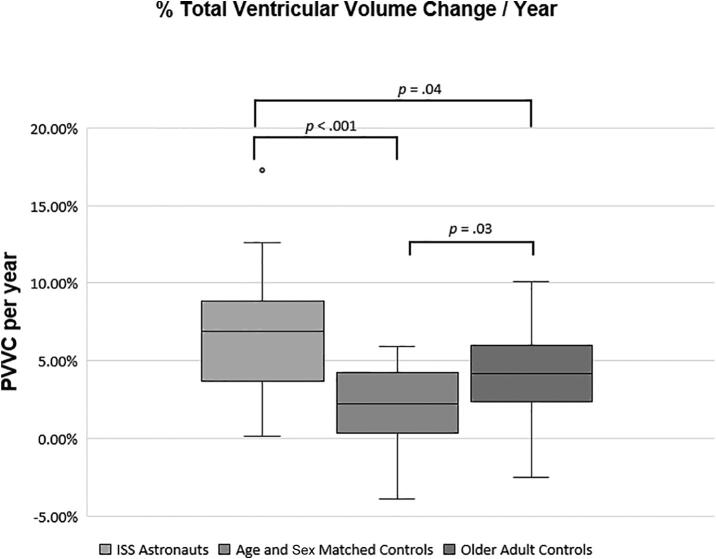
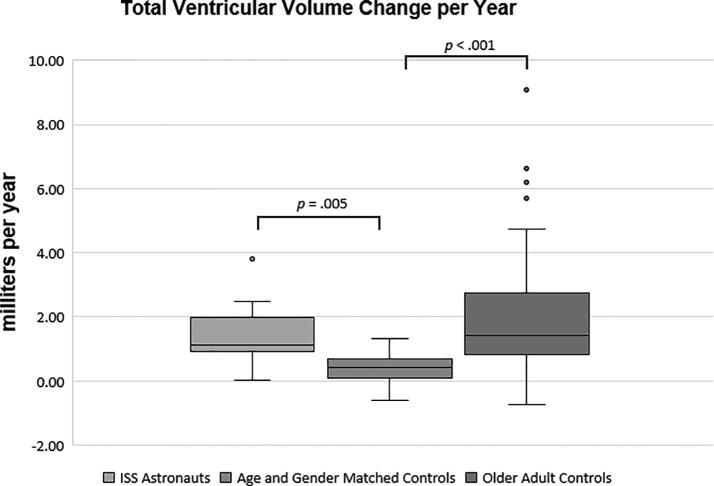
An 11-25% increase in total ventricular volume has been documented in astronauts following spaceflight on the ISS. Given the approximately 2-year time interval between pre- and post-flight MRI, it is unknown if ventricular enlargement simply reflects normal aging or is unique to spaceflight exposure. Therefore, we compared percent ventricular volume change per year (PVVC/yr) documented on pre- to post-flight MRI in a group of NASA ISS astronauts (n = 18, 16.7% women, mean age (SD) 48.43 (4.35) years) with two groups who underwent longitudinal MRI: (1.) healthy age- and sex-matched adults (n = 18, 16.7% women, mean age (SD) 51.26 (3.88) years), and (2.) healthy older adults (n = 79, 16.5% women, mean age (SD) 73.26 (5.34) years). The astronauts, who underwent a mean (SD) 173.4 (51.3) days in spaceflight, showed a greater increase in PVVC/yr than the control (6.86 vs 2.23%, respectively, p < .001) and older adult (4.18%, p = 0.04) groups. These results highlight that on top of physiologically ventricular volume changes due to normal aging, NASA astronauts undergoing ISS missions experience an additional 4.63% PVVC/yr and underscore the need to perform post-flight follow-up scans to determine the time course of PVVC in astronauts over time back on Earth along with monitoring to determine if the PVVC is ultimately clinically relevant.
One sentence summary: NASA astronauts who were exposed to prolonged spaceflight experienced an annual rate of ventricular expansion more than three times that expected from normal aging.
Keywords: Cerebral ventricles; ISS, International Space Station; Normal aging; PVVC, percent ventricular volume change; Spaceflight.
© 2021 The Author(s).
Conflict of interest statement
The authors declare that they have no known competing financial interests or personal relationships that could have appeared to influence the work reported in this paper.
Figures
References
LinkOut - more resources
Full Text Sources
