Review
. 2023 Feb 23:14:1134661.
doi: 10.3389/fimmu.2023.1134661. eCollection 2023.

NF-κB in monocytes and macrophages - an inflammatory master regulator in multitalented immune cells

Affiliations
Review

NF-κB in monocytes and macrophages - an inflammatory master regulator in multitalented immune cells

Marion Mussbacher et al. Front Immunol. .

Abstract

Nuclear factor κB (NF-κB) is a dimeric transcription factor constituted by two of five protein family members. It plays an essential role in inflammation and immunity by regulating the expression of numerous chemokines, cytokines, transcription factors, and regulatory proteins. Since NF-κB is expressed in almost all human cells, it is important to understand its cell type-, tissue-, and stimulus-specific roles as well as its temporal dynamics and disease-specific context. Although NF-κB was discovered more than 35 years ago, many questions are still unanswered, and with the availability of novel technologies such as single-cell sequencing and cell fate-mapping, new fascinating questions arose. In this review, we will summarize current findings on the role of NF-κB in monocytes and macrophages. These innate immune cells show high plasticity and dynamically adjust their effector functions against invading pathogens and environmental cues. Their versatile functions can range from antimicrobial defense and antitumor immune responses to foam cell formation and wound healing. NF-κB is crucial for their activation and balances their phenotypes by finely coordinating transcriptional and epigenomic programs. Thereby, NF-κB is critically involved in inflammasome activation, cytokine release, and cell survival. Macrophage-specific NF-κB activation has far-reaching implications in the development and progression of numerous inflammatory diseases. Moreover, recent findings highlighted the temporal dynamics of myeloid NF-κB activation and underlined the complexity of this inflammatory master regulator. This review will provide an overview of the complex roles of NF-κB in macrophage signal transduction, polarization, inflammasome activation, and cell survival.

Keywords: NF-κB – nuclear factor kappa B; immunity; inflammation; monocyte – macrophage; signaling/signaling pathways.


Conflict of interest statement

The authors declare that the research was conducted in the absence of any commercial or financial relationships that could be construed as a potential conflict of interest.

Figures
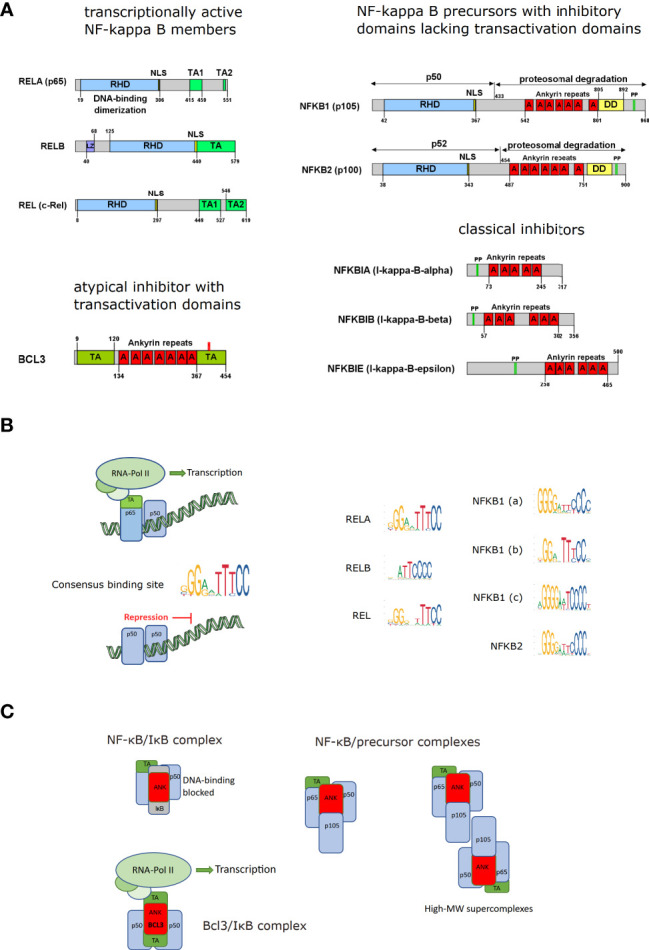
Figure 1
Figure 1
NF-κB and IκB molecules. (A) The domain structure of NF-κB family members is depicted with the common Rel-homology domain (RHD), nuclear localization sequences (NLS), transactivation domains (TA), leucine zippers (LZ), ankyrin repeats (A), death domains (DD) and phosphorylation sites (PP) targeting poly-ubiquitination and proteasomal degradation or processing. The Gene symbol names are specified with the most common aliases (modified from (4)). The precursor proteins p105 (NFKB1) and p100 (NFKB2) give rise to the processed forms p50 and p52, respectively. (B) Schematic illustration of NF-κB dimers bound to DNA including active transcription factors (with transactivation domains recruiting RNA-Polymerase II [RNA Pol II]) and inactive NF-κB complexes lacking a transactivation site and acting as repressor; Consensus DNA binding motifs for the different NF-κB members: Retrieved from the JASPAR database (5) by searching for Rel homology region factors as Class and family “NF-kappaB-related factors. The height of the nucleotide reflects the degree of conservation. (C) NF-κB/IκB complexes and NF-κB complexes containing inhibitory precursor proteins (including high-MW super-complexes formed by binding via RHD and ankyrin repeats); NF-κB bound to inhibitory IκB molecules and transcriptionally active complexes between p50- or p52-homodimers bound to BCL3, an ankyrin-repeat containing IκB family member with transactivation domains, as indicated.
Figure 2
Figure 2
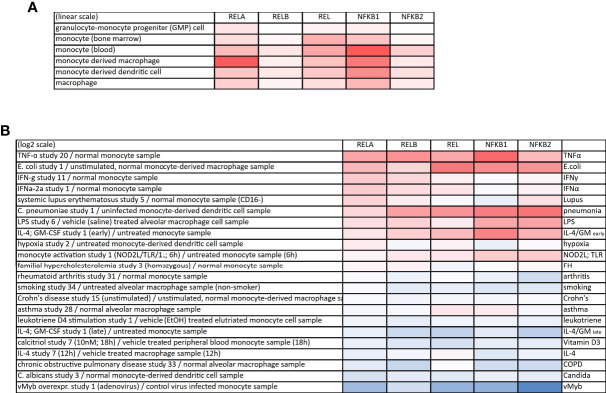
Expression of NF-κB proteins in monocytes and macrophages. (A) Expression of the NF-κB family members in monocytes, macrophages and monocyte-derived cells (linear scale). The gene symbols are provided: RELA (p65), RELB, REL (c-Rel), NFKB1 (p105/p50) and NFKB2 (p100/p52). (B) Heatmap of up- (red) or downregulation (blue) of NF-κB family members upon various perturbations. All data derived from the Genevestigator database.
Figure 3
Figure 3
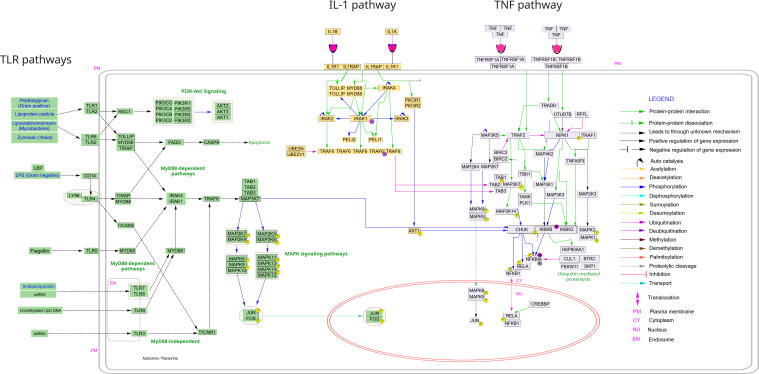
Canonical NF-κB signaling pathways from TLRs, TNFα and IL-1. The following pathways were deduced from Wikipathways (via Cytoscape) and manually curated and merged in Inkscape: TNF alpha signaling pathway; IL-1. signaling pathway and Toll-like receptor signaling pathway. The Cytoscape file with the three pathways is available upon request to the authors.
Figure 4
Figure 4
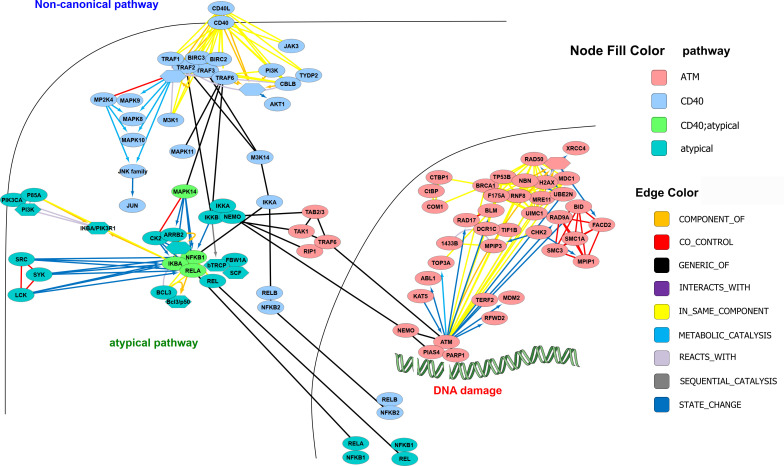
Alternative and atypical NF-κB activation pathways. The following pathways were derived from https://www.pathwaycommons.org: CD40/CD40L signaling, ATM pathway (DNA damage) and Atypical NF-kappaB; downloaded in BIOPAX format and imported to Cytoscape (with SIF-model mapping), where they were merged and manually curated. Nodes were arranged according to subcellular localization and additional edges as known from the literature were added. The colors of the nodes correspond to the pathways.
Figure 5
Figure 5
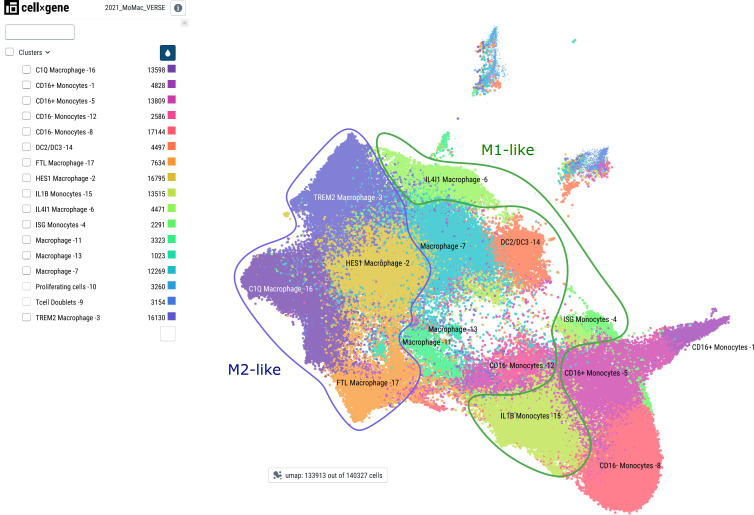
Major monocyte/macrophage subsets as defined by single-cell RNA sequencing. Major cell subsets of monocytes and macrophages were derived from the MoMac-VERSE data as described in (117) with the consent of the authors using the CZ CellxGene platform (118) with the weblink: https://macroverse.gustaveroussy.fr/2021_MoMac_VERSE/. The visualization was downloaded as pdf-file with the cell cluster names as in the publication and manually annotated for M1- and M2-like cells based on the published data (117) using Inkscape.
Figure 6
Figure 6
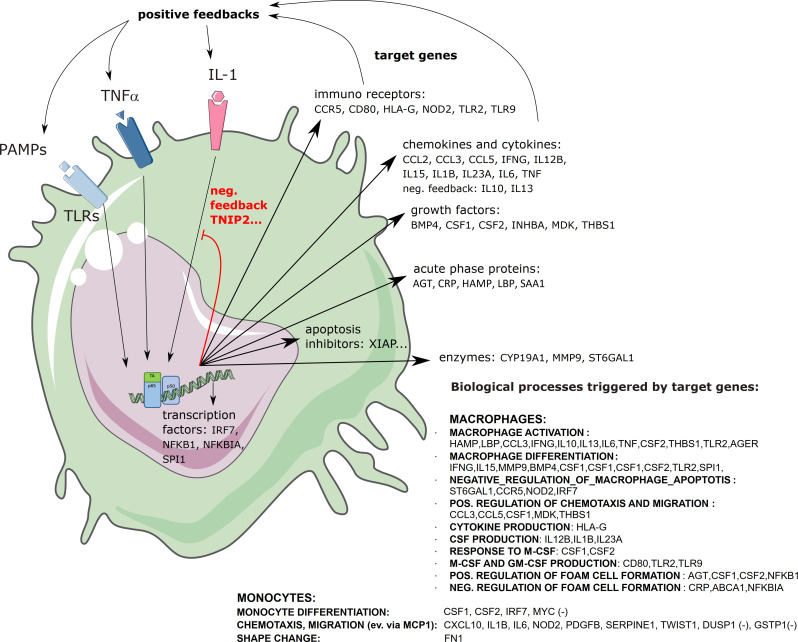
Scheme of NF-κB target genes (in monocytes and macrophages) NF-κB target genes were derived from (7) https://www.bu.edu/nf-kb/gene-resources/target-genes/). Macrophage and monocyte Gene Ontologies were retrieved using the ‘msigdbr’ package version 7.5.1, filtering for those gene sets that contained the keyword “*MACROPHAGE*” or “MONOCYTE*”. Thereafter, the intersection between the GO gene sets for monocytes and macrophages and the list of NF-κB target genes was determined.

References

    1. Shi C, Pamer EG. Monocyte recruitment during infection and inflammation. Nat Rev Immunol (2011) 11:762–74. doi: 10.1038/nri3070 - DOI - PMC - PubMed
    1. Shin K-S, Jeon I, Kim B-S, Kim I-K, Park Y-J, Koh C-H, et al. Monocyte-derived dendritic cells dictate the memory differentiation of CD8+ T cells during acute infection. Front Immunol (2019) 10:1887. doi: 10.3389/fimmu.2019.01887 - DOI - PMC - PubMed
    1. Meier-Soelch J, Mayr-Buro C, Juli J, Leib L, Linne U, Dreute J, et al. Monitoring the levels of cellular NF-κB activation states. Cancers (Basel) (2021) 13. doi: 10.3390/cancers13215351 - DOI - PMC - PubMed
    1. Mussbacher M, Salzmann M, Brostjan C, Hoesel B, Schoergenhofer C, Datler H, et al. Cell type-specific roles of NF-κB linking inflammation and thrombosis. Front Immunol (2019) 10:85. doi: 10.3389/fimmu.2019.00085 - DOI - PMC - PubMed
    1. Schmacke NA, O’Duill F, Gaidt MM, Szymanska I, Kamper JM, Schmid-Burgk JL, et al. IKKβ primes inflammasome formation by recruiting NLRP3 to the trans-golgi network. Immunity (2022). 55:2271–84. doi: 10.1016/j.immuni.2022.10.021 - DOI - PMC - PubMed

Publication types

LinkOut - more resources