Review
. 2023 Jul 10:46:39-58.
doi: 10.1146/annurev-neuro-080422-105509. Epub 2023 Mar 13.

Meningeal Mechanisms and the Migraine Connection

Affiliations
Review

Meningeal Mechanisms and the Migraine Connection

Dan Levy et al. Annu Rev Neurosci. .

Abstract

Migraine is a complex neurovascular pain disorder linked to the meninges, a border tissue innervated by neuropeptide-containing primary afferent fibers chiefly from the trigeminal nerve. Electrical or mechanical stimulation of this nerve surrounding large blood vessels evokes headache patterns as in migraine, and the brain, blood, and meninges are likely sources of headache triggers. Cerebrospinal fluid may play a significant role in migraine by transferring signals released from the brain to overlying pain-sensitive meningeal tissues, including dura mater. Interactions between trigeminal afferents, neuropeptides, and adjacent meningeal cells and tissues cause neurogenic inflammation, a critical target for current prophylactic and abortive migraine therapies. Here we review the importance of the cranial meninges to migraine headaches, explore the properties of trigeminal meningeal afferents, and briefly review emerging concepts, such as meningeal neuroimmune interactions, that may one day prove therapeutically relevant.

Keywords: cortical spreading depression; headache; meningeal afferents; meninges; migraine; neurogenic inflammation; sensitization; trigeminal.


Figures
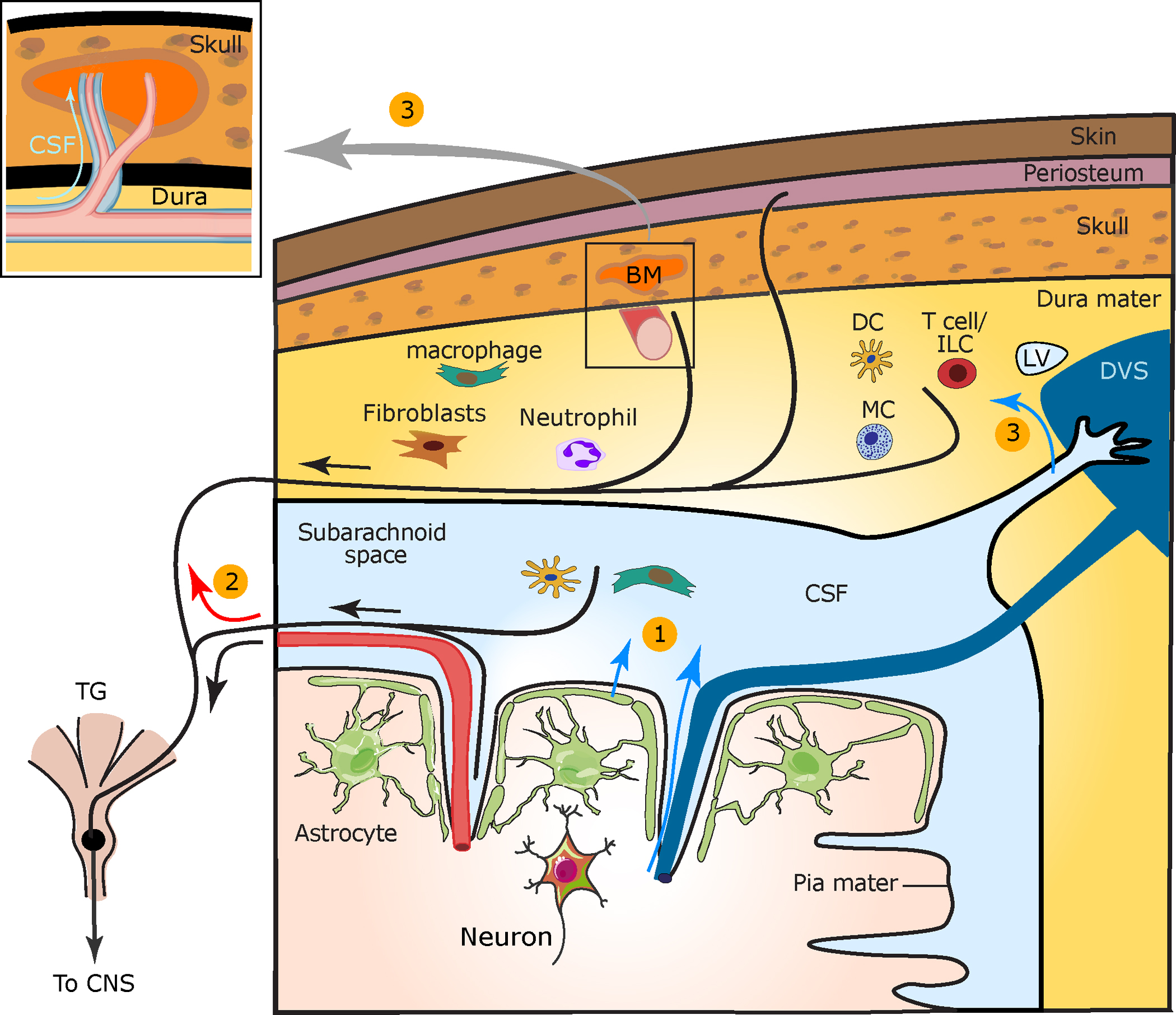
Figure 1
Figure 1
Cortical to meningeal signaling underlying CSD-evoked meningeal nociception. CSD is a key event in migraine with aura. (①) In the wake of CSD, algesic mediators are released from cortical neurons and astrocytes and diffuse across the pial membrane or are transported via glymphatic flow into the CSF (blue arrows). These mediators may directly activate meningeal afferents surrounding pial vessels. Released cortical mediators may also activate subdural immune cells to release pronociceptive factors and excite pial afferents. (②) Antidromic axon reflex (red arrow) is posited to cause the release of neuropeptides from collateral dural afferent fibers that produce neurogenic inflammation, which involves vascular and immune responses with subsequent sensitization of dural afferents. (③) CSF algesic mediators are additionally transported into the dura mater near venous sinuses, lymphatic vessels, and perivascular spaces surrounding dural vessels (box) and may further sensitize dural afferents. CSF flow into calvarial bone marrow via channels may influence meningeal immune cell production and transport and locally trigger collateral afferents. Abbreviations: BM, bone marrow; CNS, central nervous system; CSD, cortical spreading depolarization; CSF, cerebrospinal fluid; DC, dendritic cell; DVS, dural venous sinus; LV, lymphatic vessel; MC, mast cell; TG, trigeminal ganglion. Figure adapted from Carneiro-Nascimento & Levy (2022) (CC BY 4.0).
Figure 2
Figure 2
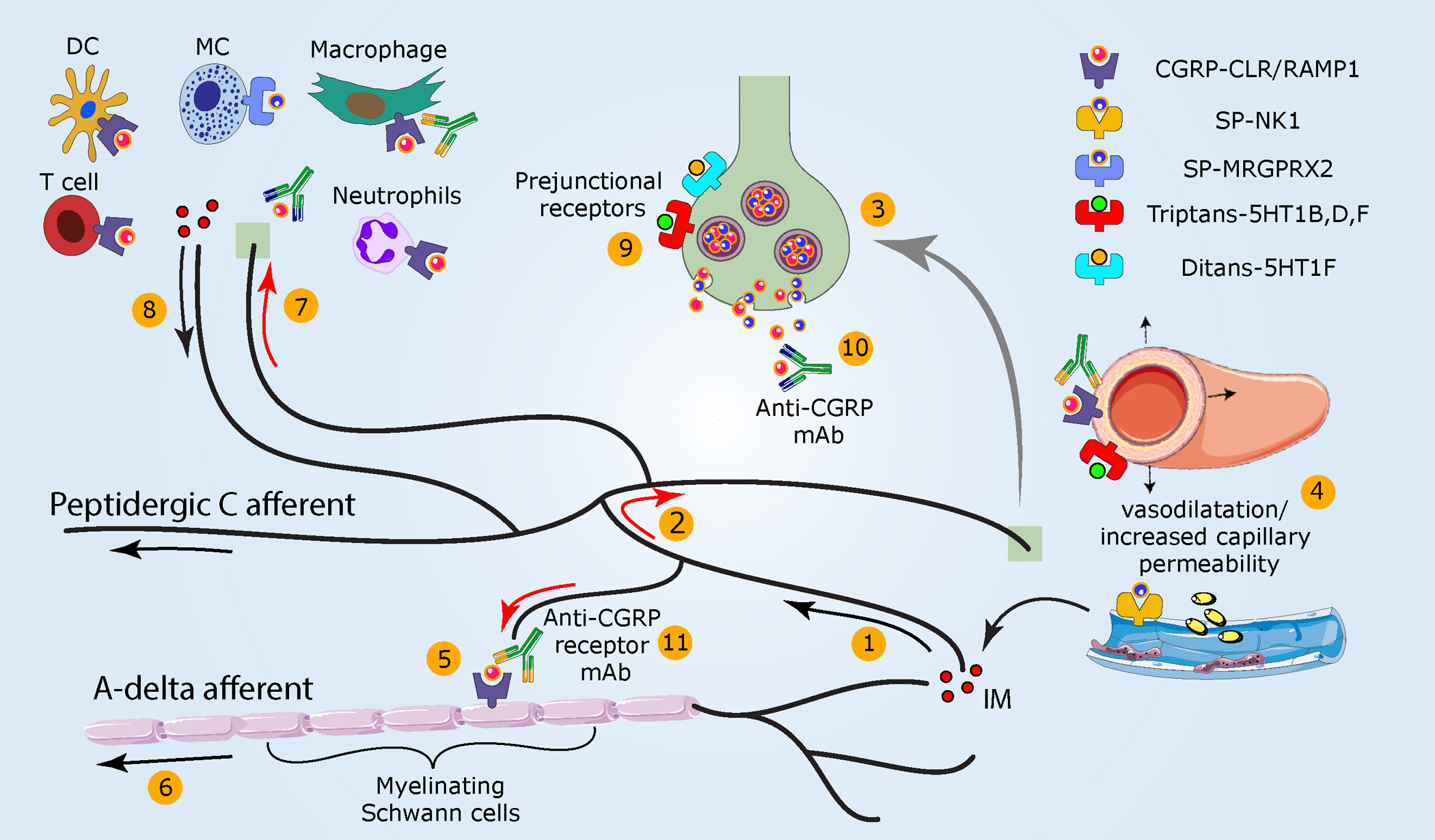
Meningeal neurogenic inflammation as a potential migraine headache mechanism. (①) As noted in Figure 1, the activation of peptidergic meningeal afferents (②) generates an antidromic axonal reflex (red arrows) and (③) neuropeptide release. (④) Subsequently, vasodilatation, increased capillary permeability, and IM release ensue. (⑤) CGRP, locally released, can also engage cell surface receptors that internalize on Schwann cells ensheathing myelinated A-delta meningeal afferents. Hypothesized downstream mechanisms include persistent CGRP receptor signaling within endosomes that (⑥) enhances A-delta afferent activity via TRPA1-dependent mechanisms. (⑦) Released sensory neuropeptides may also drive a local meningeal neurogenic immune response (⑧) that could further sensitize meningeal afferents. (⑨) Triptans used to abort migraine headache activate prejunctional 5-HT1B/1D/1F receptors on meningeal afferent terminals to inhibit the release of neuropeptides and related development of meningeal neurogenic inflammation. Triptans additionally act on vascular receptors to produce arterial vasoconstriction. Activation of prejunctional 5-HT1F receptors inhibits meningeal afferent neuropeptide release and aborts migraine pain without causing vasoconstriction. CGRP receptor antagonists block meningeal neurogenic vasodilatation and abort migraine headaches. (⑩) mAbs that bind CGRP or its receptor are used preventatively in the clinic and act selectively in the periphery. Abbreviations: CGRP, calcitonin gene–related peptide; CLR, calcitonin receptor–like receptor, IM, inflammatory mediator; mAb, monoclonal antibody; MRGPRX2, Mas-related G protein–coupled receptor-X2; NK1, neurokinin 1 receptor; RAMP1, receptor activity–modifying protein-1; SP, substance P.

References

    1. Afridi SK, Matharu MS, Lee L, Kaube H, Friston KJ, et al. 2005. A PET study exploring the laterality of brainstem activation in migraine using glyceryl trinitrate. Brain 128:932–39 - PubMed
    1. Akerman S, Karsan N, Bose P, Hoffmann JR, Holland PR, et al. 2019. Nitroglycerine triggers triptan-responsive cranial allodynia and trigeminal neuronal hypersensitivity. Brain 142:103–19 - PMC - PubMed
    1. Al-Karagholi MA, Hansen JM, Guo S, Olesen J, Ashina M. 2019. Opening of ATP-sensitive potassium channels causes migraine attacks: a new target for the treatment of migraine. Brain 142:2644–54 - PubMed
    1. Alves De Lima K, Rustenhoven J, Kipnis J. 2020. Meningeal immunity and its function in maintenance of the central nervous system in health and disease. Annu. Rev. Immunol. 38:597–620 - PubMed
    1. Ampie L, McGavern DB. 2022. Immunological defense of CNS barriers against infections. Immunity 55:781–99 - PMC - PubMed

Publication types

LinkOut - more resources