. 2023 Mar 13;14(1):1360.
doi: 10.1038/s41467-023-37010-0.

Non-falciparum malaria infection and IgG seroprevalence among children under 15 years in Nigeria, 2018

Affiliations

Non-falciparum malaria infection and IgG seroprevalence among children under 15 years in Nigeria, 2018

Camelia Herman et al. Nat Commun. .

Abstract

Plasmodium falciparum (Pf) is the dominant malaria parasite in Nigeria though P. vivax (Pv), P. ovale (Po), and P. malariae (Pm) are also endemic. Blood samples (n = 31,234) were collected from children aged 0-14 years during a 2018 nationwide HIV survey and assayed for Plasmodium antigenemia, Plasmodium DNA, and IgG against Plasmodium MSP1-19 antigens. Of all children, 6.6% were estimated to have Pm infection and 1.4% Po infection with no Pv infections detected. The highest household wealth quintile was strongly protective against infection with Pm (aOR: 0.11, 95% CI: 0.05-0.22) or Po (aOR= 0.01, 0.00-0.10). Overall Pm seroprevalence was 34.2% (95% CI: 33.3-35.2) with lower estimates for Po (12.1%, 11.6-12.5) and Pv (6.3%, 6.0-6.7). Pm seropositivity was detected throughout the country with several local government areas showing >50% seroprevalence. Serological and DNA indicators show widespread exposure of Nigerian children to Pm with lower rates to Po and Pv.


Conflict of interest statement

The authors declare no competing interests.

Figures
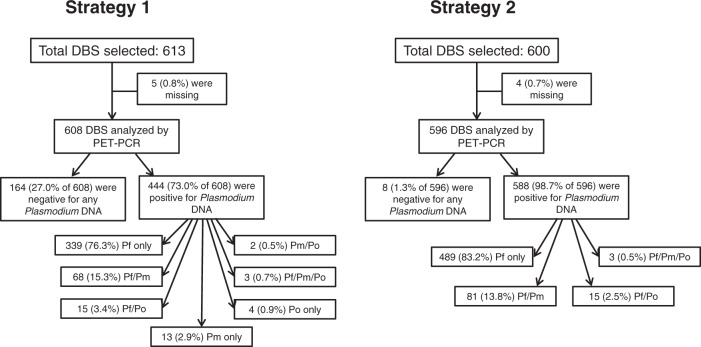
Fig. 1
Fig. 1. Number of dried blood spot samples selected for PET-PCR by selection strategy and their results: Nigeria, 2018.
Strategy 1 involved selecting DBS based on a low or negative HRP2 assay signal compared to other Plasmodium antigen targets. Strategy 2 selected a random sample of HRP2 positive DBS, with a target of 100 samples per Nigerian zone. Terminal boxes display number (and percentage) of each type of infection for samples that were Plasmodium DNA positive. DBS: dried blood spot, Pf Plasmodium falciparum, Pm Plasmodium malariae, Po Plasmodium ovale.
Fig. 2
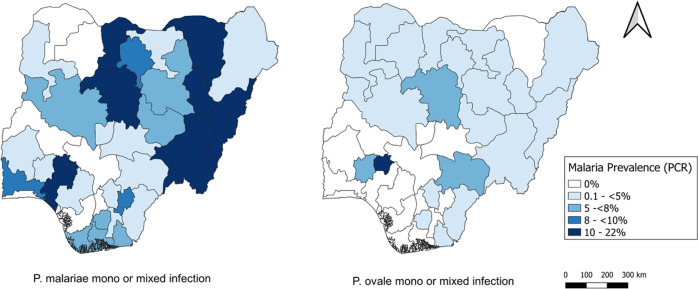
Fig. 2. Estimated prevalence of P. malariae and P. ovale infections by Nigerian state: 2018.
Presence of Plasmodium infection determined by PCR assays. Panels shown for P. malariae on left and P. ovale on right, with darker shading indicating higher estimated proportions of children infected with either of these two species.
Fig. 3
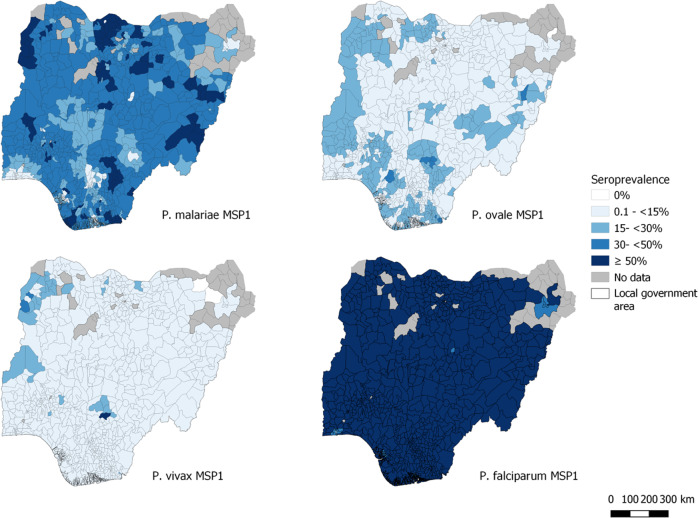
Fig. 3. Seroprevalence to P. malariae, P. ovale, P. vivax and P. falciparum MSP1 antigens among children under 15 years: Nigeria, 2018.
Darker shading indicates higher seroprevalence by local government area (LGA) with gray areas showing LGAs without samples available for IgG data collection. MSP1: merozoite surface protein 1, 19kD region.
Fig. 4
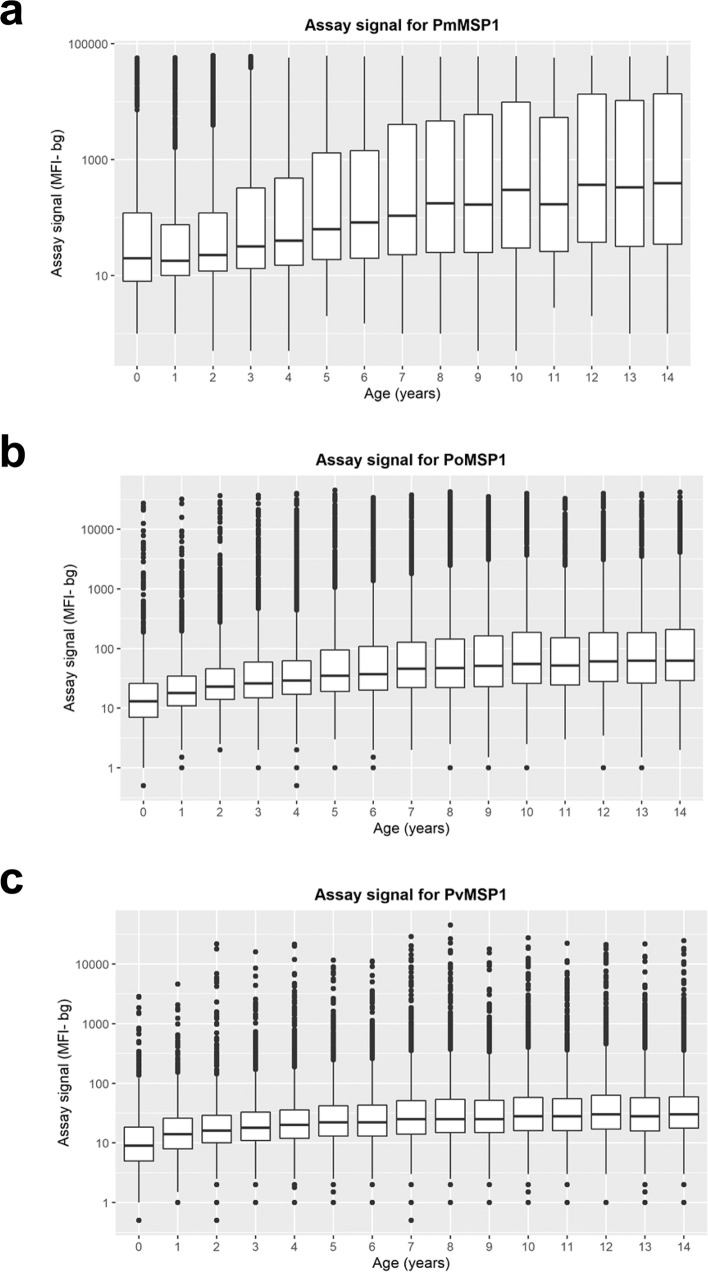
Fig. 4. Changes in IgG antibody levels in Nigerian children during the first 14 years of life.
IgG antibody levels against PmMSP1 (a), PoMSP1 (b), and PvMSP1 (c) antigens by age. Boxes display interquartile range (IQR), with horizontal lines as median assay signals and whiskers extending 1.5× IQR above and below boxes and points at >1.5× IQR. MFI-bg: median fluorescence intensity minus background assay signal. For all plots, n = 31,234 biologically independent samples.
Fig. 5
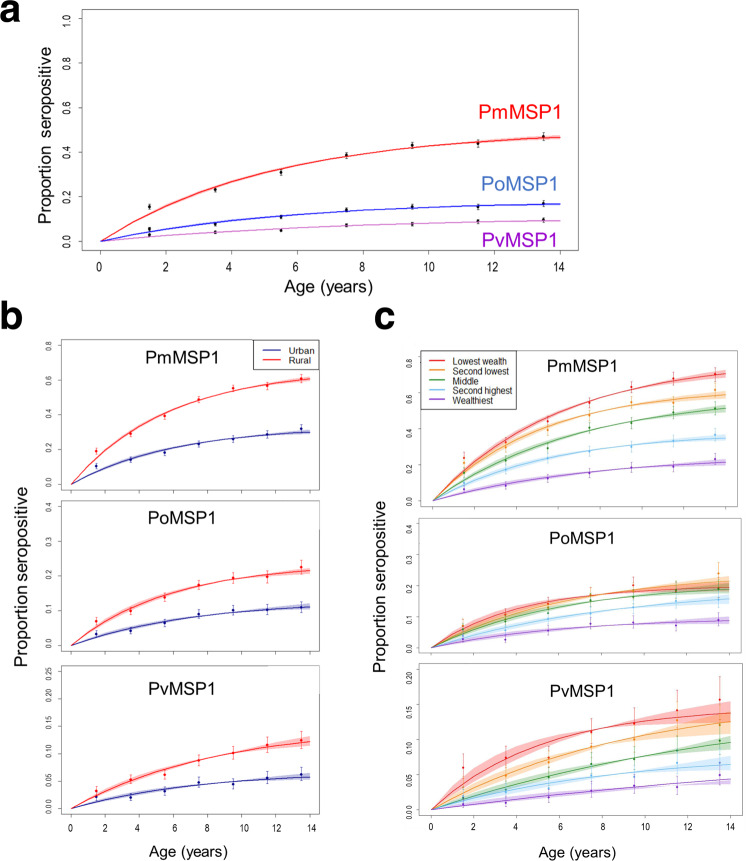
Fig. 5. Seropositivity by age for IgG against PmMSP1, PoMSP1, and PvMSP1 antigens among children under 15 years: Nigeria, 2018.
All participants (a), and as separated by urban or rural residence (b), or wealth quintile (c). Dots represent the proportion seropositive and error bars represent the 95% confidence intervals for seropositivity for each age group. Curves represent the fit of a catalytic seroconversion model, and shaded areas represent the 95% credible intervals of the model predictions. For all plots, n = 31,234 biologically independent samples.
Fig. 6
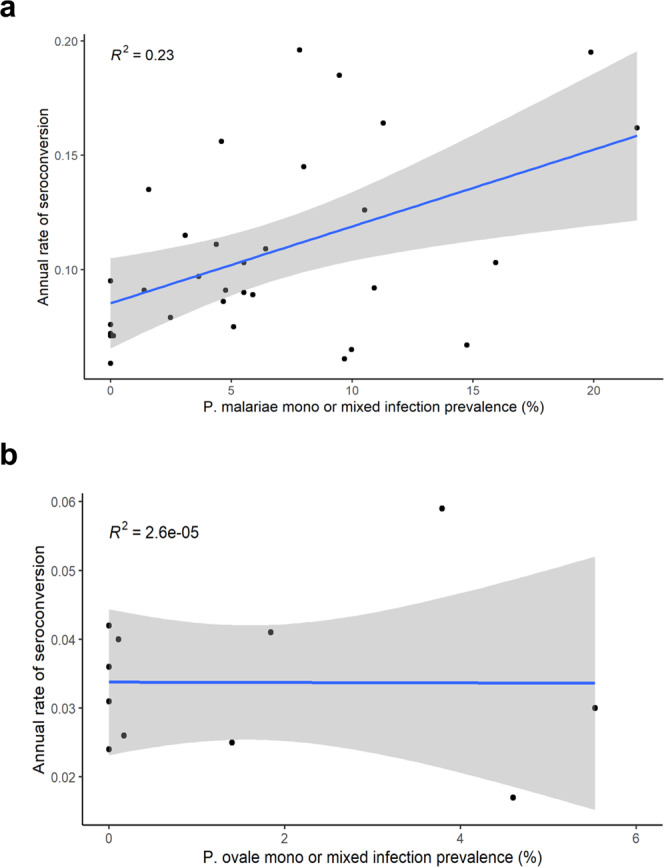
Fig. 6. Correlation of active infection and serological data for both P. malariae and P. ovale: Nigeria, 2018.
Association between infection prevalence of P. malariae (a) and P. ovale (b) infections per state and estimated annual seroconversion rate (SCR) by state to PmMSP1 and PoMSP1, respectively. Each point represents one state, blue line is the linear regression line of best fit, shading indicates the standard error, and inset text the R2 estimate. For PmMSP1, the serocatalytic model converged for 86.5% (32/37) of states to provide a seroconversion rate, and for PoMSP1, the model converged for 29.7% (11/37) of states.

References

    1. World Health Organization. World Malaria Report. Geneva, Switzerland (2021).
    1. Olasehinde GI, et al. Epidemiology of Plasmodium falciparum infection and drug resistance markers in Ota Area, Southwestern Nigeria. Infect. Drug Resist. 2019;12:1941–1949. doi: 10.2147/IDR.S190386. - DOI - PMC - PubMed
    1. The DHS Program. Nigeria Quickstats. dhsprogram.com/Countries/Country-Main.cfm?ctry_id=30&c=Nigeria&C... (2022).
    1. Titilope M, et al. Asymptomatic malaria infections and Pfmdr1 mutations in an endemic area of Nigeria. Malar. J. 2019;18:218. doi: 10.1186/s12936-019-2833-8. - DOI - PMC - PubMed
    1. Okunlola OA, Oyeyemi OT. Spatio-temporal analysis of association between incidence of malaria and environmental predictors of malaria transmission in Nigeria. Sci. Rep. 2019;9:17500. doi: 10.1038/s41598-019-53814-x. - DOI - PMC - PubMed

Publication types