


Early adjunctive methylene blue in patients with septic shock: a randomized controlled trial
- PMID: 36915146
- PMCID: PMC10010212
- DOI: 10.1186/s13054-023-04397-7
Early adjunctive methylene blue in patients with septic shock: a randomized controlled trial
Abstract
Purpose: Methylene blue (MB) has been tested as a rescue therapy for patients with refractory septic shock. However, there is a lack of evidence on MB as an adjuvant therapy, its' optimal timing, dosing and safety profile. We aimed to assess whether early adjunctive MB can reduce time to vasopressor discontinuation in patients with septic shock.
Methods: In this single-center randomized controlled trial, we assigned patients with septic shock according to Sepsis-3 criteria to MB or placebo. Primary outcome was time to vasopressor discontinuation at 28 days. Secondary outcomes included vasopressor-free days at 28 days, days on mechanical ventilator, length of stay in ICU and hospital, and mortality at 28 days.
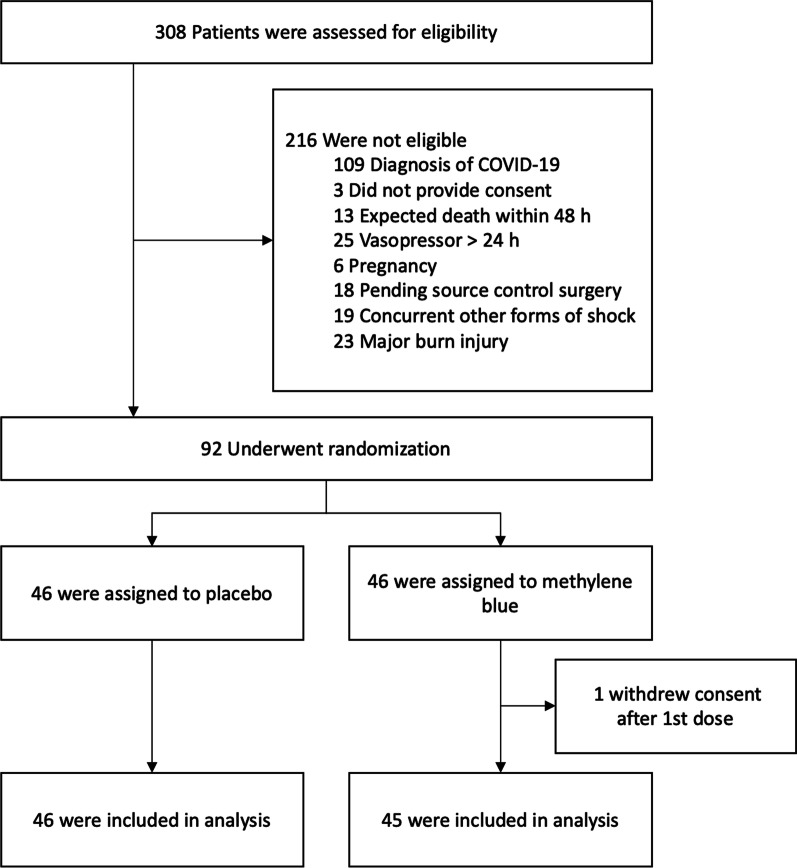
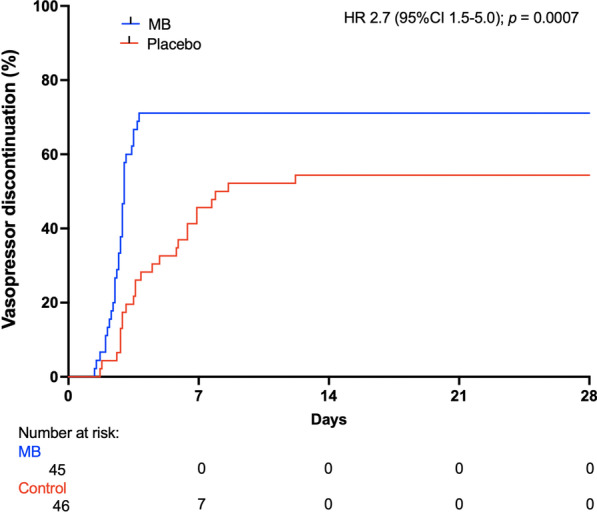
Results: Among 91 randomized patients, forty-five were assigned to MB and 46 to placebo. The MB group had a shorter time to vasopressor discontinuation (69 h [IQR 59-83] vs 94 h [IQR 74-141]; p < 0.001), one more day of vasopressor-free days at day 28 (p = 0.008), a shorter ICU length of stay by 1.5 days (p = 0.039) and shorter hospital length of stay by 2.7 days (p = 0.027) compared to patients in the control group. Days on mechanical ventilator and mortality were similar. There were no serious adverse effects related to MB administration.
Conclusion: In patients with septic shock, MB initiated within 24 h reduced time to vasopressor discontinuation and increased vasopressor-free days at 28 days. It also reduced length of stay in ICU and hospital without adverse effects. Our study supports further research regarding MB in larger randomized clinical trials. Trial registration ClinicalTrials.gov registration number NCT04446871 , June 25, 2020, retrospectively registered.
Keywords: Catecholamine sparing; Methylene blue; Norepinephrine; Randomized controlled trial; Septic shock; Vasopressin.
© 2023. The Author(s).
Conflict of interest statement
The authors have no competing interests to disclose.
Figures
Comment in
-
Methylene blue as adjunctive therapy in septic shock: correct drug diluent derives optimal efficacy.Crit Care. 2023 Aug 29;27(1):337. doi: 10.1186/s13054-023-04615-2. Crit Care. 2023. PMID: 37644588 Free PMC article. No abstract available.
-
Drug diluent and efficacy of methylene blue in septic shock: authors' reply.Crit Care. 2023 Sep 5;27(1):345. doi: 10.1186/s13054-023-04633-0. Crit Care. 2023. PMID: 37670332 Free PMC article. No abstract available.
References
-
- Bentzer P, Griesdale DE, Boyd J, MacLean K, Sirounis D, Ayas NT. Will this hemodynamically unstable patient respond to a bolus of intravenous fluids? JAMA. 2016;316:1298–1309. - PubMed
-
- Aya HD, Ster IC, Fletcher N, Grounds RM, Rhodes A, Cecconi M. Pharmacodynamic analysis of a fluid challenge. Crit Care Med. 2016;44:880–891. - PubMed
-
- Stolk RF, van der Pasch E, Naumann F, Schouwstra J, Bressers S, van Herwaarden AE, et al. Norepinephrine dysregulates the immune response and compromises host defense during sepsis. Am J Respir Crit Care Med. 2020;202:830–842. - PubMed
Publication types
MeSH terms
Substances
Associated data
LinkOut - more resources
Full Text Sources
Medical
Miscellaneous
