Utilizing Plasma Circulating Tumor DNA Sequencing for Precision Medicine in the Management of Solid Cancers
- PMID: 36915241
- PMCID: PMC10101775
- DOI: 10.4143/crt.2023.446
Utilizing Plasma Circulating Tumor DNA Sequencing for Precision Medicine in the Management of Solid Cancers
Abstract
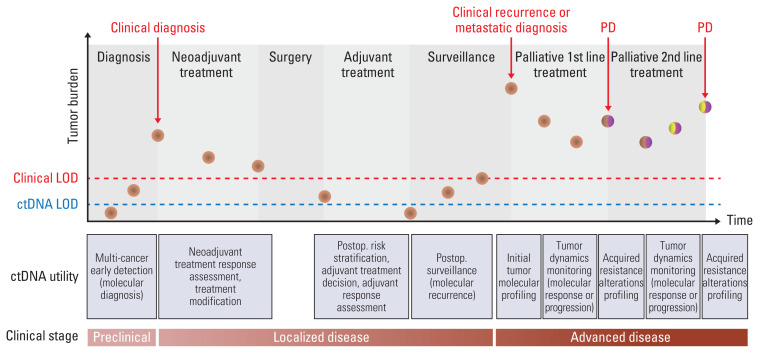
Plasma circulating tumor DNA (ctDNA) sequencing has demonstrated clinical utility for tumor molecular profiling at initial diagnosis or tumor progression in advanced solid cancers and is being rapidly incorporated into the clinical practice guidelines, including non-small cell lung and breast cancer. Despite relatively low sensitivity, plasma ctDNA sequencing has several advantages over tissue-based assays, including ease of sampling, rapid turnaround time, repeatability, and the ability to overcome spatial heterogeneity, which makes it ideal for investigating acquired resistance and monitoring tumor evolution and dynamics. With technological advancement and declining costs, the clinical application of plasma ctDNA is expanding, and numerous ongoing clinical trials are examining its potential to guide the management of advanced, localized, and even preclinical cancers of various tumor types. The ability of plasma ctDNA analysis to detect minimal residual disease following curative treatment in the absence of clinical disease is among its most promising attributes. Plasma ctDNA sequencing can also facilitate the conduct of clinical trials and drug development, particularly in immunotherapy. In order to incorporate plasma ctDNA sequencing for clinical decision-making, it is important to understand the preanalytical and analytical factors that may affect its sensitivity and reliability.
Keywords: Circulating tumor DNA; High-throughput nucleotide sequencing; Minimal residual disease; Molecular profiling; Mutation.
Conflict of interest statement
Yongjun Cha received a consulting fee from IMBdx, Inc. Sheehyun Kim disclosed no conflicts of interest. Sae-Won Han received research funding support (institutional) and honoraria from IMBdx, Inc.
Figures
References
-
- Mosele F, Remon J, Mateo J, Westphalen CB, Barlesi F, Lolkema MP, et al. Recommendations for the use of next-generation sequencing (NGS) for patients with metastatic cancers: a report from the ESMO Precision Medicine Working Group. Ann Oncol. 2020;31:1491–505. - PubMed
-
- Chakravarty D, Johnson A, Sklar J, Lindeman NI, Moore K, Ganesan S, et al. Somatic genomic testing in patients with metastatic or advanced cancer: ASCO provisional clinical opinion. J Clin Oncol. 2022;40:1231–58. - PubMed
-
- Pascual J, Attard G, Bidard FC, Curigliano G, De Mattos-Arruda L, Diehn M, et al. ESMO recommendations on the use of circulating tumour DNA assays for patients with cancer: a report from the ESMO Precision Medicine Working Group. Ann Oncol. 2022;33:750–68. - PubMed
-
- Corcoran RB, Chabner BA. Application of cell-free DNA analysis to cancer treatment. N Engl J Med. 2018;379:1754–65. - PubMed
MeSH terms
Substances
Grants and funding
LinkOut - more resources
Full Text Sources
Medical