. 2022;54(2-3):473-519.
doi: 10.1007/s10686-021-09761-5. Epub 2021 Jun 11.

A Case for Electron-Astrophysics

Affiliations

A Case for Electron-Astrophysics

Daniel Verscharen et al. Exp Astron (Dordr). 2022.

Abstract

The smallest characteristic scales, at which electron dynamics determines the plasma behaviour, are the next frontier in space and astrophysical plasma research. The analysis of astrophysical processes at these scales lies at the heart of the research theme of electron-astrophysics. Electron scales are the ultimate bottleneck for dissipation of plasma turbulence, which is a fundamental process not understood in the electron-kinetic regime. In addition, plasma electrons often play an important role for the spatial transfer of thermal energy due to the high heat flux associated with their velocity distribution. The regulation of this electron heat flux is likewise not understood. By focussing on these and other fundamental electron processes, the research theme of electron-astrophysics links outstanding science questions of great importance to the fields of space physics, astrophysics, and laboratory plasma physics. In this White Paper, submitted to ESA in response to the Voyage 2050 call, we review a selection of these outstanding questions, discuss their importance, and present a roadmap for answering them through novel space-mission concepts.

Keywords: Electrons; Voyage 2050; plasma astrophysics; solar wind; space missions; space plasma.


Conflict of interest statement

Conflicts of interest/Competing interestsNone.

Figures

Fig. 1
Fig. 1
Probability distribution of characteristic electron scales (top) and proton scales (bottom) in the solar wind at 1 au from the Wind spacecraft
Fig. 2
Fig. 2
A turbulent power spectrum of the magnetic field computed using Cluster data. It ranges from fluid scales through ion scales to electron scales [2]. The coloured bars indicate the typical ion and electron scales. Previous missions have been capable of resolving electron scales only temporally. Reprinted figure with permission from Alexandrova et al., Phys. Rev. Lett. 103, 165003, 2009. Copyright (2009) by the American Physical Society
Fig. 3
Fig. 3
Electron dissipation mechanisms. a) A Landau-resonant electron in a monochromatic wave. b) Particle orbits in small-amplitude (red) and large-amplitude (blue) gyro-scale fluctuations, leading to stochastic heating
Fig. 4
Fig. 4
Typical components of solar-wind electron distribution functions in velocity space: core, halo, and strahl. From Salem et al. [199]
Fig. 5
Fig. 5
X-ray image of the Bullet cluster (Credit: x-ray: NASA/CXC/CfA/M. Markevitch et al.; optical: NASA/STScI, Magellan/U. Arizona/D. Clowe et al.; lensing map: NASA/STScI ESO WFI, Magellan/U. Arizona/D. Clowe et al.)
Fig. 6
Fig. 6
First image of a black hole (M87*) from the Event Horizon Telescope [54]. All of the ‘light’ (i.e., radio waves) seen in this image is created by heated and accelerated plasma electrons in the accretion disc’s magnetic field
Fig. 7
Fig. 7
Simulation of ETG turbulence in the TCV-Tokamak (Credit: D. Told)
Fig. 8
Fig. 8
Magnetic helicity σm at ion scales as a function of the angle between solar-wind flow and magnetic field θVB and fluctuation period. At small angles, negative values suggest ion-cyclotron / whistler waves. At large angles, positive values suggest kinetic-Alfvén turbulence [85]. © AAS. Reproduced with permission
Fig. 9
Fig. 9
Simulation of a magnetic-hole structure: magnetic field (black), electron flow vectors (magenta), and parallel magnetic field (colour-coded) in a coherent electron-scale vortex [84]. Reprinted from Haynes et al., Phys. Plasmas 22, 012309 (2015), with the permission of AIP Publishing
Fig. 10
Fig. 10
Energy transfer from turbulent magnetosheath fluctuations to electrons as a function of perpendicular and parallel electron velocity, measured by applying the field-particle correlation technique to MMS data with 30 ms cadence [33]
Fig. 11
Fig. 11
Field-parallel heat flux (normalised to the free-streaming value) as a function of normalised collisional mean free path. The straight line represents the Spitzer-Härm prediction, and the colour indicates the column-normalised probability found in solar-wind measurements. The heat flux deviates from the Sitzer-Härm prediction at large mean free paths. From Bale et al. [6]. © AAS. Reproduced with permission
Fig. 12
Fig. 12
The standard picture of magnetic reconnection. The IDR is much larger than the EDR. However, if the current sheet is smaller than a few dp, electron-only reconnection can occur. After Phan et al. [173]. Reprinted by permission from Springer Nature: Nature, Phan et al., 557, 202 (2018)
Fig. 13
Fig. 13
Simultaneous multi-scale measurement with three radially-aligned spacecraft. This setup assumes L12 < L23 < L13, where Lij is the distance between spacecraft i and j as shown at the top
Fig. 14
Fig. 14
APMAS MSC design with payload and internal subsystems displayed
Fig. 15
Fig. 15
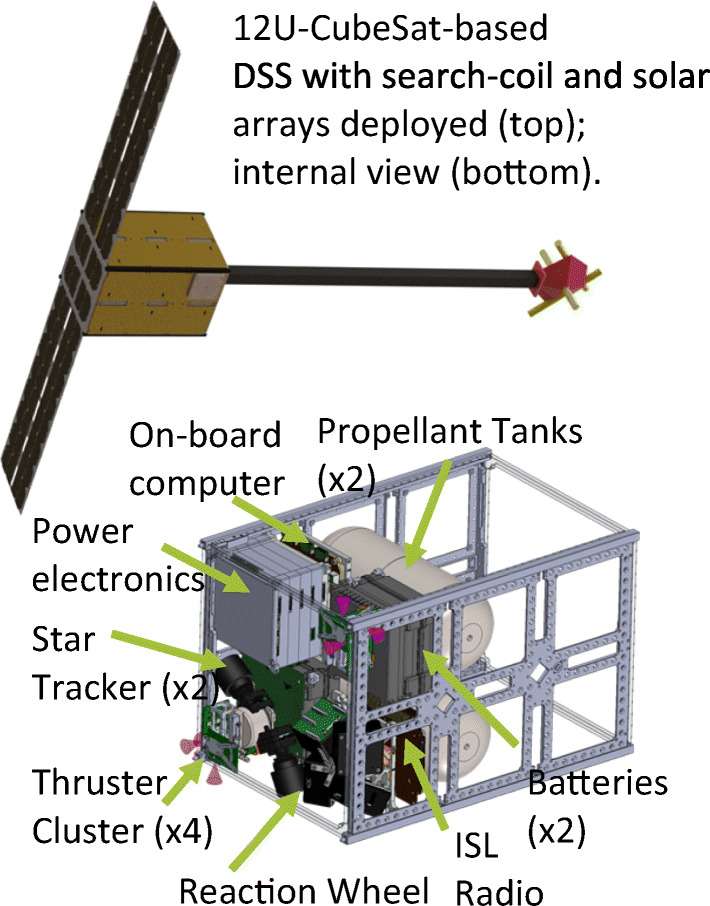
12U-CubeSat-based DSS with search-coil and solar arrays deployed (top); internal view (bottom)

References

    1. Akimoto K, Gary SP, Omidi N. Electron/ion whistler instabilities and magnetic noise bursts. J. Geophys. Res. 1987;92:11209–11214. doi: 10.1029/JA092iA10p11209. - DOI
    1. Alexandrova O, Saur J, Lacombe C, Mangeney A, Mitchell J, Schwartz SJ, Robert P. Universality of Solar-Wind Turbulent Spectrum from MHD to Electron Scales. Phys. Rev. Lett. 2009;103:165003. doi: 10.1103/PhysRevLett.103.165003. - DOI - PubMed
    1. Alexandrova O, Bale SD, Lacombe C. Comment on “Evidence of a Cascade and Dissipation of Solar-Wind Turbulence at the Electron Gyroscale”. Phys. Rev. Lett. 2013;111:149001. doi: 10.1103/PhysRevLett.111.149001. - DOI - PubMed
    1. Araneda JA, Maneva Y, Marsch E. Preferential Heating and Acceleration of α Particles by Alfvén-Cyclotron Waves. Phys. Rev. Lett. 2009;102:175001. doi: 10.1103/PhysRevLett.102.175001. - DOI - PubMed
    1. Artemyev AV, Rankin R, Blanco M. Electron trapping and acceleration by kinetic Alfven waves in the inner magnetosphere. J. Geophys. Res. (Space Physics) 2015;120:10,305–10,316. doi: 10.1002/2015JA021781. - DOI

LinkOut - more resources