


Increasing the availability of health workers in rural sub-Saharan Africa: a scoping review of rural pipeline programmes
- PMID: 36918864
- PMCID: PMC10013286
- DOI: 10.1186/s12960-023-00801-z
Increasing the availability of health workers in rural sub-Saharan Africa: a scoping review of rural pipeline programmes
Abstract
Introduction: Rural pipeline approach has recently gain prominent recognition in improving the availability of health workers in hard-to-reach areas such as rural and poor regions. Understanding implications for its successful implementation is important to guide health policy and decision-makers in Sub-Saharan Africa. This review aims to synthesize the evidence on rural pipeline implementation and impacts in sub-Saharan Africa.
Methods: We conducted a scoping review using Joanna Briggs Institute guidebook. We searched in PubMed and Google scholar databases and the grey literature. We conducted a thematic analysis to assess the studies. Data were reported following the PRISMA extension for Scoping reviews guidelines.
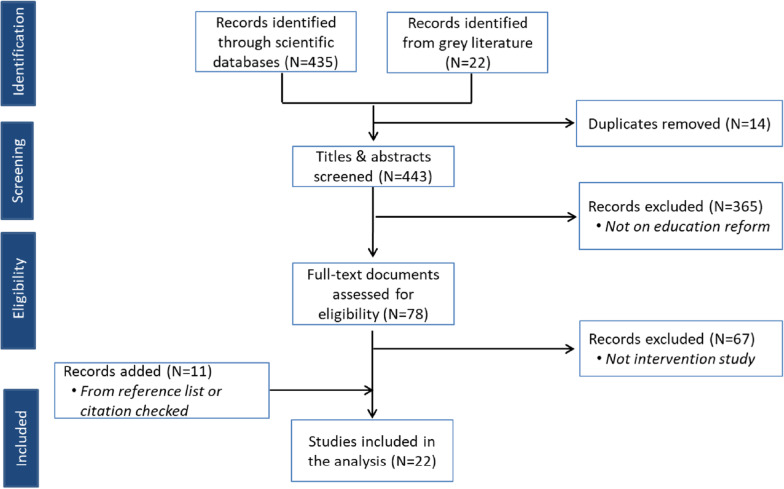
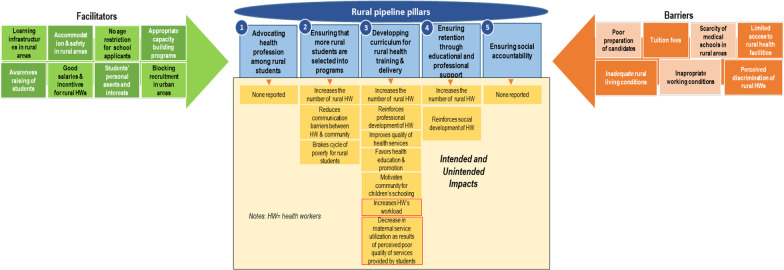
Results: Of the 443 references identified through database searching, 22 met the inclusion criteria. Rural pipeline pillars that generated impacts included ensuring that more rural students are selected into programmes; developing a curriculum oriented towards rural health and rural exposure during training; curriculum oriented to rural health delivery; and ensuring retention of health workers in rural areas through educational and professional support. These impacts varied from one pillar to another and included: increased in number of rural health practitioners; reduction in communication barriers between healthcare providers and community members; changes in household economic and social circumstances especially for students from poor family; improvement of health services quality; improved health education and promotion within rural communities; and motivation of community members to enrol their children in school. However, implementation of rural pipeline resulted in some unintended impacts such as perceived workload increased by trainee's supervisors; increased job absenteeism among senior health providers; patients' discomfort of being attended by students; perceived poor quality care provided by students which influenced health facilities attendance. Facilitating factors of rural pipeline implementation included: availability of learning infrastructures in rural areas; ensuring students' accommodation and safety; setting no age restriction for students applying for rural medical schools; and appropriate academic capacity-building programmes for medical students. Implementation challenges included poor preparation of rural health training schools' candidates; tuition fees payment; limited access to rural health facilities for students training; inadequate living and working conditions; and perceived discrimination of rural health workers.
Conclusion: This review advocates for combined implementation of rural pipeline pillars, taking into account the specificity of country context. Policy and decision-makers in sub-Saharan Africa should extend rural training programmes to involve nurses, midwives and other allied health professionals. Decision-makers in sub-Saharan Africa should also commit more for improving rural living and working environments to facilitate the implementation of rural health workforce development programmes.
Keywords: Health workers; Medical education reforms; Rural pipeline programmes; Scoping review; Sub-Saharan Africa.
© 2023. The Author(s).
Conflict of interest statement
The authors declare that they have no competing interests.
Figures
References
-
- World Health Organization. Health workforce requirements for universal health coverage and the Sustainable Development Goals. Hum Resour Heal Obs Ser. 2016;(17):1-40. ISBN 978 92 4 151140 7.
-
- Butler C. A World at Risk: Annual Report on Global Preparedness for Health Emergencies Global Preparedness Monitoring Board. vol. 151; 2019. 10.2307/40153772.
-
- WHO. WHO guideline on health workforce development, attraction, recruitment and retention in rural and remote areas. 2021:6. - PubMed
Publication types
MeSH terms
Grants and funding
LinkOut - more resources
Full Text Sources
Medical
Miscellaneous
