


Mapping reviews, scoping reviews, and evidence and gap maps (EGMs): the same but different- the "Big Picture" review family
- PMID: 36918977
- PMCID: PMC10014395
- DOI: 10.1186/s13643-023-02178-5
Mapping reviews, scoping reviews, and evidence and gap maps (EGMs): the same but different- the "Big Picture" review family
Erratum in
-
Correction: Mapping reviews, scoping reviews, and evidence and gap maps (EGMs): the same but different- the "Big Picture" review family.Syst Rev. 2023 Apr 1;12(1):61. doi: 10.1186/s13643-023-02224-2. Syst Rev. 2023. PMID: 37005692 Free PMC article. No abstract available.
Abstract
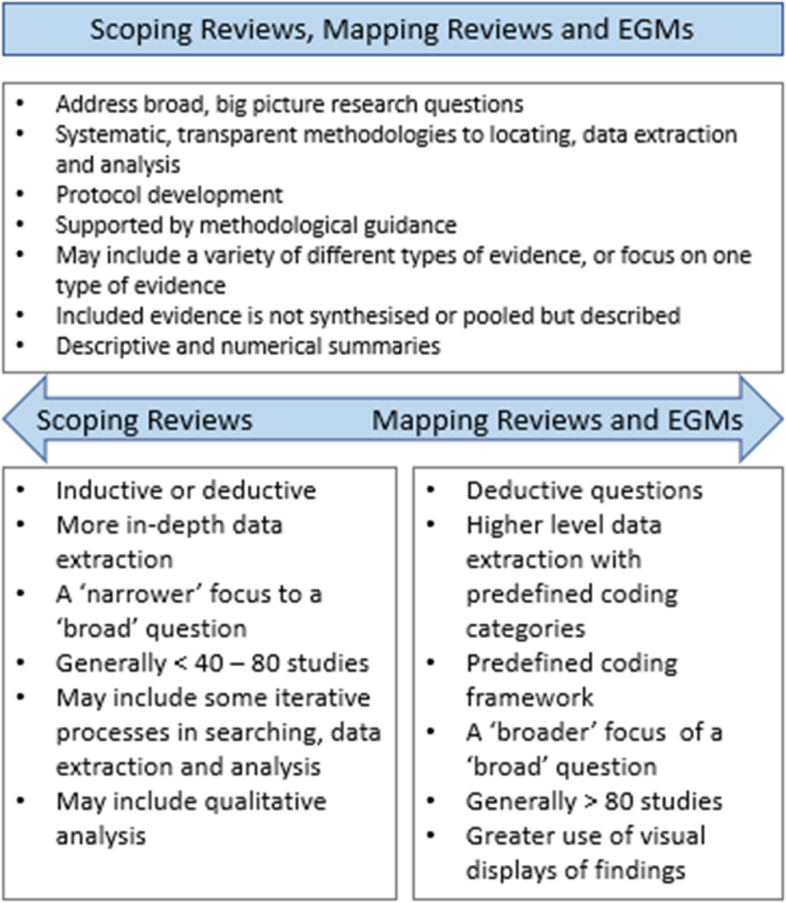
Scoping reviews, mapping reviews, and evidence and gap maps are evidence synthesis methodologies that address broad research questions, aiming to describe a bigger picture rather than address a specific question about intervention effectiveness. They are being increasingly used to support a range of purposes including guiding research priorities and decision making. There is however a confusing array of terminology used to describe these different approaches. In this commentary, we aim to describe where there are differences in terminology and where this equates to differences in meaning. We demonstrate the different theoretical routes that underpin these differences. We suggest ways in which the approaches of scoping and mapping reviews may differ in order to guide consistency in reporting and method. We propose that mapping and scoping reviews and evidence and gap maps have similarities that unite them as a group but also have unique differences. Understanding these similarities and differences is important for informing the development of methods used to undertake and report these types of evidence synthesis.
© 2023. The Author(s).
Conflict of interest statement
The authors declare that they have no competing interests.
Figures
References
Publication types
MeSH terms
LinkOut - more resources
Full Text Sources
Miscellaneous
