


Acetaminophen Metabolites on Presentation Following an Acute Acetaminophen Overdose (ATOM-7)
- PMID: 36919638
- PMCID: PMC10952325
- DOI: 10.1002/cpt.2888
Acetaminophen Metabolites on Presentation Following an Acute Acetaminophen Overdose (ATOM-7)
Abstract
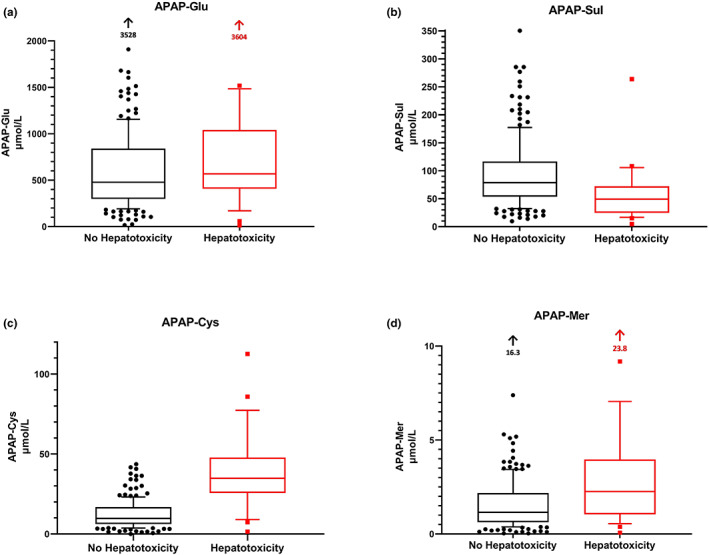
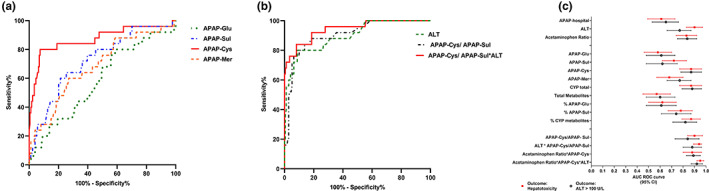
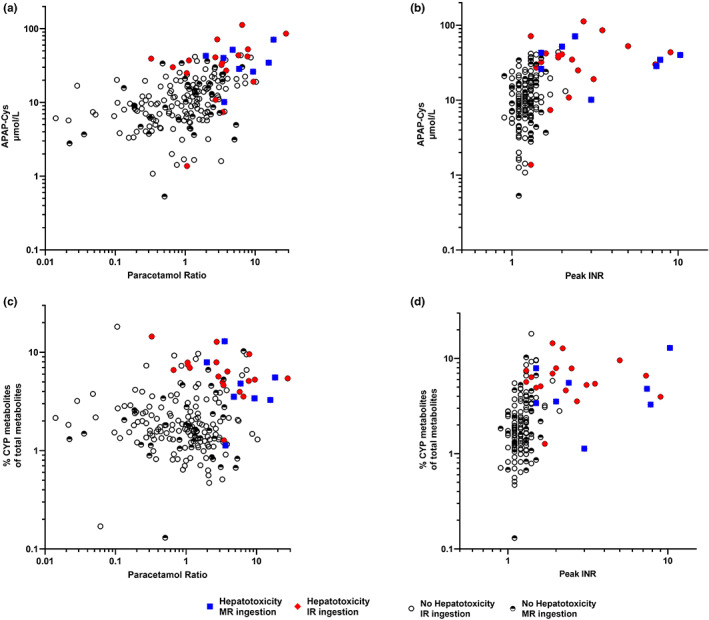
Acetaminophen (APAP) is commonly taken in overdose and can cause acute liver injury via the toxic metabolite NAPQI formed by cytochrome (CYP) P450 pathway. We aimed to evaluate the concentrations of APAP metabolites on presentation following an acute APAP poisoning and whether these predicted the subsequent onset of hepatotoxicity (peak alanine aminotransferase > 1,000 U/L). The Australian Toxicology Monitoring (ATOM) study is a prospective observational study, recruiting via two poison information centers and four toxicology units. Patients following an acute APAP ingestion presenting < 24 hours post-ingestion were recruited. Initial samples were analyzed for APAP metabolites, those measured were the nontoxic glucuronide (APAP-Glu) and sulfate (APAP-Sul) conjugates and NAPQI (toxic metabolite) conjugates APAP-cysteine (APAP-Cys) and APAP-mercapturate (APAP-Mer). The primary outcome was hepatotoxicity. In this study, 200 patients were included, with a median ingested dose of 20 g, 191 received acetylcysteine at median time of 5.8 hours post-ingestion. Twenty-six patients developed hepatotoxicity, one had hepatotoxicity on arrival (excluded from analysis). Those who developed hepatotoxicity had significantly higher total CYP metabolite concentrations: (36.8 μmol/L interquartile range (IQR): 27.8-51.7 vs. 10.8 μmol/L IQR: 6.9-19.5) and these were a greater proportion of total metabolites (5.4%, IQR: 3.8-7.7) vs. 1.7%, IQR: 1.3-2.6, P < 0.001)]. Furthermore, those who developed hepatotoxicity had lower APAP-Sul concentrations (49.1 μmol/L, IQR: 24.7-72.2 vs. 78.7 μmol/L, IQR: 53.6-116.4) and lower percentage of APAP-Sul (6.3%, IQR: 4.6-10.9 vs. 13.1%, IQR, 9.1-20.8, P < 0.001)]. This study found that those who developed hepatotoxicity had higher APAP metabolites derived from CYP pathway and lower sulfation metabolite on presentation. APAP metabolites may be utilized in the future to identify patients who could benefit from increased acetylcysteine or newer adjunct or research therapies.
© 2023 The Authors. Clinical Pharmacology & Therapeutics published by Wiley Periodicals LLC on behalf of American Society for Clinical Pharmacology and Therapeutics.
Conflict of interest statement
The authors declared no competing interests for this work.
Figures
References
-
- Cairns, R.B.J. , Wylie, C.E. , Dawson, A.H. , Isbister, G.K. & Buckley, N.A. Paracetamol poisoning in Australia, 2004‐2017: an analysis of overdose frequency, overdose size, liver injury and deaths. Med. J. Aust. 211, 218–223 (2019). - PubMed
-
- Gummin, D.D. et al. 2018 annual report of the American Association of Poison Control Centers' National Poison Data System (NPDS): 36th annual report. Clin. Toxicol. (Phila.) 57, 1220–1413 (2019). - PubMed
-
- Larson, A.M. et al. Acetaminophen‐induced acute liver failure: results of a United States multicenter, prospective study. Hepatology 42, 1364–1372 (2005). - PubMed
-
- Graudins, A. Paracetamol poisoning in adolescents in an Australian setting: not quite adults. Emerg. Med. Australas. 27, 139–144 (2015). - PubMed
Publication types
MeSH terms
Substances
Associated data
LinkOut - more resources
Full Text Sources
Medical
Miscellaneous
