. 2023 Aug;45(4):2495-2510.
doi: 10.1007/s11357-023-00770-0. Epub 2023 Mar 15.

Four anti-aging drugs and calorie-restricted diet produce parallel effects in fat, brain, muscle, macrophages, and plasma of young mice

Affiliations

Four anti-aging drugs and calorie-restricted diet produce parallel effects in fat, brain, muscle, macrophages, and plasma of young mice

Xinna Li et al. Geroscience. 2023 Aug.

Abstract

Average and maximal lifespan can be increased in mice, in one or both sexes, by four drugs: rapamycin, acarbose, 17a-estradiol, and canagliflozin. We show here that these four drugs, as well as a calorie-restricted diet, can induce a common set of changes in fat, macrophages, plasma, muscle, and brain when evaluated in young adults at 12 months of age. These shared traits include an increase in uncoupling protein UCP1 in brown fat and in subcutaneous and intra-abdominal white fat, a decline in proinflammatory M1 macrophages and corresponding increase in anti-inflammatory M2 macrophages, an increase in muscle fibronectin type III domain containing 5 (FNDC5) and its cleavage product irisin, and higher levels of doublecortin (DCX) and brain-derived neurotrophic factor (BDNF) in brain. Each of these proteins is thought to play a role in one or more age-related diseases, including metabolic, inflammatory, and neurodegenerative diseases. We have previously shown that the same suite of changes is seen in each of four varieties of slow-aging single-gene mutant mice. We propose that these changes may be a part of a shared common pathway that is seen in slow-aging mice whether the delayed aging is due to a mutation, a low-calorie diet, or a drug.

Keywords: Brain-derived neurotrophic factor (BDNF); Doublecortin (DCX); Fibronectin type III domain containing 5 (FNDC5); Inflammatory; Neurodegenerative; Slow-aging mice; Uncoupling protein UCP1.


Conflict of interest statement

The authors declare no competing interests.

Figures
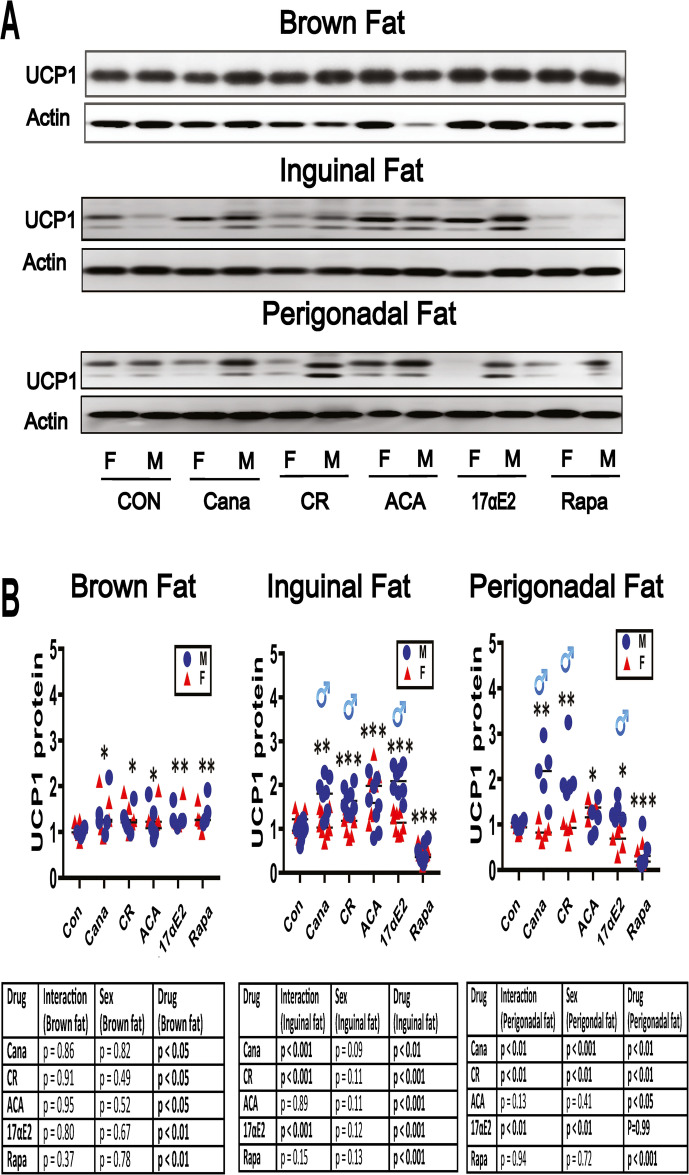
Fig. 1
Fig. 1
Expression of UCP1 in adipose tissue of five varieties of slow-aging mice. A. Cell lysates were prepared from adipose tissues (brown adipose tissue, inguinal adipose tissue, and perigonadal adipose tissue) of 48-week-old wild type littermate control mice (WT) and mice treated with the indicated interventions (CR diet, Cana, 17aE2, Aca, and Rapa) from 4 months of age. Protein levels of UCP1 (brown and beige fat marker) were measured by western blotting. Representative gel images showing UCP1 in brown adipose tissue, inguinal adipose tissue, and perigonadal adipose tissue. B. Protein quantification data normalized to β-actin and expressed as fold change compared with WT control (defined as 1.0). For BAT and PG WAT, N = 5 mice for each group (control and slow-aging mice). For ING WAT, N = 8 mice for each group (control and slow-aging mice). Each symbol shows an individual mouse. * p < 0.05; ** p < 0.01, *** p < 0.001 versus control mice
Fig. 2
Fig. 2
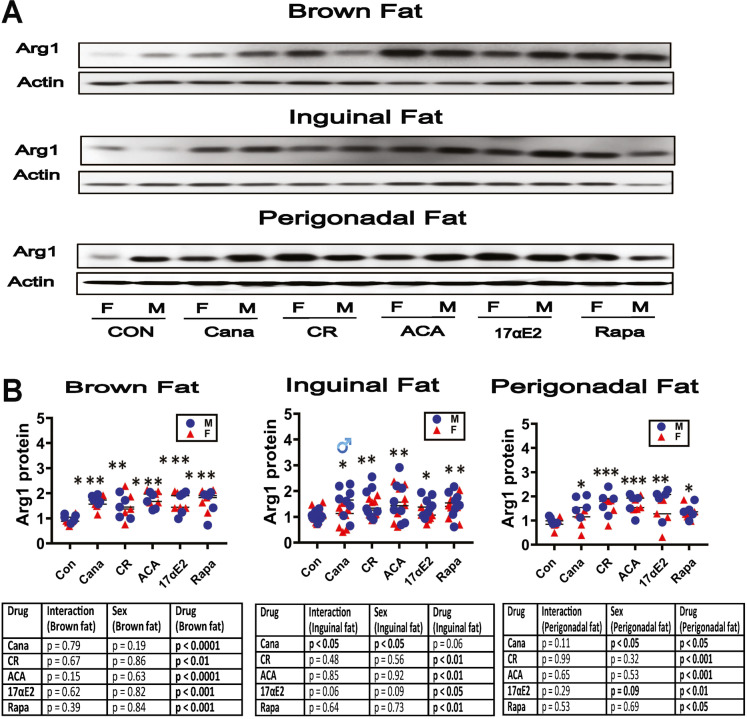
Expression of adipose tissue macrophage infiltration and M2 macrophage marker in adipose tissue of five varieties of slow-aging mice. A. Cell lysates were prepared from adipose tissues (brown adipose tissue, inguinal adipose tissue, and perigonadal adipose tissue) of 48-week-old wild type littermate control mice (WT) and mice treated with the indicated interventions (CR diet, Cana, 17aE2, Aca, and Rapa) from 4 months of age. Protein levels of Arg1 (M2 macrophage marker) were measured by western blotting. Representative gel images showing Arg1 in brown adipose tissue, inguinal adipose tissue, and perigonadal adipose tissue. B. Protein quantification data normalized to β-actin and expressed as fold change compared with WT control (defined as 1.0 For BAT and PG WAT, N = 5 mice for each group (control and slow-aging mice). For ING WAT, N = 8 mice for each group (control and slow-aging mice). Each symbol shows an individual mouse. * p < 0.05; ** p < 0.01, *** p < 0.001 versus control mice
Fig. 3
Fig. 3
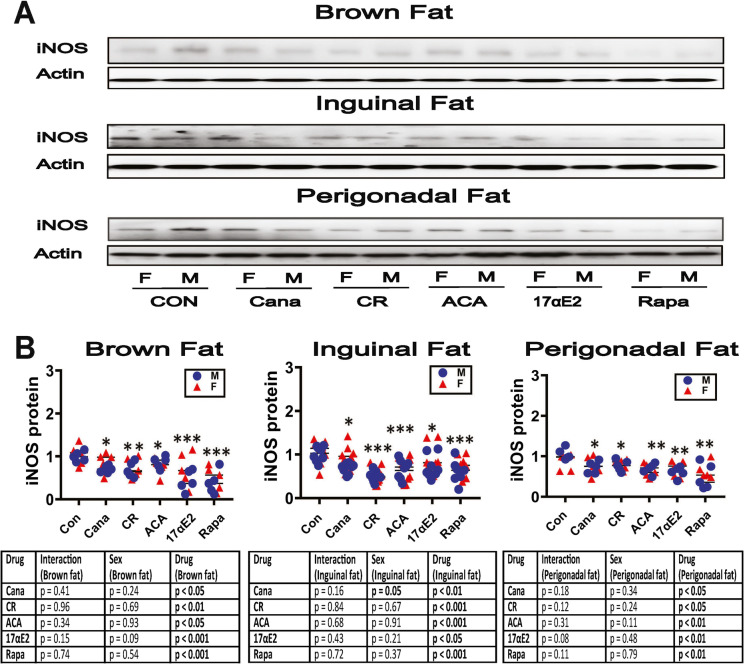
Expression of adipose tissue macrophage infiltration and M1 macrophage marker in adipose tissue of five varieties of slow-aging mice. A. Cell lysates were prepared from adipose tissues (brown adipose tissue, inguinal adipose tissue and perigonadal adipose tissue) of 48-week-old wild type littermate control mice (WT) and mice treated with the indicated interventions (CR diet, Cana, 17aE2, Aca, and Rapa) from 4 months of age. Protein levels of iNOS (M1 macrophage marker) were measured by western blotting. Representative gel images showing iNOS in brown adipose tissue, inguinal adipose tissue, and perigonadal adipose tissue. B. Protein quantification data normalized to β-actin and expressed as fold change compared with WT control (defined as 1.0 For BAT and PG FAT, N = 5 mice for each group (WT and slow-aging mice). For ING FAT, N = 8 mice for each group (WT and slow-aging mice). Each symbol shows an individual mouse. * p < 0.05; ** p < 0.01, *** p < 0.001 versus control mice
Fig. 4
Fig. 4
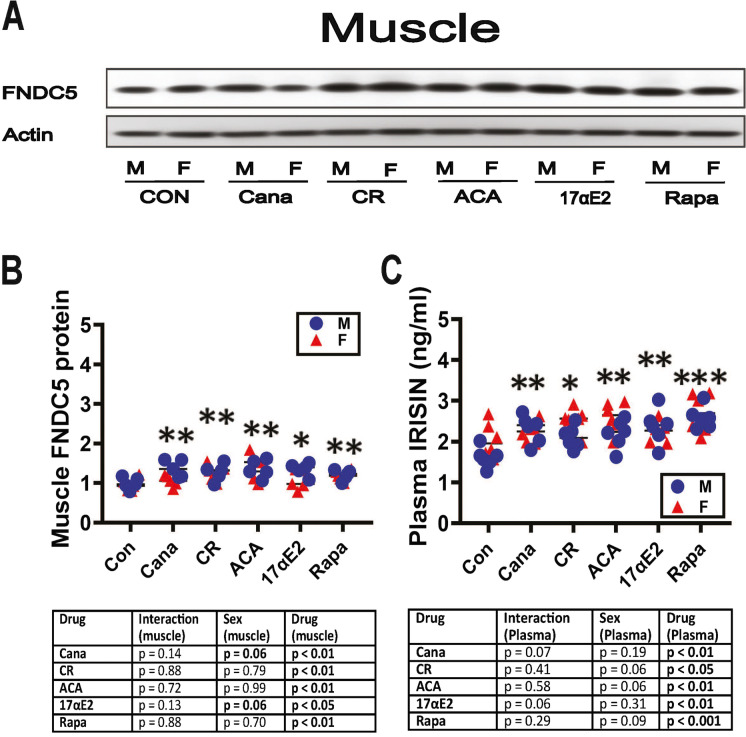
Expression of FNDC5 in thigh muscle and plasma irisin levels of five varieties of slow-aging mice. A. Cell lysates were prepared from thigh muscle of 48-week-old wild type littermate control mice (WT) and mice treated with the indicated interventions (CR diet, Cana, 17aE2, Aca, and Rapa) from 4 months of age. Protein levels of FNDC5 were measured by western blotting. Representative gel images are shown. B. Protein quantification data normalized to β-actin and expressed as fold change compared with WT control (defined as 1.0). N = 5 mice for each group (WT and slow-aging mice. Data are means ± SEM. * p < 0.05, ** p < 0.01, *** p < 0.001 versus WT. C. Irisin content was measured by ELISA assay on plasma samples of 48-week-old wild type littermate control mice (WT) and five varieties of slow-aging mice (Cana, CR, ACA, 17aE2, and Rapa). N = 6 per group. Each symbol shows an individual mouse. * p < 0.05; ** p < 0.01, *** p < 0.001 versus control mice
Fig. 5
Fig. 5
Expression of BDNF and doublecortin (Dcx) in brain cortex of five varieties of slow-aging mice. A. Cell lysates were prepared from brain cortex of 48-week-old wild type littermate control mice (WT) and mice treated with the indicated interventions (CR diet, Cana, 17aE2, Aca, and Rapa) from 4 months of age. Protein levels of BDNF and Dcx were measured by western blotting. Representative gel images are shown. B. Protein quantification data normalized to β-actin and expressed as fold change compared with WT control (defined as 1.0). N = 5 mice for each group (WT and slow-aging mice. Each symbol shows an individual mouse. * p < 0.05; ** p < 0.01, *** p < 0.001 versus control mice
Fig. 6
Fig. 6
Expression of FNDC5 in brain cortex of five varieties of slow-aging mice. A. Cell lysates were prepared from brain cortex of 48-week-old wild type littermate control mice (WT) and mice treated with the indicated interventions (CR diet, Cana, 17aE2, Aca, and Rapa) from 4 months of age. Protein levels of FNDC5 were measured by western blotting. Representative gel images are shown. B. Protein quantification data normalized to β-actin and expressed as fold change compared with WT control (defined as 1.0). N = 5 mice for each group (WT and slow-aging mice. Each symbol shows an individual mouse. * p < 0.05; ** p < 0.01, *** p < 0.001 versus control mice

References

    1. Fontana L, Partridge L, Longo VD. Extending healthy life span—from yeast to humans. Sci. 2010;328(5976):321–326. - PMC - PubMed
    1. Ravussin E, et al. A 2-year randomized controlled trial of human caloric restriction: feasibility and effects on predictors of health span and longevity. J Gerontol A Biol Sci Med Sci. 2015;70(9):1097–1104. - PMC - PubMed
    1. Mattison JA, et al. Caloric restriction improves health and survival of rhesus monkeys. Nat Commun. 2017;8:14063. - PMC - PubMed
    1. Miller RA, et al. Canagliflozin extends life span in genetically heterogeneous male but not female mice. JCI Insight. 2020;5(21). - PMC - PubMed
    1. Harrison DE, et al. Acarbose, 17-α-estradiol, and nordihydroguaiaretic acid extend mouse lifespan preferentially in males. Aging Cell. 2014;13(2):273–282. - PMC - PubMed

Publication types

LinkOut - more resources