Review
. 2023 Sep;23(9):563-579.
doi: 10.1038/s41577-023-00848-y. Epub 2023 Mar 15.

Tissue-specific macrophages: how they develop and choreograph tissue biology

Affiliations
Review

Tissue-specific macrophages: how they develop and choreograph tissue biology

Elvira Mass et al. Nat Rev Immunol. 2023 Sep.

Abstract

Macrophages are innate immune cells that form a 3D network in all our tissues, where they phagocytose dying cells and cell debris, immune complexes, bacteria and other waste products. Simultaneously, they produce growth factors and signalling molecules - such activities not only promote host protection in response to invading microorganisms but are also crucial for organ development and homeostasis. There is mounting evidence of macrophages orchestrating fundamental physiological processes, such as blood vessel formation, adipogenesis, metabolism and central and peripheral neuronal function. In parallel, novel methodologies have led to the characterization of tissue-specific macrophages, with distinct subpopulations of these cells showing different developmental trajectories, transcriptional programmes and life cycles. Here, we summarize our growing knowledge of macrophage diversity and how macrophage subsets orchestrate tissue development and function. We further interrelate macrophage ontogeny with their core functions across tissues, that is, the signalling events within the macrophage niche that may control organ functionality during development, homeostasis and ageing. Finally, we highlight the open questions that will need to be addressed by future studies to better understand the tissue-specific functions of distinct macrophage subsets.


Conflict of interest statement

The authors declare that they have no conflicts of interests.

Figures
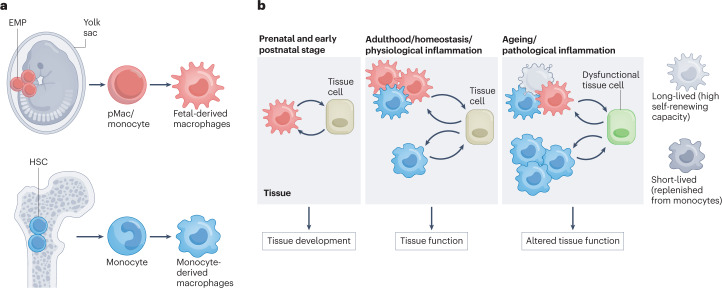
Fig. 1
Fig. 1. Contribution of distinct macrophage subsets to tissue function.
a, Distinct developmental arms of tissue macrophages. Yolk sac erythro-myeloid progenitors (EMPs) give rise to pre-macrophages (pMac) and monocytes that can differentiate into long-lived tissue-resident macrophages. By contrast, haematopoietic stem cells (HSCs) can give rise to short-lived and long-lived macrophages during early postnatal stage and during adulthood. b, EMP-derived and HSC-derived macrophages contribute to the function of tissue via cell–cell crosstalk with specialized tissue cells. Tissue development relies entirely on EMP-derived macrophages. During homeostasis, distinct macrophage subpopulations crosstalk with tissue cells to support tissue function. Upon ageing or pathological inflammation, the fine-tuned balance of macrophage distribution in the tissue is disturbed triggering, for example, apoptosis of long-lived macrophages, or increased recruitment of short-lived HSC-derived macrophages, thereby leading to tissue dysfunction.
Fig. 2
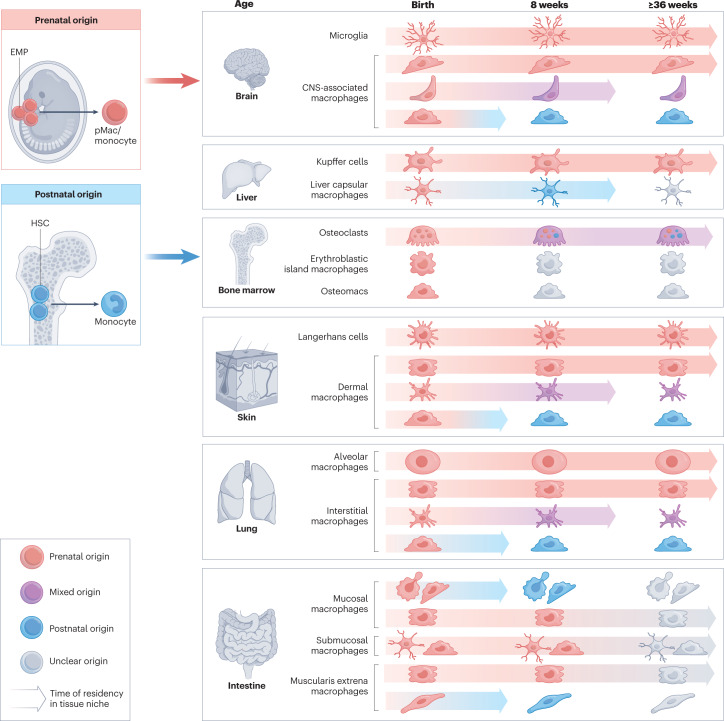
Fig. 2. Heterogeneity, ontogeny and self-renewing capacity of macrophage populations in adult tissues during steady state.
Internal and barrier tissues are colonized by yolk sac progenitors during organogenesis that develop into tissue-specific macrophages inhabiting distinct anatomical areas and subtissular niches of an organ. During organ maturation, bone-marrow erythro-myeloid progenitors (HSCs) contribute to some degree to certain macrophage populations that have a high self-renewing capacity and, thus, have a prolonged time of residency in the tissue niche, for example, the central nervous system (CNS)-associated macrophages, liver capsular macrophages, dermal macrophages and lung interstitial macrophages. Osteoclasts are long-lived, but exchange their fetal-derived nuclei for monocyte-derived nuclei over time. Additionally, a defined fraction of short-lived macrophages is constantly replenished by adult monocytes in some tissues, such as the brain, skin, lung and intestine. The ontogeny and cell cycle of many macrophage subpopulations in a fully matured organ (≥12 weeks of age) and during ageing are not known (indicated by grey colour). EMP, erythro-myeloid progenitor; pMac, pre-macrophage.
Fig. 3
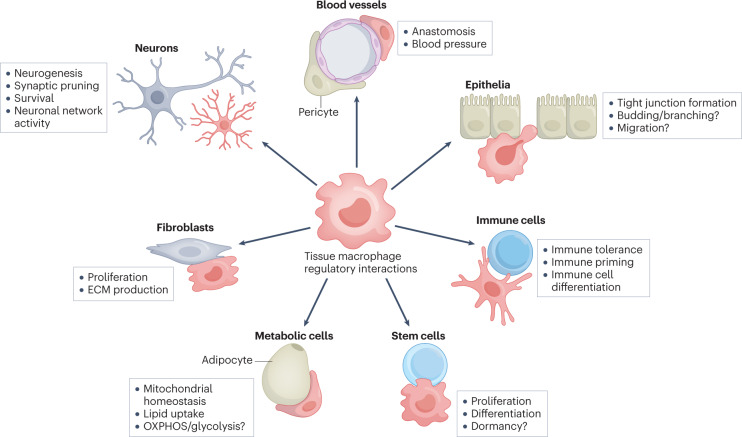
Fig. 3. Subtissular niches of tissue-specific macrophages and their role in tissue function.
Macrophages contribute to the function of the tissue via cell–cell crosstalk with specialized tissue cells. Some of the functions are well known, such as the interaction of microglia with neurons, which is essential for neurodevelopment and function. See text for further information about macrophage core functions in different tissues. Other functions are assumed (labelled with a question mark), but have not been studied. ECM, extracellular matrix; OXPHOS, oxidative phosphorylation.

References

    1. Jenkins SJ, Allen JE. The expanding world of tissue-resident macrophages. Eur. J. Immunol. 2021;51:1882–1896. doi: 10.1002/eji.202048881. - DOI - PubMed
    1. Mass E, et al. Specification of tissue-resident macrophages during organogenesis. Science. 2016;353:aaf4238. doi: 10.1126/science.aaf4238. - DOI - PMC - PubMed
    1. Dick SA, et al. Three tissue resident macrophage subsets coexist across organs with conserved origins and life cycles. Sci. Immunol. 2022;7:7777. doi: 10.1126/sciimmunol.abf7777. - DOI - PubMed
    1. Gomez Perdiguero E, et al. Tissue-resident macrophages originate from yolk-sac-derived erythro-myeloid progenitors. Nature. 2015;518:547–551. doi: 10.1038/nature13989. - DOI - PMC - PubMed
    1. Hoeffel G, et al. C-Myb(+) erythro-myeloid progenitor-derived fetal monocytes give rise to adult tissue-resident macrophages. Immunity. 2015;42:665–678. doi: 10.1016/j.immuni.2015.03.011. - DOI - PMC - PubMed

Publication types