


Effectiveness of a guided internet-based intervention for procrastination among university students - A randomized controlled trial study protocol
- PMID: 36922962
- PMCID: PMC10009202
- DOI: 10.1016/j.invent.2023.100612
Effectiveness of a guided internet-based intervention for procrastination among university students - A randomized controlled trial study protocol
Abstract
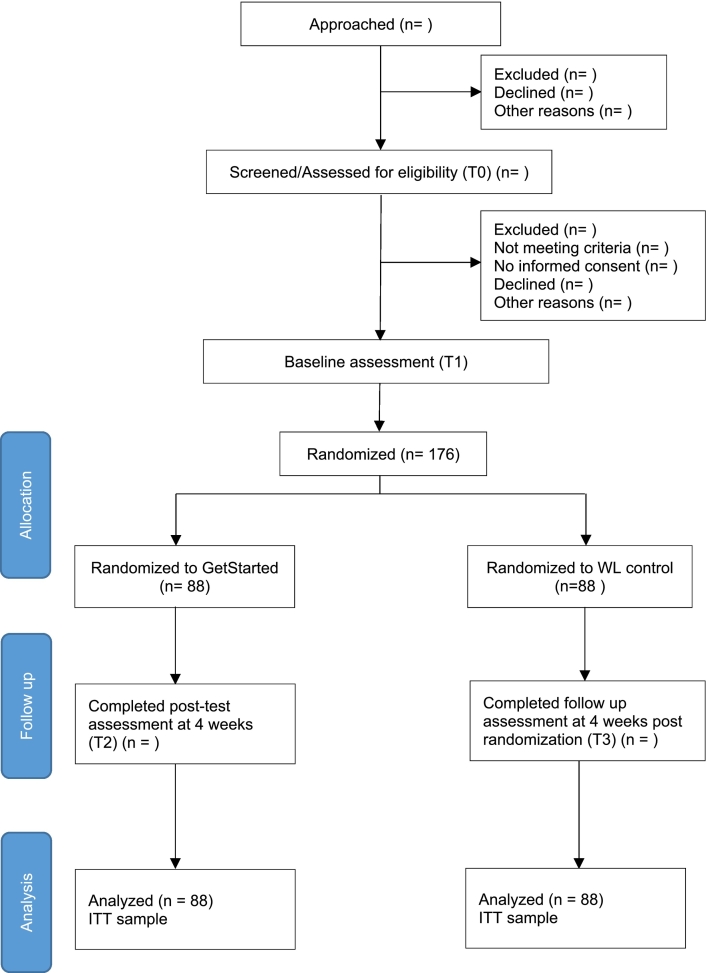
Procrastination is a widespread problem that is highly prevalent among the young adult population and is associated with several negative consequences. However, current evidence on the effectiveness of e-health interventions for procrastination either lack a comparison to an inactive control, do not include a student population or are of poor quality. This protocol describes the design of a trial that will overcome these limitations and examine the effectiveness of a guided internet-based intervention (GetStarted) to reduce problematic procrastinating behaviors in college students compared to a waitlist control. This study will be a two-armed randomized controlled trial with a calculated sample size of N = 176. Participants will be students from seven universities in the Netherlands. The intervention group will receive a four-week e-coach-guided intervention for procrastination. The waitlist control group will get access to treatment four weeks after randomization. Assessments will take place at baseline, post-test (4 weeks post-baseline) and follow-up (6 months post-baseline). Data will be analyzed with an intent-to-treat principle. The primary outcome is change in procrastination behaviors measured on the Irrational Procrastination scale (IPS). Secondary outcomes are depression, anxiety, stress, and quality of life. Additionally, sociodemographic characteristics of the participants, satisfaction with treatment, program usability, satisfaction with e-coach and treatment adherence will be examined as potential moderators. The results from this study can build evidence for the effectiveness of a guided internet-based intervention for treating procrastination in college students. Should it be effective, GetStarted could provide a flexible, low-intense and cost-effective treatment for procrastination and prevent common mental health problems in college students.
Trial registration: This trial is registered at ClinicalTrials.gov Protocol Registration and Results System (Trial number: NCT05478096).
Keywords: Guided intervention; Internet-based intervention; Mental heath; Procrastination; University students.
© 2023 The Authors.
Conflict of interest statement
The authors declare that they have no known competing financial interests or personal relationships that could have appeared to influence the work reported in this paper.
Figures
References
-
- Beutel M.E., Klein E.M., Aufenanger S., Brähler E., Dreier M., Müller K.W., Quiring O., Reinecke L., Schmutzer G., Stark B., Wölfling K. Procrastination, distress and life satisfaction across the age range - a German representative community study. PloS one. 2016;11(2) doi: 10.1371/journal.pone.0148054. - DOI - PMC - PubMed
-
- Brooke J. Usability Evaluation in Industry. 189(194) 1996. SUS-a quick and dirty usability scale; pp. 4–7.
-
- Chan A.W., Tetzlaff J.M., Altman D.G., Laupacis A., Gøtzsche P.C., Krleža-Jerić K., Hróbjartsson A., Mann H., Dickersin K., Berlin J.A., Doré C.J., Parulekar W.R., Summerskill W.S., Groves T., Schulz K.F., Sox H.C., Rockhold F.W., Rennie D., Moher D. SPIRIT 2013 statement: defining standard protocol items for clinical trials. Ann. Intern. Med. 2013;158(3):200–207. doi: 10.7326/0003-4819-158-3-201302050-00583. - DOI - PMC - PubMed
Associated data
LinkOut - more resources
Full Text Sources
Medical
