Review
. 2023 Feb 27;6(3):334-354.
doi: 10.1021/acsptsci.2c00181. eCollection 2023 Mar 10.

Association of COVID-19 with Comorbidities: An Update

Affiliations
Review

Association of COVID-19 with Comorbidities: An Update

Sayan Chatterjee et al. ACS Pharmacol Transl Sci. .

Abstract

Coronavirus disease (COVID-19) is caused by severe acute respiratory syndrome-coronavirus-2 (SARS-CoV-2) which was identified in Wuhan, China in December 2019 and jeopardized human lives. It spreads at an unprecedented rate worldwide, with serious and still-unfolding health conditions and economic ramifications. Based on the clinical investigations, the severity of COVID-19 appears to be highly variable, ranging from mild to severe infections including the death of an infected individual. To add to this, patients with comorbid conditions such as age or concomitant illnesses are significant predictors of the disease's severity and progression. SARS-CoV-2 enters inside the host cells through ACE2 (angiotensin converting enzyme2) receptor expression; therefore, comorbidities associated with higher ACE2 expression may enhance the virus entry and the severity of COVID-19 infection. It has already been recognized that age-related comorbidities such as Parkinson's disease, cancer, diabetes, and cardiovascular diseases may lead to life-threatening illnesses in COVID-19-infected patients. COVID-19 infection results in the excessive release of cytokines, called "cytokine storm", which causes the worsening of comorbid disease conditions. Different mechanisms of COVID-19 infections leading to intensive care unit (ICU) admissions or deaths have been hypothesized. This review provides insights into the relationship between various comorbidities and COVID-19 infection. We further discuss the potential pathophysiological correlation between COVID-19 disease and comorbidities with the medical interventions for comorbid patients. Toward the end, different therapeutic options have been discussed for COVID-19-infected comorbid patients.


Conflict of interest statement

The authors declare no competing financial interest.

Figures
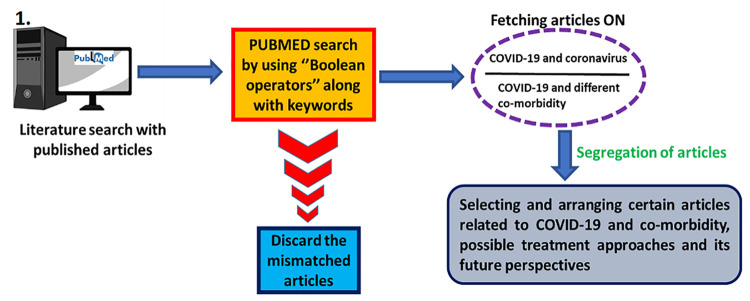
Figure 1
Figure 1
Scheme depicting the process of screening of documented articles to prepare this manuscript. All relevant papers are listed according to the keywords searched in the NCBI search engine (PUBMED) using Boolean operators such as AND, OR, and NOT. The articles were fetched for COVID-19, coronavirus, COVID-19, and comorbidity, along with their possible treatment strategy.
Figure 2
Figure 2
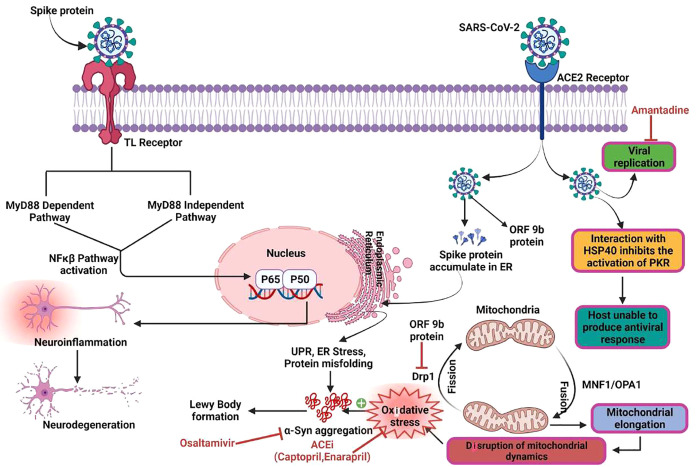
Possible connection between the pathophysiology of Parkinson’s disease and SARS-CoV-2 infection. The virus enters the neurons by binding to the ACE-2 receptors or the TLRs and activates the NF-κB pathway triggering neuroinflammation. The spike protein in the SARS-CoV-2 virus accumulates in the ER and produces a UPR, potentially leading to α-Syn accumulation. The ORF-9b protein of the virus inhibits the Drp1 responsible for mitochondrial fission, thereby disrupting the mitochondrial dynamics. SARS-CoV-2 interacts with Hsp40 and inhibits protein kinase R activation, restricting the host from producing an antiviral response. ACEi, like Captopril and Enalapril, work as antioxidants by reducing oxidative stress and halting the accumulation of α-Syn in Lewy bodies and Lewy neurites. Amantadine inhibits viral replication by blocking the influenza M2 ion channel, thereby preventing the delivery of viral ribonucleoprotein into the cytoplasm of the host and might have a disruptive effect on the lysosomal pathway. As a result, amantadine might be used as potential treatment approach in COVID-19-positive PD patients to lower viral load in these individuals. Oseltamivir, an anti-influenza medication, has also been shown to be helpful in PD because it prevents H1N1-induced α-Syn aggregation.
Figure 3
Figure 3
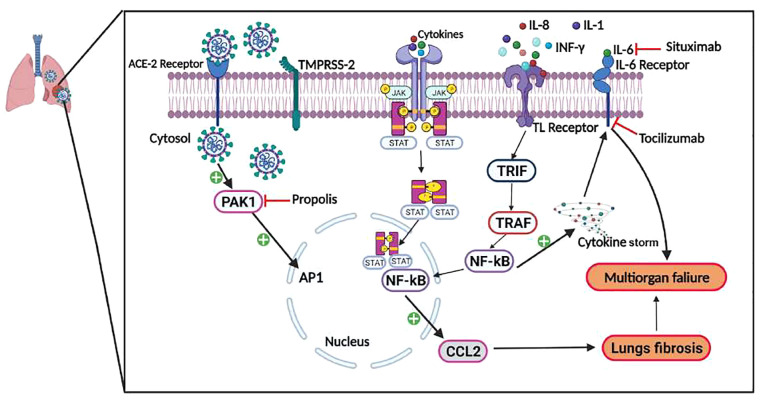
Possible connection between the pathophysiology of cancer and SARS-CoV-2 infection. SARS-CoV-2 virus entry into the host cell is facilitated by spike protein binding to ACE and activation by TMPRSS2. After binding, viral particles undergo endocytosis and active PAK1. Moreover, due to the upregulation of cytokine levels (IL-6, IL-1, and IL-8), JAK/STAT pathway, and TLRs, gets activated, which will further activate the TIR-domain-containing adapter-inducing interferon-β family (TRIF). Following this, TRIF recruits TNF receptor-associated factor (TRAF) which is followed by activation of the inflammatory marker, NF-κB, present in the cytosol. This is followed by nuclear translocation of NF-κB and binding with DNA, and ultimately the formation of CCL2 protein, results in fibrosis. The phenomenon is termed as cytokine storm and is responsible for multiorgan failure and death in cancer patients with COVID-19. Toclizumab, a monoclonal antibody, and situximab, a chimeric mouse–human monoclonal antibody, were both used to block the IL-6 receptor and already exhibited antitumor efficacy under diverse randomized trials control trials for further assessment of its effectiveness for COVID-19 patients. Another drug, propolis, was used to treat lung fibrosis during COVID-19 infection of cancer patients. Propolis inhibits the PAK1 activation in lung fibrosis by stimulating CCL2 production. PAK1 blockers may help in reviving the immune system, preventing lung fibrosis caused by viruses. In this context, propolis, a PAK1 inhibitor, was explored as a therapeutic strategy for COVID-19 patients.
Figure 4
Figure 4
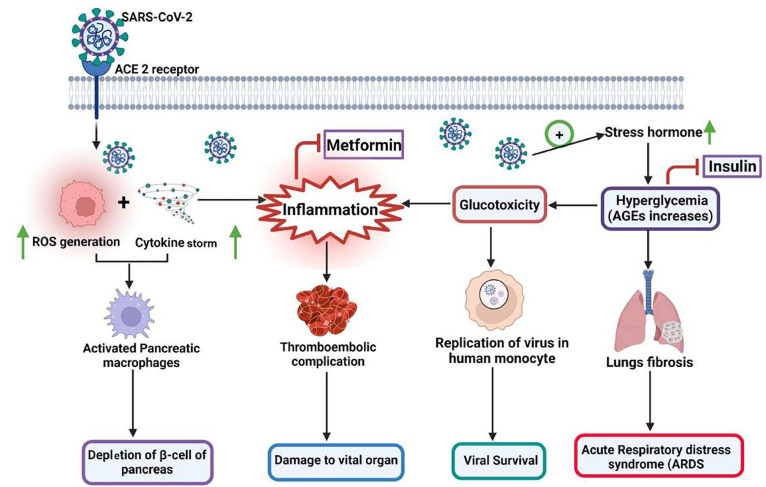
Possible connection between the pathophysiology of diabetes and SARS-CoV-2 infection. Infection with SARS-CoV-2 leads to increased levels of stress hormones like glucocorticoids that cause lung fibrosis, acute lung damage, and acute respiratory distress syndrome (ARDS). Elevated levels of inflammatory cytokines lead to the development of hyperinflammation, further causing the activation of pancreatic macrophages and subsequent depletion of β islets cells. Glucotoxicity resulting from elevated stress levels favors viral survival and eventually causes elevation of inflammation. Insulin resistance, hyperglycemia, and inflammation-induced vascular endothelial damage contribute to cardiovascular events, and thromboembolism leads to multiple organ failures. Due to its anti-inflammatory property, Metformin has demonstrated potential for treatment of the SARS-CoV-2 virus-mediated infection. Metformin inhibits the interaction between the virus and the host cell, and suppresses the production of ACE2 via activation of adenosine monophosphate-activated protein kinase (AMPK).
Figure 5
Figure 5
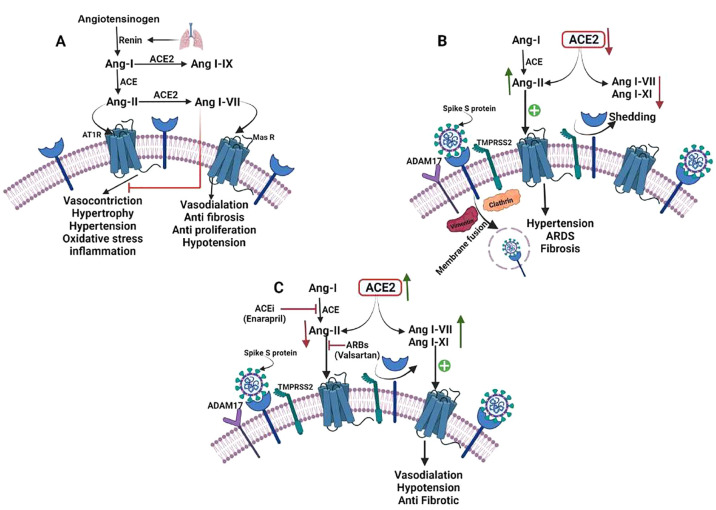
Possible connection between the pathophysiology of Hypertension and SARS-CoV-2 infection. (A) ACE2/Ang I–VII/Mas axis and the renin-angiotensin system (RAS). Angiotensinogen is transformed to Ang-I by the protease renin, which is then converted to Ang-II by the ACE. Vasoconstriction, hypertrophy, fibrosis, proliferation, inflammation, and oxidative stress can be caused by Ang-II following binding to the AT1 receptor. Ang-I and Ang-II can be converted to Ang I–IX and Ang I–VII respectively by ACE2. Vasodilatation, vascular protection, anti-fibrosis, anti-proliferation, and anti-inflammation are effects of Ang I–VII binding to the Mas receptor. (B) When SARS-CoV-2 binds to ACE2, the virus is internalized with the receptor, and ACE2 is removed via ADAM17. Reduced ACE2 availability causes a decrease in the levels of Ang I–VII, I–IX, and Ang-II degradation, as well as increased AT1 receptor activation, facilitating HTN, ARDS, and fibrosis. (C) Infection with SARS-CoV-2 and therapy with ACEi/ARB. After SARS-CoV-2 binding, ACE2 is upregulated by ACEi and ARB, and free ACE2 persists. Ang I–VII, a favorable metabolite of Ang II, is still destroyed by ACE2, although the AT1 receptor is less activated than Mas receptor-activated through increased levels of Ang I–VII and I–IX resulting in vasodilatation, hypotension, and antifibrotic activity. ARB prevents Ang II binding on the AT1 receptor, while ACE decreases Ang II production, resulting in decreased AT1 receptor activation and sustained interaction with ACE2, preventing ACE2 internalization.

References

    1. Zhu N.; Zhang D.; Wang W.; Li X.; Yang B.; Song J.; Zhao X.; Huang B.; Shi W.; Lu R.; et al. A novel coronavirus from patients with pneumonia in China, 2019. N. Engl. J. Med. 2020, 382, 727. 10.1056/NEJMoa2001017. - DOI - PMC - PubMed
    1. Coronavirus resources center.https://coronavirus.jhu.edu/ (acccessed 05–12–2022).
    1. Ejaz H.; Alsrhani A.; Zafar A.; Javed H.; Junaid K.; Abdalla A. E.; Abosalif K. O.; Ahmed Z.; Younas S. COVID-19 and comorbidities: Deleterious impact on infected patients. Journal of infection public health 2020, 13 (12), 1833–1839. 10.1016/j.jiph.2020.07.014. - DOI - PMC - PubMed
    1. Yin Y.; Wunderink R. G. MERS, SARS and other coronaviruses as causes of pneumonia. Respirology 2018, 23 (2), 130–137. 10.1111/resp.13196. - DOI - PMC - PubMed
    1. Al-Qahtani A. A. Severe acute respiratory syndrome coronavirus 2 (SARS-CoV-2): emergence, history, basic and clinical aspects. Saudi journal of biological sciences 2020, 27 (10), 2531–2538. 10.1016/j.sjbs.2020.04.033. - DOI - PMC - PubMed

LinkOut - more resources