


A latent profile analysis of COVID-19 conspiracy beliefs: Associations with thinking styles, mistrust, socio-political control, need for closure and verbal intelligence
- PMID: 36923243
- PMCID: PMC9988712
- DOI: 10.1016/j.paid.2023.112155
A latent profile analysis of COVID-19 conspiracy beliefs: Associations with thinking styles, mistrust, socio-political control, need for closure and verbal intelligence
Abstract
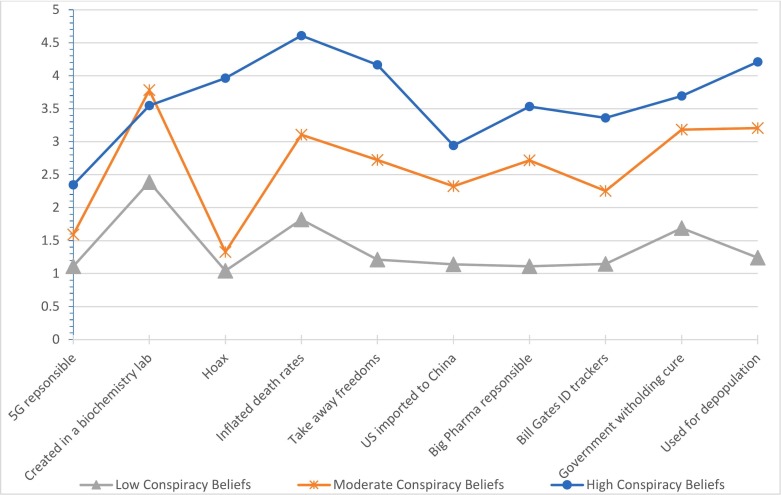
Throughout the COVID-19 pandemic, attention has been drawn to conspiracy theories. To date, research has largely examined commonalities in conspiracy theory belief, however it is important to identify where there may be notable differences. The aim of the present research was first to distinguish between typologies of COVID-19 conspiracy belief and explore demographic, social cognitive factors associated with these beliefs. Secondly, we aimed to examine the effects of such beliefs on adherence to government health guidelines. Participants (N = 319) rated well known COVID-19 conspiracy theories, completing measures of thinking style, socio-political control, mistrust, verbal intelligence, need for closure and demographic information. Participants also rated the extent to which they followed government health guidelines. Latent profile analysis suggests three profiles of COVID-19 conspiracy beliefs with low, moderate, and high COVID conspiracy belief profiles and successively stronger endorsement on all but one of the COVID-19 conspiracy theories. Those holding stronger COVID-19 conspiracy theory beliefs are more likely to reason emotively, feel less socio-political control, mistrust others, have lower verbal ability and adhere less to COVID-19 guidelines. The social and health implications of these findings are discussed.
Keywords: Conspiracy beliefs; Conspiracy theories; Covid-19.
© 2023 The Authors.
Conflict of interest statement
None.
Figures

References
-
- Abalakina-Paap M., Stephan W.G., Craig T., Gregory L.W. Belief in conspiracies. Political Psychology. 1999;20(3):637–647. doi: 10.1111/0162-895X.00160. - DOI
-
- Akaike H. Factor analysis and AIC. Psychometrika. 1987;52(3):317–332.
LinkOut - more resources
Full Text Sources