Protective immunity of SARS-CoV-2 infection and vaccines against medically attended symptomatic omicron BA.4, BA.5, and XBB reinfections in Singapore: a national cohort study
- PMID: 36924786
- PMCID: PMC10306341
- DOI: 10.1016/S1473-3099(23)00060-9
Protective immunity of SARS-CoV-2 infection and vaccines against medically attended symptomatic omicron BA.4, BA.5, and XBB reinfections in Singapore: a national cohort study
Abstract
Background: Despite a large proportion of the population having been vaccinated and infected, Singapore had SARS-CoV-2 waves driven by the BA.5 and XBB sublineages of the omicron (B.1.1.529) variant. Data on the protective immunity against medically attended, symptomatic reinfections with omicron BA.4, BA.5, and XBB conferred by previous SARS-CoV-2 infections and vaccinations are scarce. We therefore aimed to derive information from Singapore's experience as one of the first countries with an XBB-driven wave.
Methods: For this retrospective national cohort study, we used information from official databases of the Ministry of Health of Singapore to assess hybrid immunity (obtained from previous infection and vaccination) against medically attended, symptomatic BA.4 and BA.5 reinfections from Oct 1, 2022, to Nov 1, 2022, and medically attended, symptomatic XBB reinfections from Oct 18, 2022, to Nov 1, 2022, among Singapore citizens and permanent residents aged at least 18 years. All individuals with acute respiratory symptoms who presented at any health-care facility in Singapore between the stated dates were tested for SARS-CoV-2. Individuals were grouped into SARS-CoV-2-naive, pre-omicron, omicron BA.1, and omicron BA.2 groups according to their previous infection status. Data were also stratified by time from first infection to analyse the waning of immunity. Incidence rate ratios (IRRs) were measured by generalised linear Poisson regressions, with SARS-CoV-2-naive individuals as the reference group, and protective immunity was calculated as one minus the risk ratio multiplied by 100.
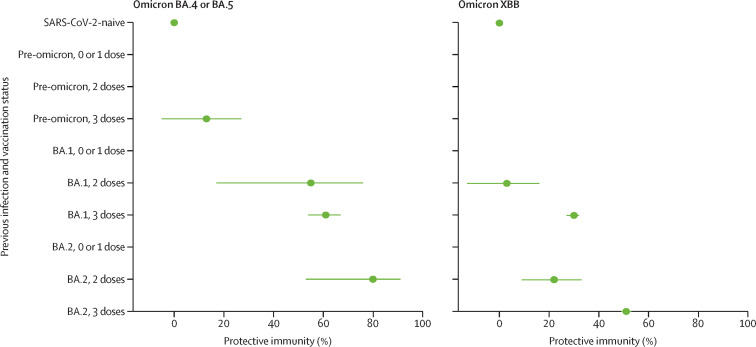
Findings: 2 456 791 individuals were included in the study, contributing 53·1 million person-days of observation for the SARS-CoV-2-naive group, 3·4 million person-days for the pre-omicron group, 6·6 million person-days for the BA.1 group, and 13·7 million person-days for the BA.2 group between Oct 1, 2022, and Nov 1, 2022. Compared with SARS-CoV-2-naive individuals, first infections with pre-omicron variants did not confer protection against reinfection with BA.4 or BA.5 (IRR 0·87 [95% CI 0·73-1·05] for pre-omicron infection with booster vaccination) or XBB (IRR 1·29 [1·23-1·35] for pre-omicron infection with booster vaccination). Previous BA.2 infection with booster provided the greatest protection against reinfection, but this was lower against reinfection with XBB (protective immunity 51%; 95% CI 49-53) than against reinfection with BA.4 or BA.5 (78%; 74-82). Protection conferred by previous BA.2 infection against XBB reinfection waned faster over time from first infection (from 74% [72-75] at 3-6 months to 49% [47-52] at 7-8 months) than protection against BA.4 or BA.5 reinfection (from 87% [82-90] at 3-6 months to 74% [66-80] at 7-8 months).
Interpretation: Protection against XBB reinfection conferred by a previous omicron infection with vaccination was lower and waned faster than protection against BA.4 or BA.5 reinfection, which is indicative of the greater immune evasiveness of the XBB sublineage. Although severe COVID-19 is uncommon, populations remain vulnerable to future reinfection waves from emerging SARS-CoV-2 variants despite high rates of vaccination and infection, as reflected by substantially higher reinfection rates during Singapore's XBB wave than during the previous BA.5-driven wave. Policy makers could consider emerging public health interventions, such as omicron-adapted bivalent vaccines, to maintain population immunity against COVID-19.
Funding: None.
Copyright © 2023 Elsevier Ltd. All rights reserved.
Conflict of interest statement
Declaration of interests We declare no competing interests.
Figures

Comment in
-
Imprinted hybrid immunity against XBB reinfection.Lancet Infect Dis. 2023 Jul;23(7):764-765. doi: 10.1016/S1473-3099(23)00138-X. Epub 2023 Mar 13. Lancet Infect Dis. 2023. PMID: 36924785 Free PMC article. No abstract available.
References
-
- Ministry of Health Singapore COVID-19 statistics. https://www.moh.gov.sg/covid-19/statistics
-
- Global Initiative on Sharing Avian Influenza Data Genomic epidemiology of SARS-CoV-2 with subsampling focused globally over the past 6 months. https://gisaid.org/phylodynamics/global/nextstrain
-
- Ministry of Health Singapore Opening remarks by Minister for Health Mr Ong Ye Kung at the MOH press conference to update on the COVID-19 situation on 15 October 2022. Oct 15, 2022. https://www.moh.gov.sg/news-highlights/details/opening-remarks-by-minist...
MeSH terms
Substances
Supplementary concepts
LinkOut - more resources
Full Text Sources
Medical
Miscellaneous