Review
. 2023 Feb 27;15(2):180-200.
doi: 10.4254/wjh.v15.i2.180.

Antioxidant and anti-inflammatory agents in chronic liver diseases: Molecular mechanisms and therapy

Affiliations
Review

Antioxidant and anti-inflammatory agents in chronic liver diseases: Molecular mechanisms and therapy

Chun-Ye Zhang et al. World J Hepatol. .

Abstract

Chronic liver disease (CLD) is a continuous process that causes a reduction of liver function lasting more than six months. CLD includes alcoholic liver disease (ALD), non-alcoholic fatty liver disease (NAFLD), chronic viral infection, and autoimmune hepatitis, which can lead to liver fibrosis, cirrhosis, and cancer. Liver inflammation and oxidative stress are commonly associated with the development and progression of CLD. Molecular signaling pathways such as AMP-activated protein kinase (AMPK), C-Jun N-terminal kinase, and peroxisome proliferator-activated receptors (PPARs) are implicated in the pathogenesis of CLD. Therefore, antioxidant and anti-inflammatory agents from natural products are new potent therapies for ALD, NAFLD, and hepatocellular carcinoma (HCC). In this review, we summarize some powerful products that can be potential applied in all the stages of CLD, from ALD/NAFLD to HCC. The selected agents such as β-sitosterol, curcumin, genistein, and silymarin can regulate the activation of several important molecules, including AMPK, Farnesoid X receptor, nuclear factor erythroid 2-related factor-2, PPARs, phosphatidylinositol-3-kinase, and lysyl oxidase-like proteins. In addition, clinical trials are undergoing to evaluate their efficacy and safety.

Keywords: Alcoholic liver disease; Chronic liver disease; Clinical trials; Hepatocellular carcinoma; Inflammation; Natural products; Non-alcoholic fatty liver disease; Oxidative stress; Treatment.


Conflict of interest statement

Conflict-of-interest statement: All the authors report no relevant conflicts of interest for this article.

Figures
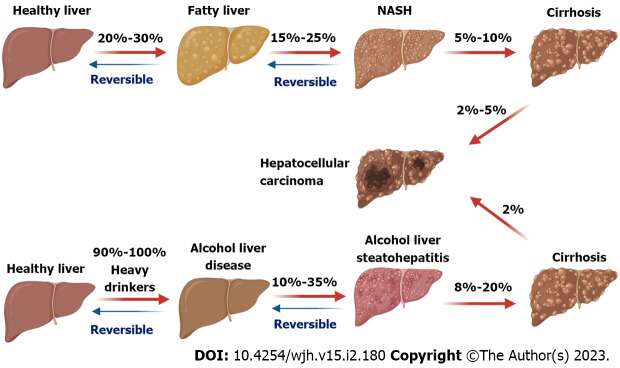
Figure 1
Figure 1
The development of hepatocellular carcinoma from non-alcoholic fatty liver disease and alcoholic fatty liver disease. The prevalence (20%-30%) of non-alcoholic fatty liver (NAFL) in the world population and the following percentages of NAFL into non-alcoholic steatohepatitis (NASH) (15%-25%), NASH into cirrhosis (5%-10%), and cirrhosis into hepatocellular carcinoma (HCC) (2%-5%) are labeled. Around 90%-100% of heavy drinkers can develop alcoholic liver disease (ALD), then the percentages of progression from simple ALD into alcohol liver steatohepatitis (10%-35%), cirrhosis (8%-20%), and HCC (2%) are shown in the graphic. This cartoon was created using Biorender online tools (https://biorender.com). NASH: Non-alcoholic steatohepatitis.
Figure 2
Figure 2
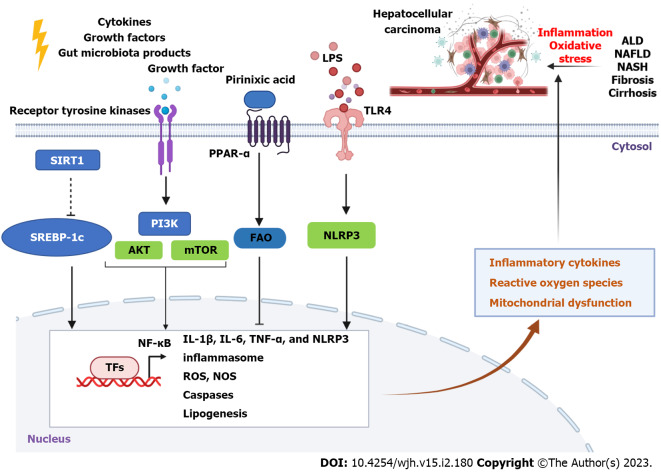
Molecular signaling pathway in liver inflammation and oxidative stress. Inflammation and oxidative stress are involved in the development of chronic liver diseases such as alcoholic liver disease, non-alcoholic fatty liver disease, non-alcoholic steatohepatitis, fibrosis, and cirrhosis into hepatocellular carcinoma. Many factors including cytokines, growth factors, and gut microbiota-derived products such as lipopolysaccharide can activate their receptors such as peroxisome proliferator-activated receptor-α and toll-like receptor 4, resulting in upregulation or inhibition of downstream genes to induce or prevent inflammatory cytokines and production of reactive oxygen species. This cartoon was created using Biorender online tools (https://biorender.com). LPS: Lipopolysaccharide; TLR4: Toll-like receptor 4; ALD: Alcoholic liver disease; NAFLD: Non-alcoholic fatty liver disease; NASH: Non-alcoholic steatohepatitis; PPAR-α: Peroxisome proliferator-activated receptor-α; SIRT1: Sirtuin 1; SREBP-1c: Sterol regulatory element binding protein 1c; PI3K: Phosphatidylinositol-3-kinase; AKT: Protein kinase B; mTOR: Mammalian target of rapamycin; FAO: Fatty acid oxidation; NLRP3: NOD-like receptor family pyrin domain containing 3; NF-κB: Nuclear factor kappa B; IL: Interleukin; TNF-α: Tumor necrosis factor-α; NLRP3: NOD-like receptor family pyrin domain containing 3; ROS: Reactive oxygen species; NOS: Nitric oxide synthase.
Figure 3
Figure 3
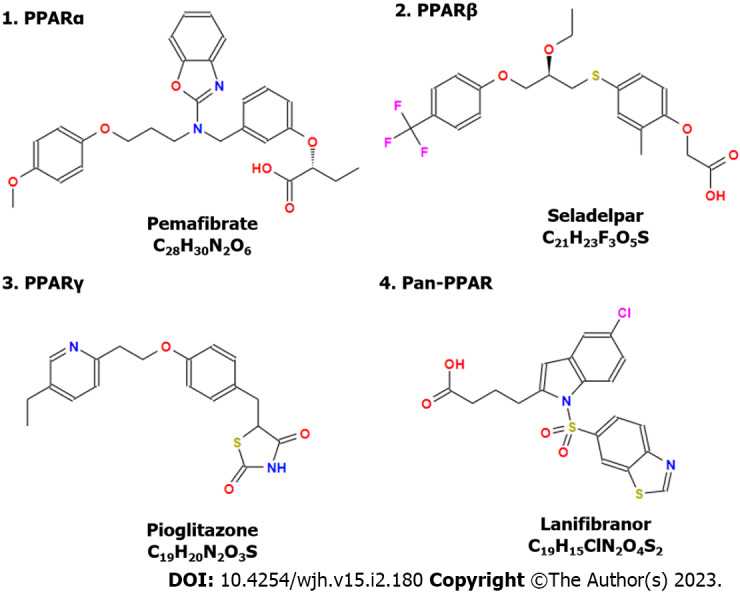
Structures of peroxisome proliferator-activated receptor agonists or modulators applied for the treatment of chronic liver disease. Many peroxisome proliferator-activated receptor regulators have been evaluated in the clinic, showing promising effects in patients with chronic liver disease. All the chemical structures were collected online from the Chemical Book (https://www.chemicalbook.com, accessed on August 10, 2022). PPAR: Peroxisome proliferator-activated receptor.

References

    1. Sharma A, Nagalli S. Chronic Liver Disease. StatPearls Publishing LLC., 2022. [cited 10 December 2022]. Available from: https://www.ncbi.nlm.nih.gov/books/NBK554597 . - PubMed
    1. Embade N, Millet O. Molecular Determinants of Chronic Liver Disease as Studied by NMR-Metabolomics. Curr Top Med Chem. 2017;17:2752–2766. - PubMed
    1. Seitz HK, Bataller R, Cortez-Pinto H, Gao B, Gual A, Lackner C, Mathurin P, Mueller S, Szabo G, Tsukamoto H. Alcoholic liver disease. Nat Rev Dis Primers. 2018;4:16. - PubMed
    1. Mantovani A, Beatrice G, Dalbeni A. Coronavirus disease 2019 and prevalence of chronic liver disease: A meta-analysis. Liver Int. 2020;40:1316–1320. - PubMed
    1. Sharma P, Arora A. Clinical presentation of alcoholic liver disease and non-alcoholic fatty liver disease: spectrum and diagnosis. Transl Gastroenterol Hepatol. 2020;5:19. - PMC - PubMed