


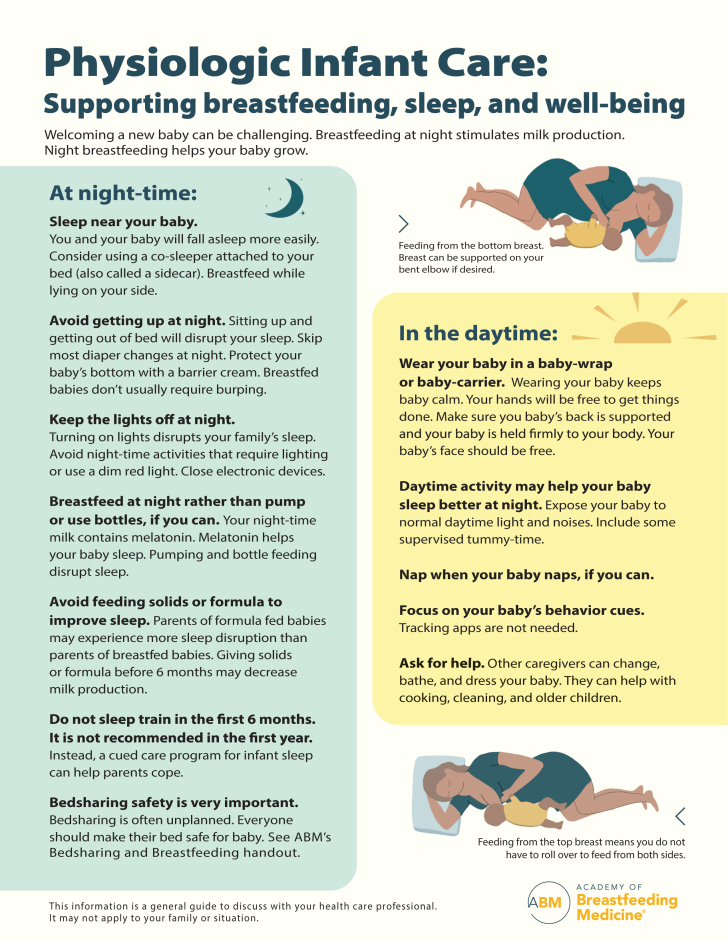
ABM Clinical Protocol #37: Physiological Infant Care-Managing Nighttime Breastfeeding in Young Infants
- PMID: 36927076
- PMCID: PMC10083892
- DOI: 10.1089/bfm.2023.29236.abm
ABM Clinical Protocol #37: Physiological Infant Care-Managing Nighttime Breastfeeding in Young Infants
Abstract
A central goal of the Academy of Breastfeeding Medicine (ABM) is the development of clinical protocols for managing common medical problems that may impact breastfeeding success. These protocols serve only as guidelines for the care of breastfeeding mothers and infants and do not delineate an exclusive course of treatment or serve as standards of medical care. Variations in treatment may be appropriate according to the needs of an individual patient. The ABM empowers health professionals to provide safe, inclusive, patient-centered, and evidence-based care. Pregnant and lactating people identify with a broad spectrum of genders, pronouns, and terms for feeding and parenting. There are two reasons ABM's use of gender-inclusive language may be transitional or inconsistent across protocols. First, gender-inclusive language is nuanced and evolving across languages, cultures, and countries. Second, foundational research has not adequately described the experiences of gender-diverse individuals. Therefore, ABM advocates for, and will strive to use language that is as inclusive and accurate as possible within this framework. For more explanation, please read ABM Position Statements on Infant Feeding and Lactation-Related Language and Gender (https://doi.org/10.1089/bfm.2021.29188.abm) and Breastfeeding As a Basic Human Right (https://doi.org/10.1089/bfm.2022.29216.abm).
Keywords: breastfeeding; infant; infant care; newborn; sleep deprivation; sudden infant death.
Conflict of interest statement
No competing financial interests exist.
References
-
- Blair PS, Ball HL, McKenna JJ, et al. . Bedsharing and breastfeeding: The Academy of Breastfeeding Medicine protocol #6, revision 2019. Breastfeed Med 2020;15(1):5–16. - PubMed
-
- World Health Organization. Protecting, Promoting, and Supporting Breastfeeding in Facilities Providing Maternity and Newborn Services: The Revised Baby-Friendly Hospital Initiative: Implemention Guidance. World Health Organization and UNICEF: Geneva; 2018.
-
- Kent JC, Mitoulas LR, Cregan MD, et al. . Volume and frequency of breastfeedings and fat content of breast milk throughout the day. Pediatrics 2006;117(3):e387–e395. - PubMed
MeSH terms
LinkOut - more resources
Full Text Sources
Medical
Research Materials
