


Effectiveness of community case management of malaria on severe malaria and inpatient malaria deaths in Zambia: a dose-response study using routine health information system data
- PMID: 36927440
- PMCID: PMC10022244
- DOI: 10.1186/s12936-023-04525-2
Effectiveness of community case management of malaria on severe malaria and inpatient malaria deaths in Zambia: a dose-response study using routine health information system data
Abstract
Background: Community case management of malaria (CCM) has been expanded in many settings, but there are limited data describing the impact of these services in routine implementation settings or at large scale. Zambia has intensively expanded CCM since 2013, whereby trained volunteer community health workers (CHW) use rapid diagnostic tests and artemether-lumefantrine to diagnose and treat uncomplicated malaria.
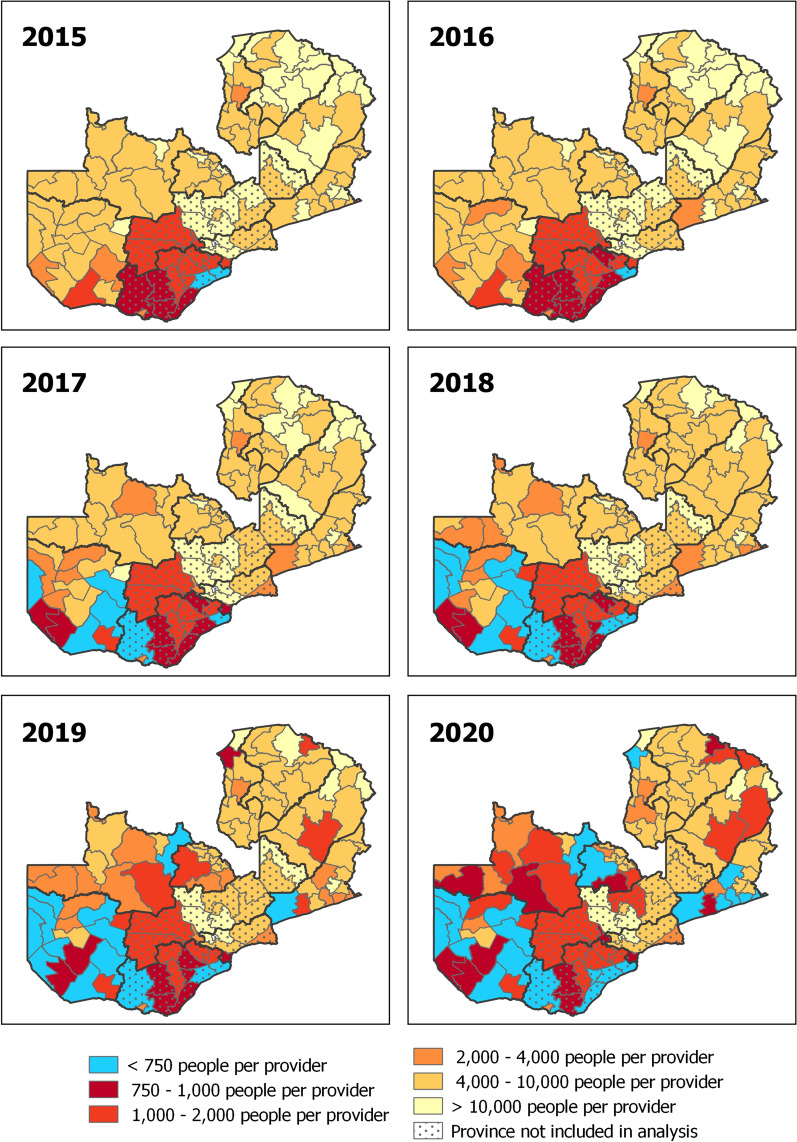
Methods: This retrospective, observational study explored associations between changing malaria service point (health facility or CHW) density per 1000 people and severe malaria admissions or malaria inpatient deaths by district and month in a dose-response approach, using existing routine and programmatic data. Negative binomial generalized linear mixed-effect models were used to assess the impact of increasing one additional malaria service point per 1000 population, and of achieving Zambia's interim target of 1 service point per 750 population. Access to insecticide-treated nets, indoor-residual spraying, and rainfall anomaly were included in models to reduce potential confounding.
Results: The study captured 310,855 malaria admissions and 7158 inpatient malaria deaths over 83 districts (seven provinces) from January 2015 to May 2020. Total CHWs increased from 43 to 4503 during the study period, while health facilities increased from 1263 to 1765. After accounting for covariates, an increase of one malaria service point per 1000 was associated with a 19% reduction in severe malaria admissions among children under five (incidence rate ratio [IRR] 0.81, 95% confidence interval [CI] 0.75-0.87, p < 0.001) and 23% reduction in malaria deaths among under-fives (IRR 0.77, 95% CI 0.66-0.91). After categorizing the exposure of population per malaria service point, there was evidence for an effect on malaria admissions and inpatient malaria deaths among children under five only when reaching the target of one malaria service point per 750 population.
Conclusions: CCM is an effective strategy for preventing severe malaria and deaths in areas such as Zambia where malaria diagnosis and treatment access remains challenging. These results support the continued investment in CCM scale-up in similar settings, to improve access to malaria diagnosis and treatment.
Keywords: Community case management; Community health workers; Impact evaluation; Routine health information system; Severe malaria; Zambia.
© 2023. The Author(s).
Conflict of interest statement
The authors declare they have no competing interests.
Figures
References
-
- WHO . World malaria report 2020. Geneva: World Health Organization; 2020.
-
- World Health Organization . Global Technical Strategy for Malaria 2016–2030. Geneva: World Health Organization; 2015.
-
- WHO. Guidelines for malaria. Geneva: World Health Organization; 2021.
-
- Schneider H, Okello D, Lehmann U. The global pendulum swing towards community health workers in low- and middle-income countries: a scoping review of trends, geographical distribution and programmatic orientations, 2005 to 2014. Hum Resour Health. 2016;14:65. doi: 10.1186/s12960-016-0163-2. - DOI - PMC - PubMed
-
- Sunguya BF, Mlunde LB, Ayer R, Jimba M. Towards eliminating malaria in high endemic countries: the roles of community health workers and related cadres and their challenges in integrated community case management for malaria: a systematic review. Malar J. 2017;16:10. doi: 10.1186/s12936-016-1667-x. - DOI - PMC - PubMed
Publication types
MeSH terms
Substances
LinkOut - more resources
Full Text Sources
Other Literature Sources
Medical
