


Synthetic T2-weighted fat sat based on a generative adversarial network shows potential for scan time reduction in spine imaging in a multicenter test dataset
- PMID: 36928566
- PMCID: PMC10326102
- DOI: 10.1007/s00330-023-09512-4
Synthetic T2-weighted fat sat based on a generative adversarial network shows potential for scan time reduction in spine imaging in a multicenter test dataset
Abstract
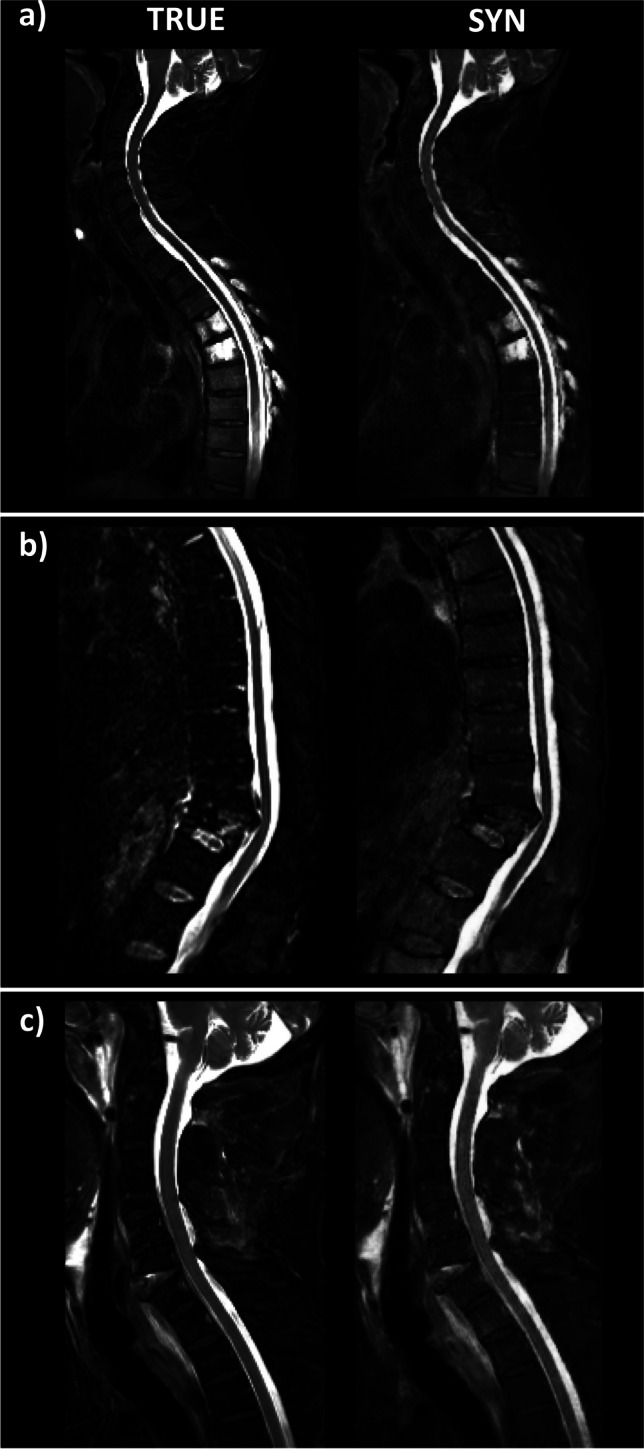
Objectives: T2-weighted (w) fat sat (fs) sequences, which are important in spine MRI, require a significant amount of scan time. Generative adversarial networks (GANs) can generate synthetic T2-w fs images. We evaluated the potential of synthetic T2-w fs images by comparing them to their true counterpart regarding image and fat saturation quality, and diagnostic agreement in a heterogenous, multicenter dataset.
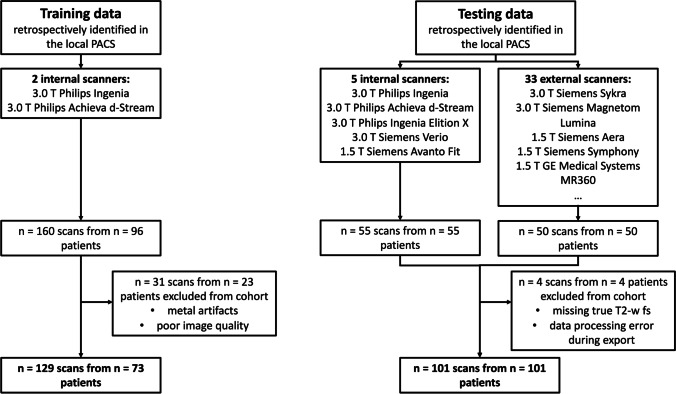
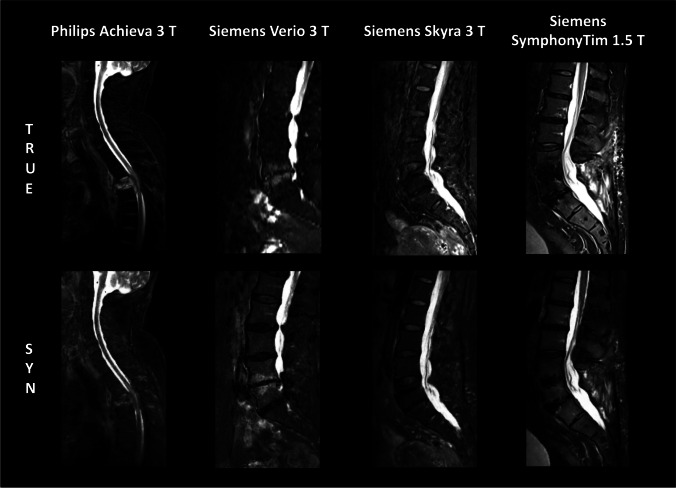
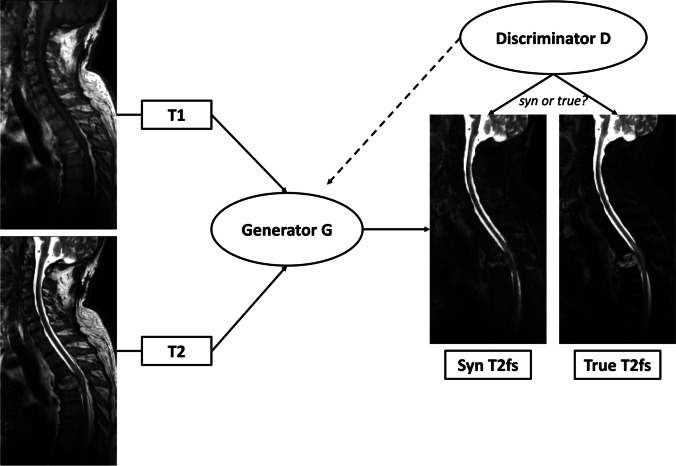
Methods: A GAN was used to synthesize T2-w fs from T1- and non-fs T2-w. The training dataset comprised scans of 73 patients from two scanners, and the test dataset, scans of 101 patients from 38 multicenter scanners. Apparent signal- and contrast-to-noise ratios (aSNR/aCNR) were measured in true and synthetic T2-w fs. Two neuroradiologists graded image (5-point scale) and fat saturation quality (3-point scale). To evaluate whether the T2-w fs images are indistinguishable, a Turing test was performed by eleven neuroradiologists. Six pathologies were graded on the synthetic protocol (with synthetic T2-w fs) and the original protocol (with true T2-w fs) by the two neuroradiologists.
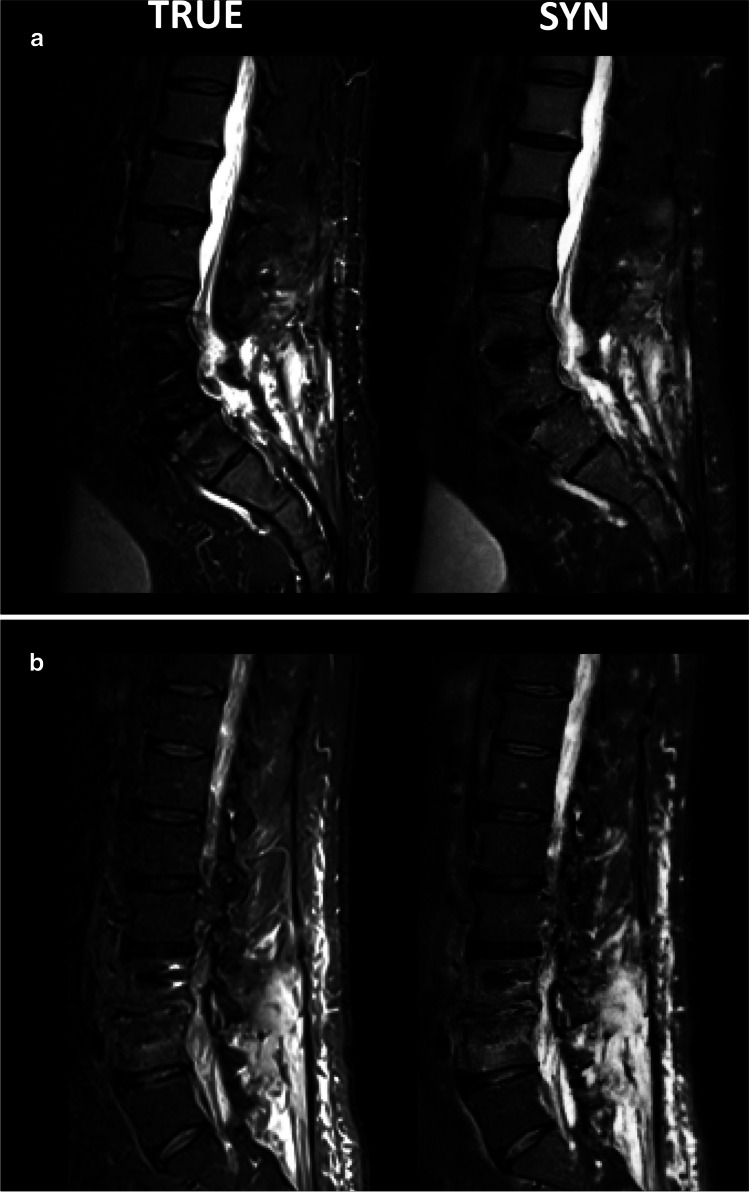
Results: aSNR and aCNR were not significantly different between the synthetic and true T2-w fs images. Subjective image quality was graded higher for synthetic T2-w fs (p = 0.023). In the Turing test, synthetic and true T2-w fs could not be distinguished from each other. The intermethod agreement between synthetic and original protocol ranged from substantial to almost perfect agreement for the evaluated pathologies.
Discussion: The synthetic T2-w fs might replace a physical T2-w fs. Our approach validated on a challenging, multicenter dataset is highly generalizable and allows for shorter scan protocols.
Key points: • Generative adversarial networks can be used to generate synthetic T2-weighted fat sat images from T1- and non-fat sat T2-weighted images of the spine. • The synthetic T2-weighted fat sat images might replace a physically acquired T2-weighted fat sat showing a better image quality and excellent diagnostic agreement with the true T2-weighted fat images. • The present approach validated on a challenging, multicenter dataset is highly generalizable and allows for significantly shorter scan protocols.
Keywords: Artificial intelligence; Magnetic resonance imaging; Spine.
© 2023. The Author(s).
Conflict of interest statement
Jan S. Kirschke is co-founder of Bonescreen GmbH. All other authors declare no relationships with any companies, whose products or services may be related to the subject matter of the article.
Figures
References
-
- ACR–ASNR–SCBT-MR–SSR practice parameter for the performance of magnetic resonance imaging (MRI) of the adult spine. https://www.acr.org/-/media/ACR/Files/Practice-Parameters/mradult-spine.pdf
Publication types
MeSH terms
Grants and funding
LinkOut - more resources
Full Text Sources
Medical
Research Materials
