. 2023 Mar 16;8(1):41.
doi: 10.1038/s41541-023-00640-y.

Synthetic multiantigen MVA vaccine COH04S1 and variant-specific derivatives protect Syrian hamsters from SARS-CoV-2 Omicron subvariants

Affiliations

Synthetic multiantigen MVA vaccine COH04S1 and variant-specific derivatives protect Syrian hamsters from SARS-CoV-2 Omicron subvariants

Felix Wussow et al. NPJ Vaccines. .

Abstract

Emerging SARS-CoV-2 Omicron subvariants continue to disrupt COVID-19 vaccine efficacy through multiple immune mechanisms including neutralizing antibody evasion. We developed COH04S1, a synthetic modified vaccinia Ankara vector that co-expresses Wuhan-Hu-1-based spike and nucleocapsid antigens. COH04S1 demonstrated efficacy against ancestral virus and Beta and Delta variants in animal models and was safe and immunogenic in a Phase 1 clinical trial. Here, we report efficacy of COH04S1 and analogous Omicron BA.1- and Beta-specific vaccines to protect Syrian hamsters from Omicron subvariants. Despite eliciting strain-specific antibody responses, all three vaccines protect hamsters from weight loss, lower respiratory tract infection, and lung pathology following challenge with Omicron BA.1 or BA.2.12.1. While the BA.1-specifc vaccine affords consistently improved efficacy compared to COH04S1 to protect against homologous challenge with BA.1, all three vaccines confer similar protection against heterologous challenge with BA.2.12.1. These results demonstrate efficacy of COH04S1 and variant-specific derivatives to confer cross-protective immunity against SARS-CoV-2 Omicron subvariants.


Conflict of interest statement

While unknown whether publication of this report will aid in receiving grants and contracts, it is possible that this publication will be of benefit to City of Hope (COH). COH had no role in the conceptualization, design, data collection, analysis, decision to publish, or preparation of the manuscript. D.J.D. and F.W. are co-inventors on patent application PCT/US2021/016247 which covers the design and construction of the synthetic MVA platform. D.J.D., F.W. and F.C. are co-inventors on PCT/US2021/032821 and provisional applications covering the development of ancestral and variant-adapted COVID-19 vaccines. D.J.D. is a consultant for GeoVax Labs Inc. All remaining authors declare no competing interests. GeoVax Labs Inc. has taken a worldwide exclusive license for COH04S1 from COH under the name of GEO-CM04S1.

Figures

Fig. 1
Fig. 1. COH04S1 and Omicron BA.1 and Beta sequence-modified vaccines elicit strain-specific antibody responses against SARS-CoV-2 ancestral virus and VOC.
a. Vaccine constructs. COH04S1, COH04S529, and COH04S351 are sMVA-vectored COVID-19 vaccines co-expressing S and N antigens based on the Wuhan-Hu-1 reference strain or Omicron BA.1 (Ο) or Beta (β) variants, respectively. The antigen sequences were inserted into the MVA deletion sites 2 (Del2) and 3 (Del3) as indicated. b. Study design. Hamsters were vaccinated twice with COH04S1 (n = 20), COH04S351 (n = 20), or COH04S529 (n = 20) by intramuscular route as indicated (black arrows). Hamsters vaccinated with empty sMVA vector (n = 10), or unvaccinated hamsters (n = 10) were used as controls. Blood samples were collected at day 14 and 42 (red arrows) after the first and second vaccination. COH04S1-, COH04S529-, and COH04S351-vaccinated hamsters were challenged intranasally at day 42 with Omicron subvariants BA.1 or BA.2.12.1 (n = 10/group). sMVA control animals were challenged with BA.1. Unvaccinated controls were challenged with BA.2.12.1. Post-challenge body weight changes were recorded daily for 8 days. Lung tissue and nasal turbinates for viral load measurements and lung histopathology were collected at days 4 and 8 post-challenge (n = 5/group/timepoint). IgG endpoint titers. S-specific (c) and N-specific (d) binding antibody titers to ancestral virus, Beta and Omicron subvariants BA.1, BA.2, BA.2.12.1, BA.4, and BA.5 were measured in serum samples of vaccine and control groups at day 14 (d14) post-prime vaccination via ELISA. Dotted lines indicate lower limit of detection (LLOD). # indicates significantly higher IgG titers in vaccine groups compared to controls. e. NAb titers. NAb titers were measured in serum samples of vaccine and control groups at day 42 (d42) post-second vaccination via PRNT assay against ancestral SARS-CoV-2 (WA/01), and Omicron BA.1 and BA.2.12.1. Dotted line indicates LLOD. Values below the LLOD are indicated as half the LLOD. Data are presented as box plots extending from 25th to 75th percentiles, with lines indicating medians, and whiskers going from minimum to maximum values. Two-way ANOVA with Tukey’s multiple comparison test was used in c-e following log transformation. *0.05 < p < 0.01, **0.01 < p < 0.001, ***0.001 < p < 0.0001, ****p < 0.0001. When not indicated, differences are not significant (p > 0.05).
Fig. 2
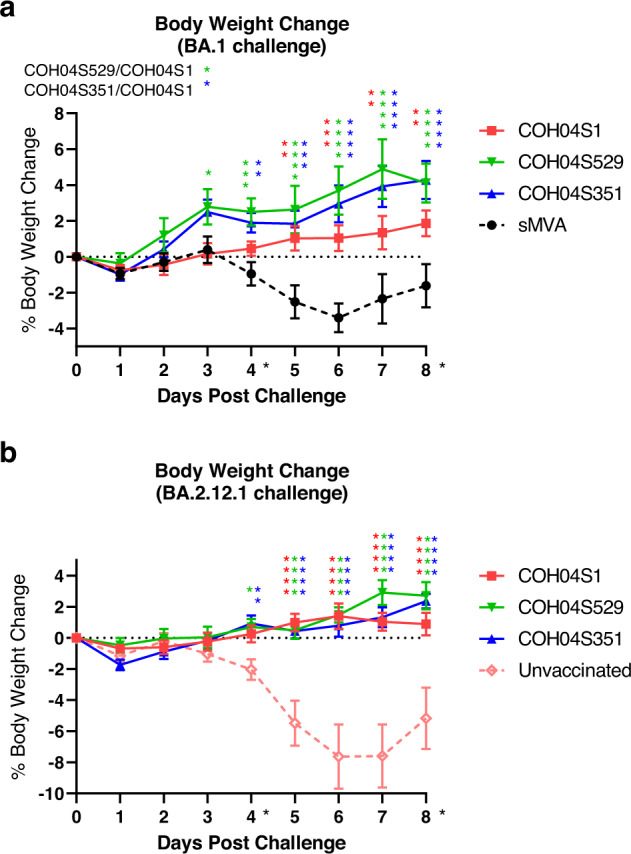
Fig. 2. COH04S1 and Omicron BA.1- and Beta-modified vaccines protect hamsters from weight loss following challenge with Omicron BA.1 or BA.2.12.1.
Body weight of COH04S1, COH04S529-, COH04S351-vaccinated animals was measured daily for 8 days following challenge with Omicron variants BA.1 (a) and BA.2.12.1 (b). Hamsters vaccinated with empty sMVA vector or unvaccinated hamsters were used as controls. Weight loss compared to day 0 is reported as mean ± SEM. Two-way ANOVA followed by Tukey’s multiple comparison test was used to compare group mean values at each timepoint following log transformation. Color-coded asterisks indicate significant difference compared to controls unless specified. *0.05 < p < 0.01, **0.01 < p < 0.001, ***0.001 < p < 0.0001, ****p < 0.0001. When not indicated, differences are not significant (p > 0.05). Black asterisks indicate time of sacrifice (n = 5/group).
Fig. 3
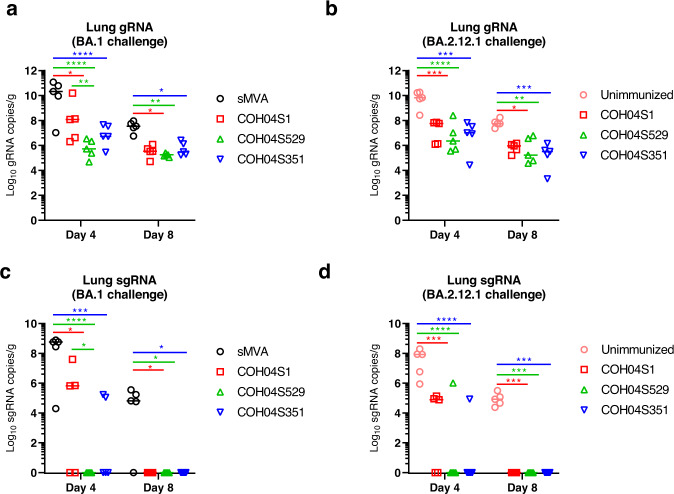
Fig. 3. COH04S1 and Omicron BA.1- and Beta-modified vaccines protect hamsters from lower respiratory tract infection following virus challenge with Omicron BA.1 or BA.2.12.1.
SARS-CoV-2 genomic RNA (gRNA, a, b) and sub-genomic RNA (sgRNA, c, d) copies were quantified by qPCR in lung tissue of COH04S1, COH04S351, and COH04S529 vaccine and control groups at days 4 and 8 following challenge with Omicron subvariants BA.1 (a, c) and BA.2.12.1 (b, d). Lines indicate median RNA copies. Two-way ANOVA followed by Tukey’s multiple comparison test was used following log transformation. *0.05 < p < 0.01, **0.01 < p < 0.001, ***0.001 < p < 0.0001, ****p < 0.0001. When not indicated, differences are not significant (p > 0.05).
Fig. 4
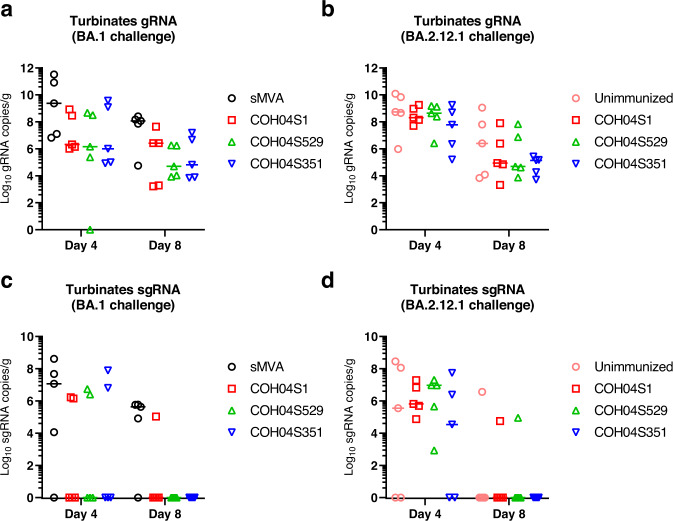
Fig. 4. Viral loads at upper respiratory tracts in COH04S1-, COH04S529-, and COH04S351-vaccinated hamsters following challenge with Omicron BA.1 or BA.2.12.1.
SARS-CoV-2 genomic RNA (gRNA, a, b) and sub-genomic RNA (sgRNA, c, d) copies were quantified by qPCR in nasal turbinates of COH04S1, COH04S529, and COH04S351 vaccine and control groups at days 4 and 8 following challenge with Omicron subvariants BA.1 (a, c) and BA.2.12.1 (b, d). Lines indicate median RNA copies. One-way ANOVA followed by Tukey’s multiple comparison test was used following log transformation. When not indicated, differences are not significant (p > 0.05).
Fig. 5
Fig. 5. COH04S1 and Omicron BA.1- and Beta-modified vaccines protect hamsters from lung pathology following challenge with Omicron BA.1 or BA.2.12.1.
Hematoxylin/eosin-stained lung sections of COH04S1-, COH04S529, and COH04S351-vaccinated hamsters and control animals at days 4 and 8 following challenge with SARS-CoV-2 BA.1 (ac) or BA.2.12.1 (df) variants were evaluated by a board-certified pathologist and microscopic findings were graded based on severity on a scale from 1 to 5 (Supplementary Table 3). Cumulative pathology score of all histopathologic findings (a, d), grading of bronchioalveolar hyperplasia disease severity (b, e), and severity of lung inflammatory microscopic findings (c, f) are shown. Lines indicate median values. Two-way ANOVA followed by Tukey’s multiple comparison test was used following log transformation. *=0.05 < p < 0.01, **=0.01 < p < 0.001, ***=0.001 < p < 0.0001, ****=p < 0.0001. When not indicated, differences are not significant (p > 0.05).

References

    1. Flores-Vega, V. R. et al. SARS-CoV-2: Evolution and emergence of new viral variants. Viruses14, 10.3390/v14040653 (2022). - PMC - PubMed
    1. Garcia-Beltran WF, et al. Multiple SARS-CoV-2 variants escape neutralization by vaccine-induced humoral immunity. Cell. 2021;184:2523. doi: 10.1016/j.cell.2021.04.006. - DOI - PMC - PubMed
    1. Carreno, J. M. et al. Activity of convalescent and vaccine serum against SARS-CoV-2 Omicron. Nature, 10.1038/s41586-022-04399-5 (2021). - PubMed
    1. Tegally, H. et al. Emergence of SARS-CoV-2 Omicron lineages BA.4 and BA.5 in South Africa. Nat. Med.10.1038/s41591-022-01911-2 (2022). - PMC - PubMed
    1. Wang Q, et al. Antibody evasion by SARS-CoV-2 Omicron subvariants BA.2.12.1, BA.4 and BA.5. Nature. 2022;608:603–608. doi: 10.1038/s41586-022-05053-w. - DOI - PMC - PubMed