. 2023 Apr 4;40(4):msad061.
doi: 10.1093/molbev/msad061.

Evolutionary Trajectories are Contingent on Mitonuclear Interactions

Affiliations

Evolutionary Trajectories are Contingent on Mitonuclear Interactions

Damien Biot-Pelletier et al. Mol Biol Evol. .

Abstract

Critical mitochondrial functions, including cellular respiration, rely on frequently interacting components expressed from both the mitochondrial and nuclear genomes. The fitness of eukaryotic organisms depends on a tight collaboration between both genomes. In the face of an elevated rate of evolution in mtDNA, current models predict that the maintenance of mitonuclear compatibility relies on compensatory evolution of the nuclear genome. Mitonuclear interactions would therefore exert an influence on evolutionary trajectories. One prediction from this model is that the same nuclear genome evolving with different mitochondrial haplotypes would follow distinct molecular paths toward higher fitness. To test this prediction, we submitted 1,344 populations derived from 7 mitonuclear genotypes of Saccharomyces cerevisiae to >300 generations of experimental evolution in conditions that either select for a mitochondrial function or do not strictly require respiration for survival. Performing high-throughput phenotyping and whole-genome sequencing on independently evolved individuals, we identified numerous examples of gene-level evolutionary convergence among populations with the same mitonuclear background. Phenotypic and genotypic data on strains derived from this evolution experiment identify the nuclear genome and the environment as the main determinants of evolutionary divergence, but also show a modulating role for the mitochondrial genome exerted both directly and via interactions with the two other components. We finally recapitulated a subset of prominent loss-of-function alleles in the ancestral backgrounds and confirmed a generalized pattern of mitonuclear-specific and highly epistatic fitness effects. Together, these results demonstrate how mitonuclear interactions can dictate evolutionary divergence of populations with identical starting nuclear genotypes.

Keywords: evolutionary convergence; experimental evolution; mitochondria; mitonuclear evolution.


Figures

<sc>Fig.</sc> 1.
Fig. 1.
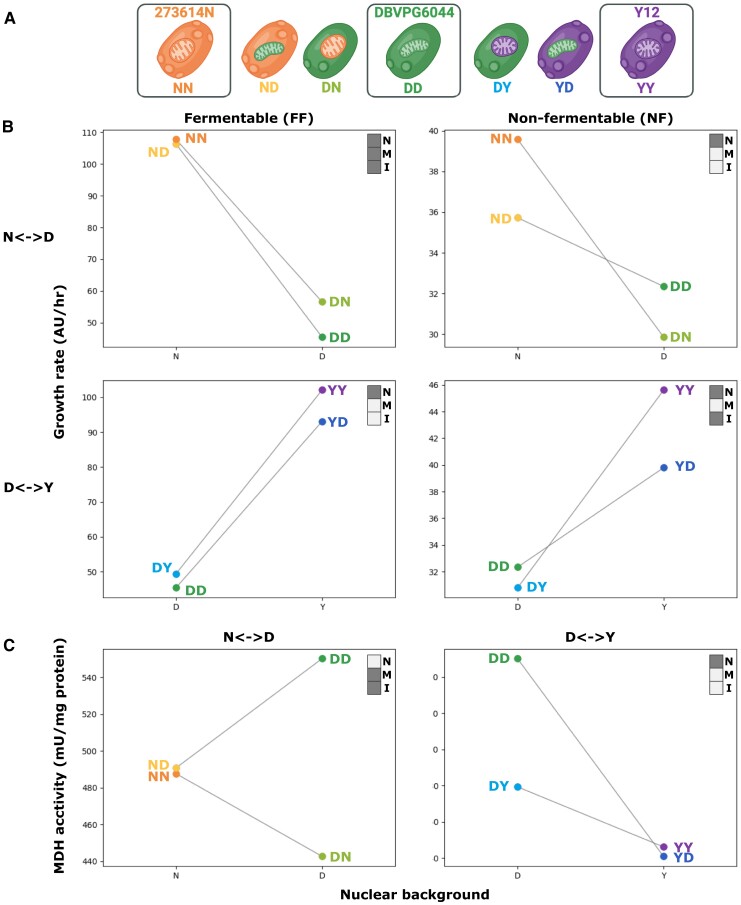
Mitonuclear interactions in founding strains of experimental evolution. (A) Yeast strains submitted to experimental evolution were derived from strains 273614N (NN), DBVPG6044 (DD), and Y12 (YY). Crosses of 273614N with DBVPG6044 (ND; DN) and Y12 with DBVPG6044 (DY; YD) yielded two cybrids each, identified according to their nuclear (left) and mitochondrial (right) backgrounds. We thus evolved seven ancestral mitonuclear backgrounds (panel created with BioRender.com). (B) Growth rate recorded for all seven strains in fermentable (FF) and nonfermentable (NF) media is reported as interaction plots for crosses of NN with DD (N < −>D) and DD with YY (D < −>Y). In each panel, the upper right corner insets indicate if nuclear (N) and mitochondrial (M) backgrounds, as well as mitonuclear interactions (I), have a significant effect on growth rate (two-way ANOVA P < 0.05). Plots report the mean values of 4 biological replicates, estimated from 8 to 42 technical replicates, for an average of 27 per point. (C) Malate dehydrogenase (MDH) activity also appears affected by nuclear and mitochondrial background or their interaction. Plots report the mean values of three or four biological replicates.
<sc>Fig.</sc> 2.
Fig. 2.
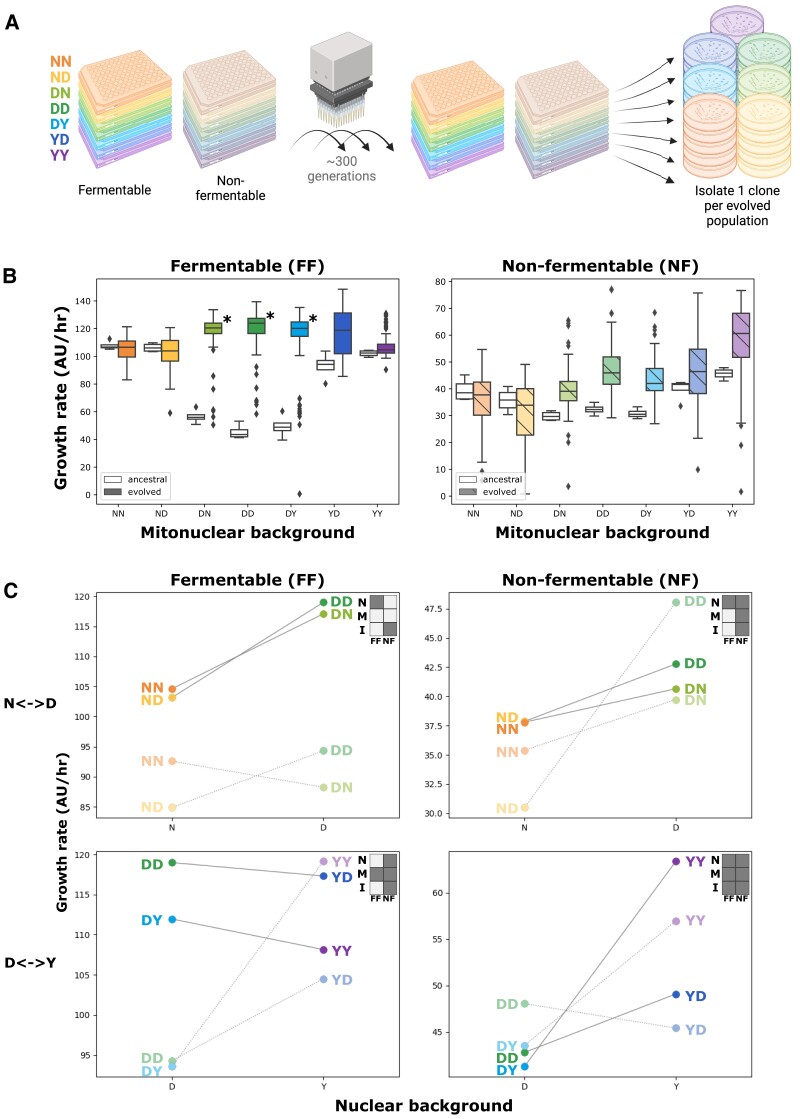
Experimental evolution in mitonuclear hybrids leads to changes in fitness in a mitonuclear background-dependent manner. (A) Each of the 7 founding mitonuclear backgrounds was evolved in fermentable and nonfermentable media, in 96 replicates. Evolving populations were propagated for approximately 300 generations by daily robot-assisted serial passage. At the end of the experiment, a single independently evolved individual was isolated from each population (panel created with BioRender.com). (B) Evolved individuals were assessed for growth rate in fermentable (left) and nonfermentable (right) media. Two-way ANOVAs indicate significant effects on growth rate for mitonuclear background and evolution. Asterisks indicate growth rate significantly above ancestral levels (Tukey HSD P < 0.05). (C) Interaction plots and two-way ANOVAs (upper right insets) indicate significant effects (P < 0.05) for nuclear background (N), mitochondrial background (M), or mitonuclear interactions (I) on growth rate in fermentable (left) and nonfermentable (right) media for strains of both crosses evolved in fermentable (dark hues, FF in inset) and nonfermentable (light hues, NF in inset) environments. Plots report the mean value for 37–91 strains, for an average of 80 per point.
<sc>Fig.</sc> 3.
Fig. 3.
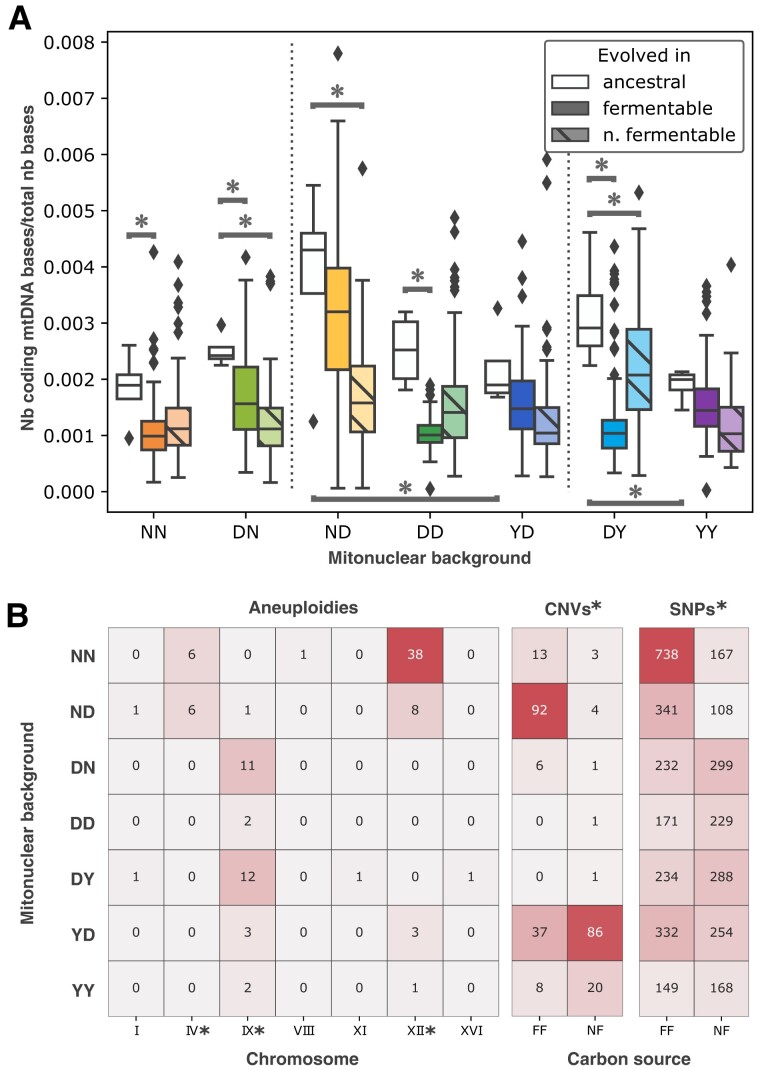
Whole-genome resequencing reveals mitonuclear background- and carbon source-specific genomic changes in experimental evolution isolates. (A) Fraction of sequenced bases mapped to coding regions of the mitochondrial genome was used as an indicator of genome-scale alterations to mtDNA, revealing impacts of mitonuclear background and evolution. Vertical dotted lines segregate strains based on mitochondrial background. Two-way ANOVAs comparing mtDNA fraction among strains bearing the same mitochondrial background reveal a significant effect for the nuclear background and evolution regimen (P < 0.05). Connectors marked by asterisks indicate significant differences in mtDNA fraction between ancestral strains bearing the same mitochondrial genome or between ancestral strains and their offsprings (Tukey HSD P < 0.05). (B) Changes in chromosome copy numbers (aneuploidies) and smaller, gene-scale copy number changes (CNVs) were detected using sequencing depth of coverage. Many single-nucleotide changes (SNVs) were also called. Asterisks indicate uneven distribution between mitonuclear backgrounds and carbon sources (χ2 test P < 0.05).
<sc>Fig.</sc> 4.
Fig. 4.
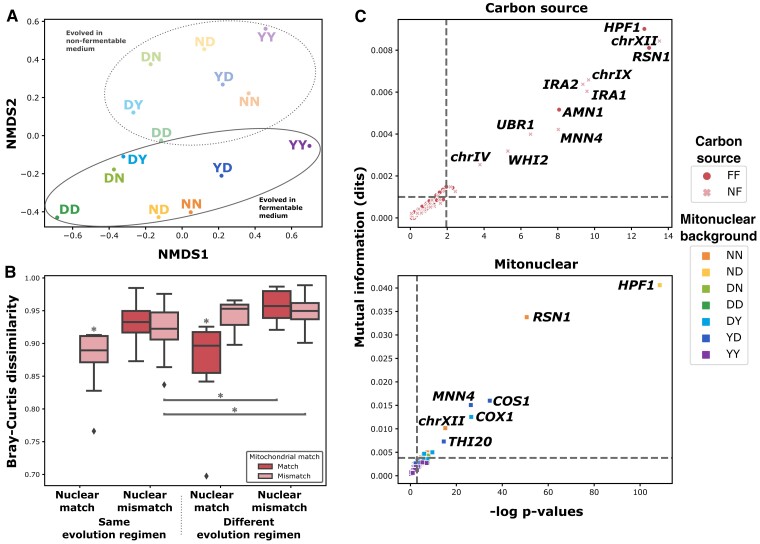
Unique evolutionary trajectories are characterized by mitonuclear and carbon source-specific patterns of convergence. (A) Bray–Curtis dissimilarity computed between the mutational profiles (vector of mutation counts at each mutant annotation) of all pairs of mitonuclear backgrounds evolved in each carbon source was used as input for nonparametric multidimensional scaling, revealing their relative differences. (B) Dissimilarity between mutational profiles is high in all conditions but modulated by a shared environment as well as common nuclear and mitochondrial backgrounds (three-way ANOVA P < 0.05). Boxes marked by asterisks (*) indicate evolutionary circumstances associated with significantly lower dissimilarity than all other circumstances (Tukey HSD test P < 0.05). Asterisk (*)-marked connectors indicate pairs of evolutionary circumstances associated with significantly different levels of dissimilarity (Tukey HSD test P < 0.05). (C) Mutant loci were considered specific to a certain carbon source (top) or mitonuclear background (bottom) if their distribution differed significantly from that of all detected mutations, taken as a whole. χ2 tests were performed on contingency tables of all mutations, classifying them as mapping or not to the locus and according to either carbon source or mitonuclear background. Mutual information was calculated from the same contingency tables. Specificity thresholds, indicated by dotted lines, were set at a P value of 0.05, corrected for false-discovery rate, and at two standard deviations above mean (∼95th percentile) mutual information across all loci.
<sc>Fig.</sc> 5.
Fig. 5.
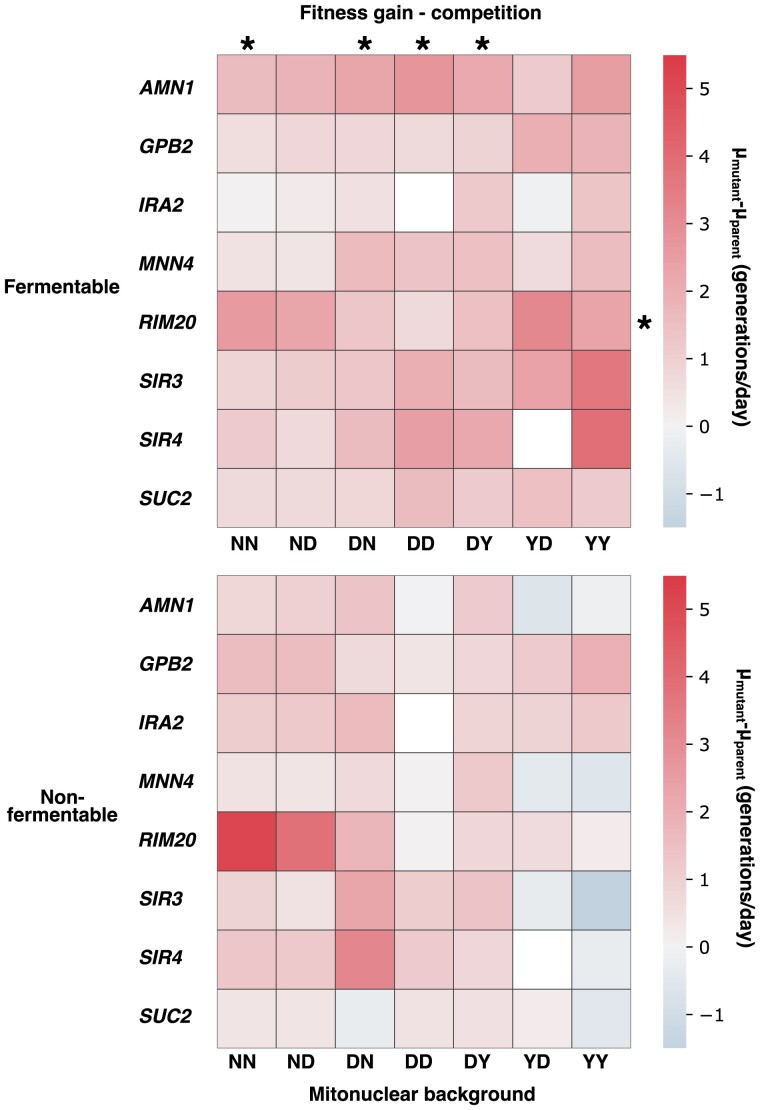
Fitness effect for loss-of-function at select loci is dependent on mitonuclear background and carbon source. Gene knockouts were performed at the loci indicated on the left in fluorescent derivatives of all seven ancestral strains used in the evolution experiment, mimicking the effect of loss-of-function alleles. These knockouts were competed against their deletion-free counterparts of the same mitonuclear genotype in fermentable (top) and nonfermentable (bottom) media. This enabled estimation of the fitness effect of loss-of-function at these loci relative to the ancestor. For all loci, effect of deletion was found to differ significantly between mitonuclear genotypes and in a manner influenced by mitonuclear interactions (two-way ANOVA P < 0.05). Fitness effect of each locus over mitonuclear genotypes did not correlate (Spearman rho < 0.95, P < 0.05 that slope of regression = 0) with frequency of mutation at the locus in each genotype, with one exception indicated by an asterisk on the right-hand side. Asterisks at the top of heatmaps indicate genotypes that display rank order correlation between locus fitness effect preference and frequency of mutation at the locus (Spearman rho > 0.7, P < 0.05 that slope of regression = 0).

References

    1. Allen JF. 2003. The function of genomes in bioenergetic organelles. Philos Trans R Soc Lond B Biol Sci. 358:19–38. - PMC - PubMed
    1. Andrews S. 2010. FastQC: a quality control tool for high throughput sequence data. Available from:http://www.bioinformatics.babraham.ac.uk/projects/fastqc/
    1. Balakrishnan R, Park J, Karra K, Hitz BC, Binkley G, Hong EL, Sullivan J, Micklem G, Cherry JM. 2012. YeastMine-an integrated data warehouse for Saccharomyces cerevisiae data as a multipurpose tool-kit. Database 2012:bar062. - PMC - PubMed
    1. Barreto FS, Watson ET, Lima TG, Willett CS, Edmands S, Li W, Burton RS. 2018. Genomic signatures of mitonuclear coevolution across populations of Tigriopus californicus. Nat Ecol Evol. 2:1250–1257. - PubMed
    1. Barrientos A, Kenyon L, Moraes CT. 1998. Human xenomitochondrial cybrids. J Biol Chem. 273:14210–14217. - PubMed

Publication types

Substances