


Which clinical research questions are the most important? Development and preliminary validation of the Australia & New Zealand Musculoskeletal (ANZMUSC) Clinical Trials Network Research Question Importance Tool (ANZMUSC-RQIT)
- PMID: 36930668
- PMCID: PMC10022765
- DOI: 10.1371/journal.pone.0281308
Which clinical research questions are the most important? Development and preliminary validation of the Australia & New Zealand Musculoskeletal (ANZMUSC) Clinical Trials Network Research Question Importance Tool (ANZMUSC-RQIT)
Abstract
Background and aims: High quality clinical research that addresses important questions requires significant resources. In resource-constrained environments, projects will therefore need to be prioritized. The Australia and New Zealand Musculoskeletal (ANZMUSC) Clinical Trials Network aimed to develop a stakeholder-based, transparent, easily implementable tool that provides a score for the 'importance' of a research question which could be used to rank research projects in order of importance.
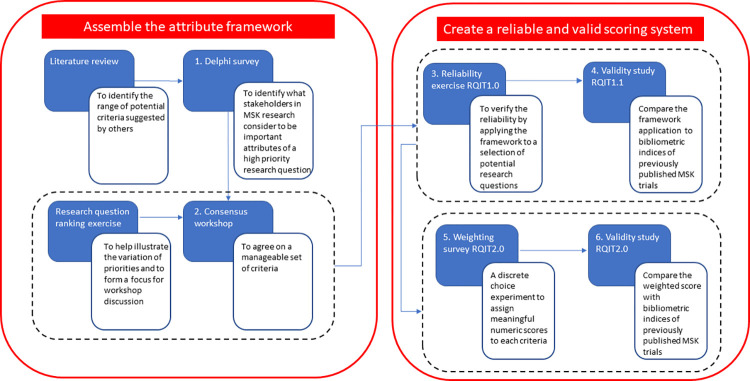
Methods: Using a mixed-methods, multi-stage approach that included a Delphi survey, consensus workshop, inter-rater reliability testing, validity testing and calibration using a discrete-choice methodology, the Research Question Importance Tool (ANZMUSC-RQIT) was developed. The tool incorporated broad stakeholder opinion, including consumers, at each stage and is designed for scoring by committee consensus.
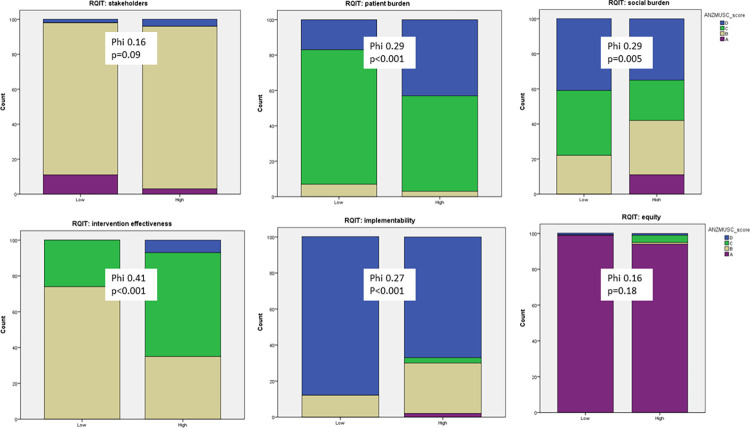
Results: The ANZMUSC-RQIT tool consists of 5 dimensions (compared to 6 dimensions for an earlier version of RQIT): (1) extent of stakeholder consensus, (2) social burden of health condition, (3) patient burden of health condition, (4) anticipated effectiveness of proposed intervention, and (5) extent to which health equity is addressed by the research. Each dimension is assessed by defining ordered levels of a relevant attribute and by assigning a score to each level. The scores for the dimensions are then summed to obtain an overall ANZMUSC-RQIT score, which represents the importance of the research question. The result is a score on an interval scale with an arbitrary unit, ranging from 0 (minimal importance) to 1000. The ANZMUSC-RQIT dimensions can be reliably ordered by committee consensus (ICC 0.73-0.93) and the overall score is positively associated with citation count (standardised regression coefficient 0.33, p<0.001) and journal impact factor group (OR 6.78, 95% CI 3.17 to 14.50 for 3rd tertile compared to 1st tertile of ANZMUSC-RQIT scores) for 200 published musculoskeletal clinical trials.
Conclusion: We propose that the ANZMUSC-RQIT is a useful tool for prioritising the importance of a research question.
Copyright: © 2023 Taylor et al. This is an open access article distributed under the terms of the Creative Commons Attribution License, which permits unrestricted use, distribution, and reproduction in any medium, provided the original author and source are credited.
Conflict of interest statement
The authors have declared that no competing interests exist.
Figures
References
-
- Safiri S, Kolahi AA, Cross M, Hill C, Smith E, Carson, et al. Burden of musculoskeletal disorders in 195 countries and territories, 1990–2017: findings from the Global Burden of Disease Study 2017. Arthritis Rheum. 2021; 73(4):702–14. - PubMed
-
- Australian Institute of Health and Welfare. Australian Burden of Disease Study: impact and causes of illness and death in Australia 2018.; 2021. Contract No.: Cat. no. BOD 29.
-
- Buchbinder R, Maher C, Harris I. Setting the research agenda for improving health care in musculoskeletal disorders. Nature Rev Rheum. 2015;11:597–605. - PubMed
-
- Buchbinder R, Bourne A, Latimer J, Harris I, Whittle S, Richards B, et al. Early development of the Australia & New Zealand Musculoskeletal (ANZMUSC) Clinical Trials Network. Intern Med J. 2020;50(1):17–23. - PubMed
-
- Gilbert SE, Buchbinder R, Harris IA, Maher CG. A comparison of the distribution of Medical Research Future Fund grants with disease burden in Australia. The Medical Journal of Australia. 2021;214(3):111–3. - PubMed
Publication types
MeSH terms
Associated data
LinkOut - more resources
Full Text Sources
