Vector mapping and bloodmeal metabarcoding demonstrate risk of urban Chagas disease transmission in Caracas, Venezuela
- PMID: 36930686
- PMCID: PMC10057784
- DOI: 10.1371/journal.pntd.0010613
Vector mapping and bloodmeal metabarcoding demonstrate risk of urban Chagas disease transmission in Caracas, Venezuela
Erratum in
-
Correction: Vector mapping and bloodmeal metabarcoding demonstrate risk of urban Chagas disease transmission in Caracas, Venezuela.PLoS Negl Trop Dis. 2023 Jul 14;17(7):e0011489. doi: 10.1371/journal.pntd.0011489. eCollection 2023 Jul. PLoS Negl Trop Dis. 2023. PMID: 37450429 Free PMC article.
-
Correction: Assessing insecticide susceptibility, diagnostic dose and time for the sand fly Phlebotomus argentipes, the vector of visceral leishmaniasis in India, using the CDC bottle bioassay.PLoS Negl Trop Dis. 2023 Jul 19;17(7):e0011480. doi: 10.1371/journal.pntd.0011480. eCollection 2023 Jul. PLoS Negl Trop Dis. 2023. PMID: 37467196 Free PMC article.
Abstract
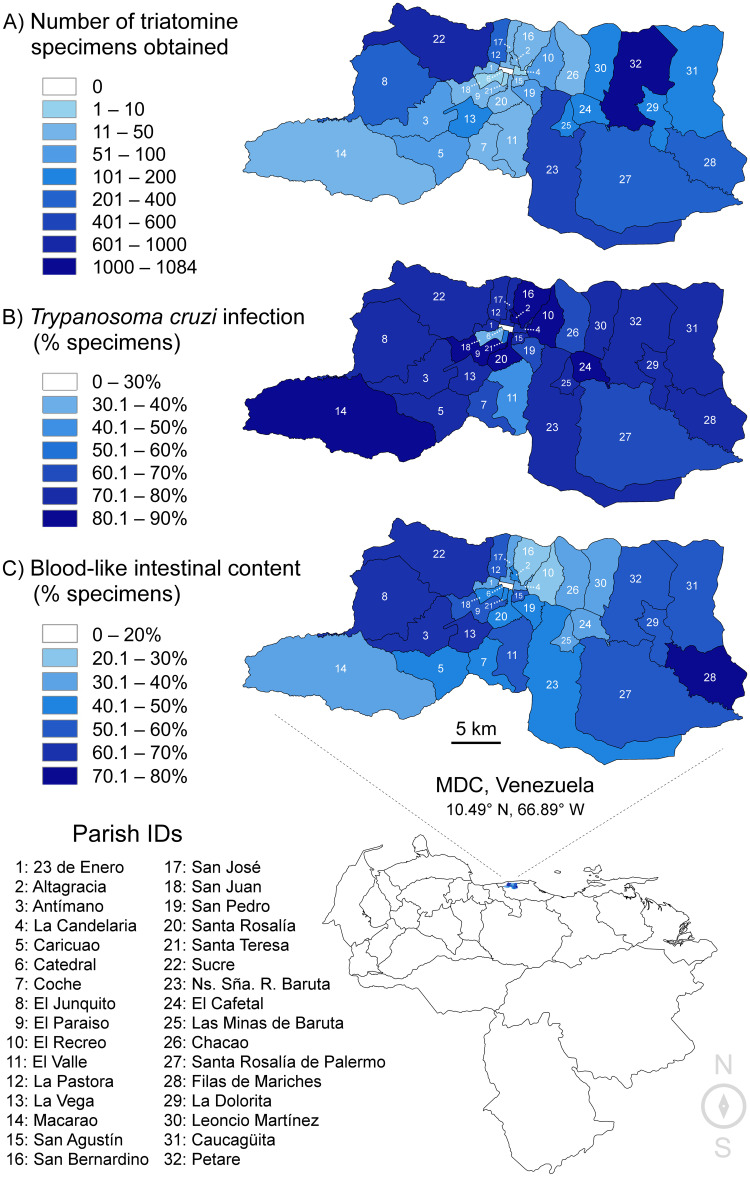
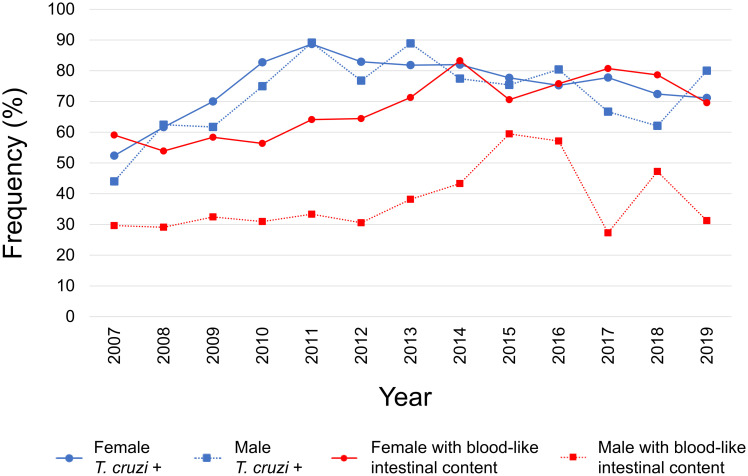
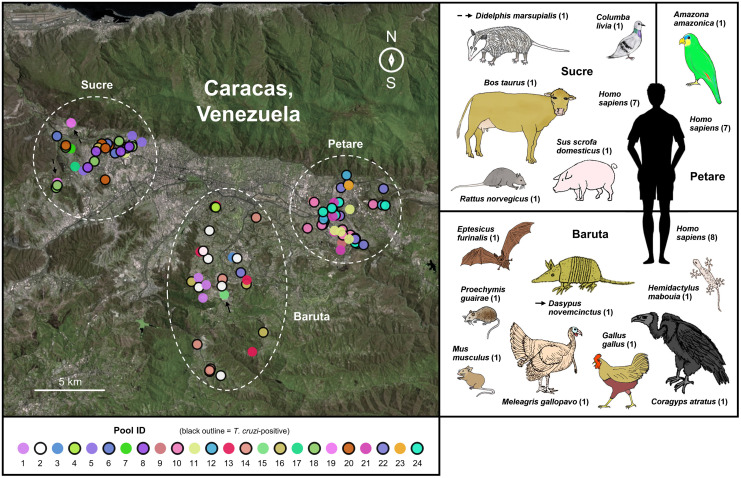
Chagas disease is a significant public health risk in rural and semi-rural areas of Venezuela. Triatomine infection by the aetiological agent Trypanosoma cruzi is also observed in the Metropolitan District of Caracas (MDC), where foodborne T. cruzi outbreaks occasionally occur but active vector-to-human transmission (infection during triatomine bloodmeal) is considered absent. Citizen science-based domiciliary triatomine collection carried out between 2007 and 2013 in the MDC has advanced understanding of urban T. cruzi prevalence patterns and represents an important public awareness-building tool. The present study reports on the extension of this triatomine collection program from 2014 to 2019 and uses mitochondrial metabarcoding to assess feeding behavior in a subset of specimens. The combined, thirteen-year dataset (n = 4872) shows a high rate of T. cruzi infection (75.2%) and a predominance of Panstrongylus geniculatus (99.01%) among triatomines collected in domiciliary areas by MDC inhabitants. Collection also involved nymphal stages of P. geniculatus in 18 of 32 MDC parishes. Other collected species included Triatoma nigromaculata, Triatoma maculata, Rhodnius prolixus, and Panstrongylus rufotuberculatus. Liquid intestinal content indicative of bloodmeal was observed in 53.4% of analyzed specimens. Dissection pools representing 108 such visually blooded P. geniculatus specimens predominantly tested positive for human cytochrome b DNA (22 of 24 pools). Additional bloodmeal sources detected via metabarcoding analysis included key sylvatic T. cruzi reservoirs (opossum and armadillo), rodents, and various other synanthropic and domesticated animals. Results suggest a porous sylvatic-domiciliary transmission interface and ongoing adaptation of P. geniculatus to the urban ecotope. Although P. geniculatus defecation traits greatly limit the possibility of active T. cruzi transmission for any individual biting event, the cumulation of this low risk across a vast metropolitan population warrants further investigation. Efforts to prevent triatomine contact with human food sources also clearly require greater attention to protect Venezuela's capital from Chagas disease.
Copyright: © 2023 Segovia et al. This is an open access article distributed under the terms of the Creative Commons Attribution License, which permits unrestricted use, distribution, and reproduction in any medium, provided the original author and source are credited.
Conflict of interest statement
The authors have declared that no competing interests exist.
Figures
References
-
- Galvão C. Taxonomy. In: Guarneri A, Lorenzo M, editors. Triatominae—the biology of Chagas disease vectors. Cham: Springer; 2021. p. 15–38.
-
- Hoare CA. The trypanosomes of mammals. A zoological monograph. Blackwell Scientific Publications; 1972.
-
- Grillet ME, Hernández-Villena J V., Llewellyn MS, Paniz-Mondolfi AE, Tami A, Vincenti-Gonzalez MF, et al. Venezuela’s humanitarian crisis, resurgence of vector-borne diseases, and implications for spillover in the region. Lancet Infect Dis. 2019;19:e149–61. doi: 10.1016/S1473-3099(18)30757-6 - DOI - PubMed
Publication types
MeSH terms
LinkOut - more resources
Full Text Sources
Medical